


Epistemic Beliefs: Relationship to Future Expectancies and Quality of Life in Cancer Patients
- PMID: 34952170
- PMCID: PMC8930513
- DOI: 10.1016/j.jpainsymman.2021.12.017
Epistemic Beliefs: Relationship to Future Expectancies and Quality of Life in Cancer Patients
Abstract
Context: Expectations about the future (future expectancies) are important determinants of psychological well-being among cancer patients, but the strategies patients use to maintain positive and cope with negative expectancies are incompletely understood.
Objectives: To obtain preliminary evidence on the potential role of one strategy for managing future expectancies: the adoption of "epistemic beliefs" in fundamental limits to medical knowledge.
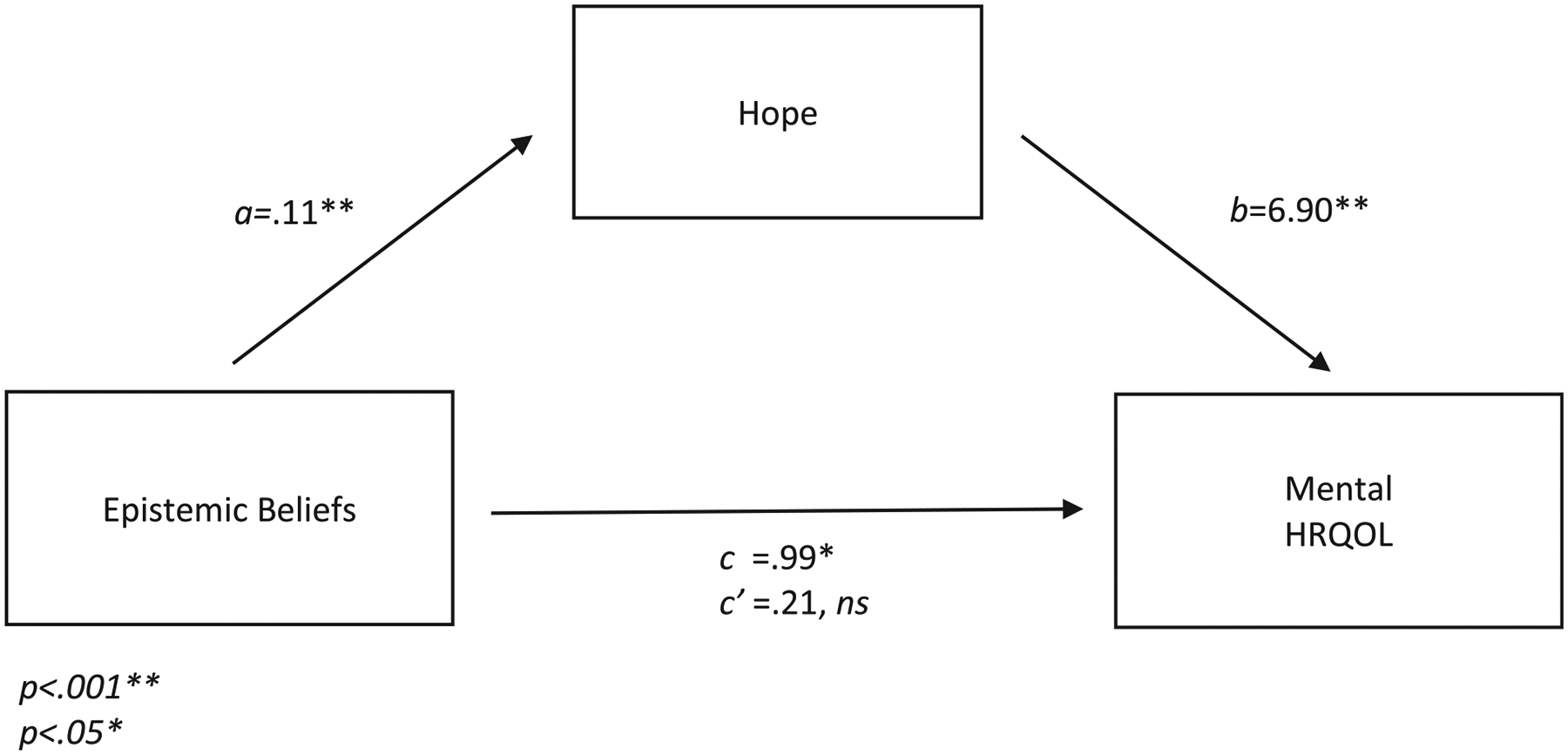
Methods: A sample of 1307 primarily advanced-stage cancer patients participating in a genomic tumor testing study in community oncology practices completed measures of epistemic beliefs, positive future expectancies, and mental and physical health-related quality of life (HRQOL). Descriptive and linear regression analyses were conducted to assess the relationships between these factors and test two hypotheses: 1) epistemic beliefs affirming fundamental limits to medical knowledge ("fallibilistic epistemic beliefs") are associated with positive future expectancies and mental HRQOL, and 2) positive future expectancies mediate this association.
Results: Participants reported relatively high beliefs in limits to medical knowledge (M = 2.94, s.d.=.67) and positive future expectancies (M = 3.01, s.d.=.62) (range 0-4), and relatively low mental and physical HRQOL. Consistent with hypotheses, fallibilistic epistemic beliefs were associated with positive future expectancies (b = 0.11, SE=.03, P< 0.001) and greater mental HRQOL (b = 0.99, SE=.34, P = 0.004); positive expectancies also mediated the association between epistemic beliefs and mental HRQOL (Sobel Z=4.27, P<0.001).
Conclusions: Epistemic beliefs in limits to medical knowledge are associated with positive future expectancies and greater mental HRQOL; positive expectancies mediate the association between epistemic beliefs and HRQOL. More research is needed to confirm these relationships and elucidate their causal mechanisms.
Keywords: Epistemic beliefs; coping; positive expectancies; prognosis; quality of life; well-being.
Published by Elsevier Inc.
Figures
References
-
- Oettingen G, Mayer D. The motivating function of thinking about the future: expectations versus fantasies. J Pers Soc Psychol 2002;83:1198–1212. - PubMed
-
- Gallagher MW, Lopez SJ. Positive expectancies and mental health: Identifying the unique contributions of hope and optimism. J Positive Psychol 2009;4:548–556.
-
- Scheier M, Carver CS. Optimism, coping, and health: assessment and implications of generalized outcome expectancies. Health Psychol 1985;4:219–247. - PubMed
-
- Scheier M, Carver CS. Effects of optimism on psychological and physical well-being: theoretical overview and empirical update. Cog Ther Res 1992;16:201–228.
Publication types
MeSH terms
Grants and funding
LinkOut - more resources
Full Text Sources
Medical
