Diet and development among children aged 36-59 months in low-income countries
- PMID: 34952837
- PMCID: PMC9304107
- DOI: 10.1136/archdischild-2021-323218
Diet and development among children aged 36-59 months in low-income countries
Abstract
Objective: To assess the associations between diet, stimulation and development among children 36-59 months of age in low-income and middle-income countries (LMICs).
Design: We pooled Demographic and Health Survey data on 12 126 children aged 36-59 months from 15 LMICs. Child diet indicators included dietary diversity score (DDS, range 0-7), minimum dietary diversity (MDD, defined as DDS ≥4) and animal source foods (ASFs) consumption. Child development was assessed using the Early Childhood Development Index and stimulation by the number of stimulation activities (range 0-6). Associations were assessed using generalised linear models.
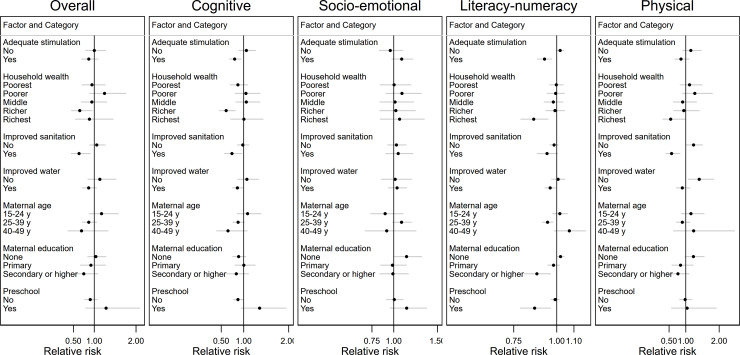
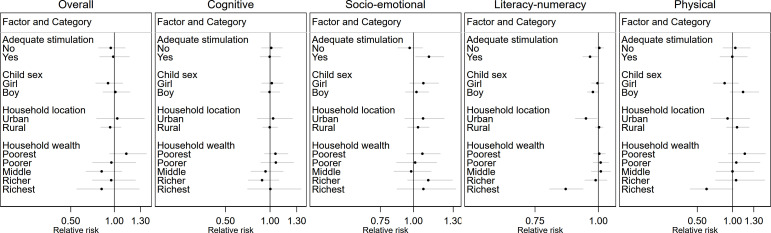
Results: In our sample, 18% of children met MDD and 50% received ≥4 stimulation activities. The prevalence of suboptimal cognitive, socioemotional, literacy-numeracy and physical development was 24%, 32%, 87% and 11%, respectively. Higher DDS, meeting MDD and consuming ASFs were associated with 8%-13% more stimulation activities. Children who met MDD were slightly less likely to have suboptimal literacy-numeracy development compared with children who did not meet MDD: relative risk 0.97 (95% CI 0.95 to 1.00). DDS, meeting MDD and ASFs consumption were not associated with cognitive, socioemotional or physical development. However, there was evidence of positive associations between MDD and cognitive and literacy-numeracy development among subgroups of children, including those who received ≥4 stimulation activities or attended an early childhood care and education programme.
Conclusions: Child diet was associated with more stimulation activities. However, independent of stimulation, socioeconomic status and other factors, child diet appeared to be a prominent determinant only of literacy-numeracy development among children 36-59 months of age.
Keywords: child development; child health; global health.
© Author(s) (or their employer(s)) 2022. Re-use permitted under CC BY. Published by BMJ.
Conflict of interest statement
Competing interests: None declared.
Figures
Comment in
-
Diet and development beyond 1000 days: ensuring children thrive as well as survive.Arch Dis Child. 2022 Aug;107(8):701-702. doi: 10.1136/archdischild-2022-323780. Epub 2022 Mar 28. Arch Dis Child. 2022. PMID: 35346921 No abstract available.
References
-
- Yu H, McCoach DB, Gottfried AW, et al. . Stability of intelligence from infancy through adolescence: an autoregressive latent variable model. Intelligence 2018;69:8–15. 10.1016/j.intell.2018.03.011 - DOI
Publication types
MeSH terms
LinkOut - more resources
Full Text Sources
Miscellaneous