


Neuropsychiatric Profile as a Predictor of Cognitive Decline in Mild Cognitive Impairment
- PMID: 34955804
- PMCID: PMC8693625
- DOI: 10.3389/fnagi.2021.718949
Neuropsychiatric Profile as a Predictor of Cognitive Decline in Mild Cognitive Impairment
Abstract
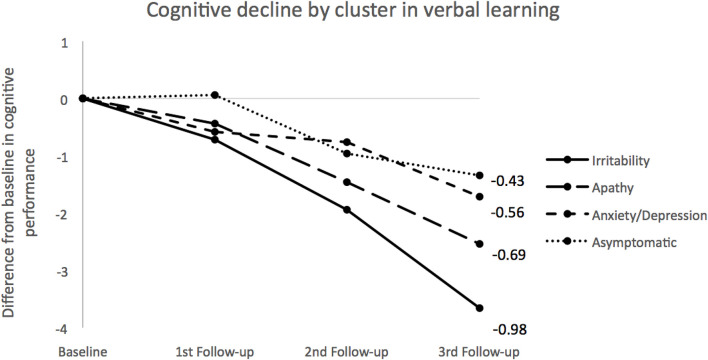
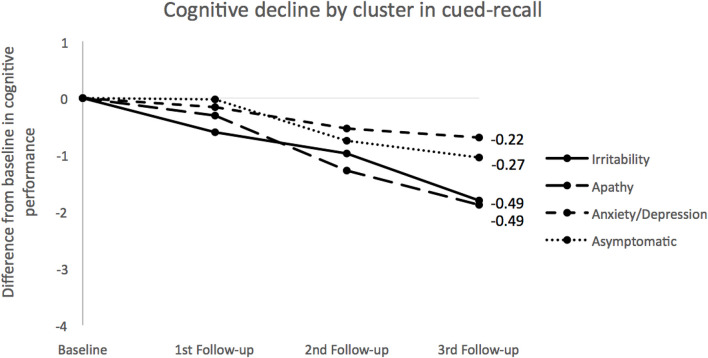
Introduction: Mild cognitive impairment is often associated with affective and other neuropsychiatric symptoms (NPS). This co-occurrence might have a relevant impact on disease progression, from MCI to dementia. Objective: The aim of this study was to explore the trajectories of cognitive decline in an MCI sample from a memory clinic, taking into consideration a perspective of isolated cognitive functions and based on NPS clusters, accounting for the different comorbid symptoms collected at their baseline visit. Methods: A total of 2,137 MCI patients were monitored over a 2.4-year period. Four clusters of NPS (i.e., Irritability, Apathy, Anxiety/Depression and Asymptomatic) were used to run linear mixed models to explore the interaction of cluster with time on cognitive trajectories using a comprehensive neuropsychological battery (NBACE) administered at baseline and at the three subsequent follow-ups. Results: A significant interaction between cluster and time in cognitive decline was found when verbal learning and cued-recall were explored (p = 0.002 for both memory functions). For verbal learning, the Irritability cluster had the largest effect size (0.69), whereas the Asymptomatic cluster showed the smallest effect size (0.22). For cued-recall, the Irritability cluster had the largest effect size among groups (0.64), and Anxiety/Depression had the smallest effect size (0.21). Conclusions: In MCI patients, the Irritability and Apathy NPS clusters shared similar patterns of worsening in memory functioning, which could point to these NPS as risk factors of a faster cognitive decline, acting as early prognostic markers and helping in the diagnostic process.
Keywords: anxiety; apathy; cognitive decline; depression; irritability; mild cognitive impairment; neuropsychiatric symptoms.
Copyright © 2021 Roberto, Portella, Marquié, Alegret, Hernández, Mauleón, Rosende-Roca, Abdelnour, Esteban de Antonio, Tartari, Vargas, López-Cuevas, Bojaryn, Espinosa, Ortega, Pérez-Cordón, Sanabria, Orellana, de Rojas, Moreno-Grau, Montrreal, Alarcón-Martín, Ruíz, Tárraga, Boada and Valero.
Conflict of interest statement
The authors declare that the research was conducted in the absence of any commercial or financial relationships that could be construed as a potential conflict of interest.
Figures
References
-
- Boada M., Cejudo J. C., Tàrraga L., López O. L., Kaufer D. (2002). Neuropsychiatric inventory questionnaire (NPI-Q): validación española de una forma abreviada del Neuropsychiatric Inventory (NPI). Neurología 17 317–323. - PubMed
-
- Burhanullah M. H., Tschanz J. A. T., Peters M. E., Leoutsakos J. M., Matyi J., Lyketsos C. G., et al. (2020). Neuropsychiatric symptoms as risk factors for cognitive decline in clinically normal older adults: the cache county study. Am. J. Geriatr. Psychiatry 28 64–71. 10.1016/j.jagp.2019.03.023 - DOI - PMC - PubMed
LinkOut - more resources
Full Text Sources
