


Generating Evidence From Contextual Clinical Research in Low- to Middle Income Countries: A Roadmap Based on Theory of Change
- PMID: 34956976
- PMCID: PMC8696471
- DOI: 10.3389/fped.2021.764239
Generating Evidence From Contextual Clinical Research in Low- to Middle Income Countries: A Roadmap Based on Theory of Change
Abstract
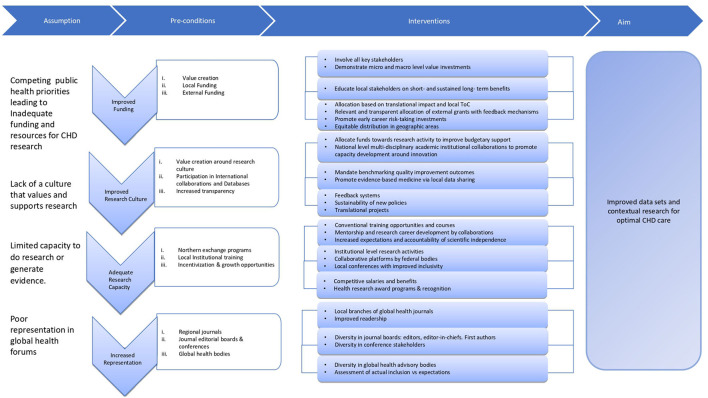
Along with inadequate access to high-quality care, competing health priorities, fragile health systems, and conflicts, there is an associated delay in evidence generation and research from LMICs. Lack of basic epidemiologic understanding of the disease burden in these regions poses a significant knowledge gap as solutions can only be developed and sustained if the scope of the problem is accurately defined. Congenital heart disease (CHD), for example, is the most common birth defect in children. The prevalence of CHD from 1990 to 2017 has progressively increased by 18.7% and more than 90% of children with CHD are born in Low and Middle-Income Countries (LMICs). If diagnosed and managed in a timely manner, as in high-income countries (HICs), most children lead a healthy life and achieve adulthood. However, children with CHD in LMICs have limited care available with subsequent impact on survival. The large disparity in global health research focus on this complex disease makes it a solid paradigm to shape the debate. Despite many challenges, an essential aspect of improving research in LMICs is the realization and ownership of the problem around paucity of local evidence by patients, health care providers, academic centers, and governments in these countries. We have created a theory of change model to address these challenges at a micro- (individual patient or physician or institutions delivering health care) and a macro- (government and health ministries) level, presenting suggested solutions for these complex problems. All stakeholders in the society, from government bodies, health ministries, and systems, to frontline healthcare workers and patients, need to be invested in addressing the local health problems and significantly increase data to define and improve the gaps in care in LMICs. Moreover, interventions can be designed for a more collaborative and effective HIC-LMIC and LMIC-LMIC partnership to increase resources, capacity building, and representation for long-term productivity.
Keywords: complex care; contextual clinical research; global health; global health inequity; research disparity; theory of change.
Copyright © 2021 Hasan, Rasheed, Wahid, Kumar and Zuhlke.
Conflict of interest statement
The authors declare that the research was conducted in the absence of any commercial or financial relationships that could be construed as a potential conflict of interest.
Figures
References
Publication types
Grants and funding
LinkOut - more resources
Full Text Sources
Miscellaneous
