


The Assessment of the Innovativeness of a New Medicine in Italy
- PMID: 34957163
- PMCID: PMC8692651
- DOI: 10.3389/fmed.2021.793640
The Assessment of the Innovativeness of a New Medicine in Italy
Abstract
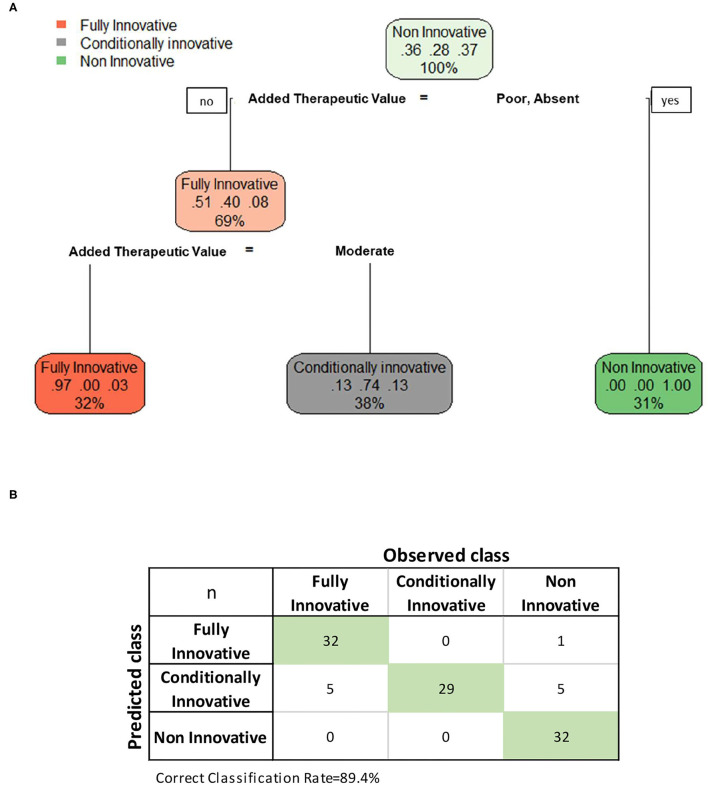
Objectives: Starting from April 2017, the Italian Medicine Agency (AIFA) has approved new criteria for defining any new medicinal product with an innovative indication. The purpose of the study is to analyze the activity of innovativeness evaluation according to the new approach, to estimate the weight of each criterion considered for innovativeness definition, and to evaluate how the new approach works in terms of consistency and reproducibility. Methods: A retrospective analysis was performed on the final reports evaluating the drug innovativeness assessment published on the AIFA's website between April 2017 and January 2021. Descriptive statistics, chi-square test, whether the conditions were respected, or Fisher's exact test was used to explore the association between characteristics of drugs and the innovativeness status and the association between the three criteria. Profiles of the decision process and their relationship with innovativeness response were described. In order to evaluate the weight of each criterion in predicting the innovativeness status, a Classification Tree (CT) algorithm was applied. Results: Overall, of the 109 published drugs reports, 37 (33.9%) were recognized as fully innovative, 29 (26.6%) were considered conditionally innovative, while for 43 (39.4%) reports innovativeness was not recognized. Considering the three criteria of the decision process, the added therapeutic value was the only criterion statistically associated with a drug's degree of innovation (p < 0.001). The therapeutic need and the quality of clinical evidence were statistically associated (p = 0.008) even if only a mild association was observed. The added therapeutic value was the most important variable in predicting the innovativeness status according to the classification tree (CT) model applied, achieving an accuracy of 89.4%. No difference was found between orphans and non-orphan drugs or oncological and non-oncological drugs. Discussion: The added therapeutic value is the most important criterion of the multidimensional approach for the innovativeness status definition of a new medical product. A mild association was found between the therapeutic need and the quality of evidence. Overall, similar decision profiles bring the same evaluation of innovativeness status, indicating a good consistency and reproducibility between decisions.
Keywords: added therapeutic value; drug therapy; grade; innovativeness; therapeutic need.
Copyright © 2021 Fortinguerra, Perna, Marini, Dell'Utri, Trapanese, Trotta and Scientific & Technical Committee (Commissione Tecnico-Scientifica, CTS) of Italian Medicines Agency-AIFA.
Conflict of interest statement
The authors declare that the research was conducted in the absence of any commercial or financial relationships that could be construed as a potential conflict of interest.
Figures
References
-
- Agenzia, Italiana del Farmaco (AIFA) . Report di Valutazione Dell'innovatività per Indicazione Terapeutica. Available online at: https://www.aifa.gov.it/web/guest/farmaci-innovativi (accessed October 10, 2021).
LinkOut - more resources
Full Text Sources
Miscellaneous
