. 2022 Apr;30(4):3187-3200.
doi: 10.1007/s00520-021-06743-3. Epub 2021 Dec 26.

Reductions in sleep quality and circadian activity rhythmicity predict longitudinal changes in objective and subjective cognitive functioning in women treated for breast cancer

Affiliations

Reductions in sleep quality and circadian activity rhythmicity predict longitudinal changes in objective and subjective cognitive functioning in women treated for breast cancer

Sonia Ancoli-Israel et al. Support Care Cancer. 2022 Apr.

Abstract

Purpose: To examine long-term cognitive effects of chemotherapy and identify predictors among women with breast cancer (WBC).

Patients and methods: Sixty-nine WBC scheduled to receive chemotherapy, and 64 matched-controls with no cancer, participated. Objective and subjective cognition, total sleep time, nap time, circadian activity rhythms (CAR), sleep quality, fatigue, and depression were measured pre-chemotherapy (Baseline), end of cycle 4 (Cycle-4), and one-year post-chemotherapy (1-Year).

Results: WBC showed no change in objective cognitive measures from Baseline to Cycle-4 but significantly improved from both time points to 1-Year. Matched-controls showed an increase in test performance at all time points. WBC had significantly higher self-reported cognitive dysfunction at Cycle-4 and 1-Year compared to baseline and compared to matched-controls. Worse neuropsychological functioning was predicted by less robust CARs (i.e., inconsistent 24 h pattern), worse sleep quality, longer naps, and worse cognitive complaints. Worse subjective cognition was predicted by lower sleep quality and higher fatigue and depressed mood.

Conclusion: Objective testing showed increases in performance scores from pre- and post-chemotherapy to one year later in WBC, but matched-controls showed an increase in test performance from baseline to Cycle-4 and from Cycle-4 to 1-Year, likely due to a practice effect. The fact that WBC showed no practice effects may reflect a form of learning deficit. Compared with the matched-controls, WBC reported significant worsened cognitive function. In WBC, worse objective and subjective cognitive functioning were predicted by worse sleep and sleep-related behaviors (naps and CAR). Interventions that target sleep, circadian rhythms, and fatigue may benefit cognitive function in WBC.

Keywords: Breast cancer; Chemotherapy; Circadian activity rhythms; Cognitive function; Depression; Fatigue; Sleep quality.


Conflict of interest statement

SAI is a consultant for Eisai, Biogen, Idorsia, Merck, and Pear Therapeutics. The other authors have no relevant financial or non-financial interests to disclose.

Figures
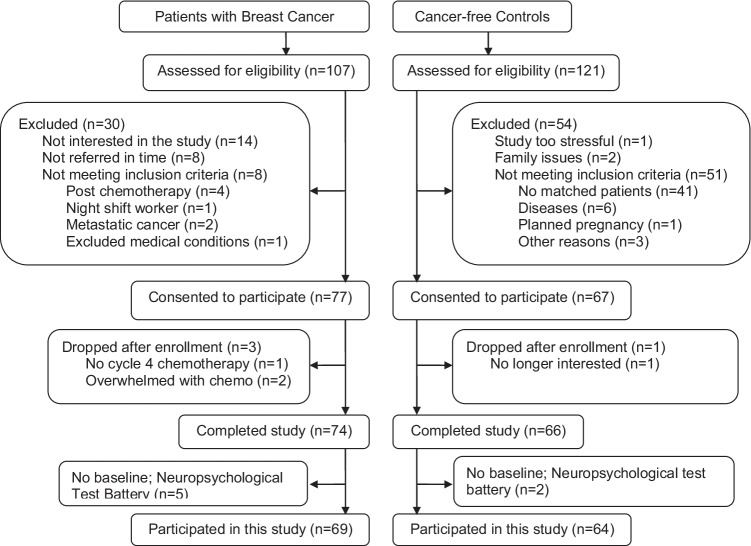
Fig. 1
Fig. 1
Screening and enrollment flowchart
Fig. 2
Fig. 2
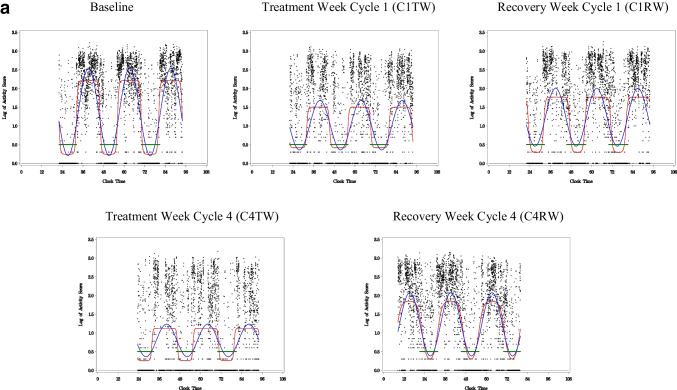
Example of a weak CAR. This woman with BC showed a robust sleep-wake rhythm at baseline indicated by clear contrast between daytime and nighttime activity. The rhythm then became disrupted during the first week of chemotherapy treatment (C1TW) and remained disrupted for the duration of chemotherapy, as indicated by lower amplitude and less contrast between bedtime and wake time. X-axis is clock time. Y-axis is log value. Black dots, log of activity scores calculated by the actigraphy. Blue line, best-fitting traditional cosine curve. Red line, extended cosine curve. Green line, in-bed time
Fig. 3
Fig. 3
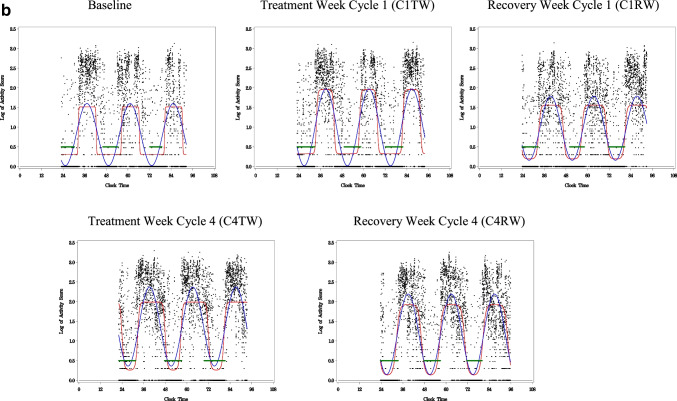
Example of a robust CAR. This woman with BC showed a robust sleep-wake rhythm at baseline, indicated by clear contrast between daytime and nighttime activity. This patient’s rhythm remained overall stable and robust throughout chemotherapy. X-axis is clock time. Y-axis is log value. Black dots, log of activity scores calculated by the actigraphy. Blue line, best-fitting traditional cosine curve. Red line, extended cosine curve. Green line, in-bed time
Fig. 4
Fig. 4
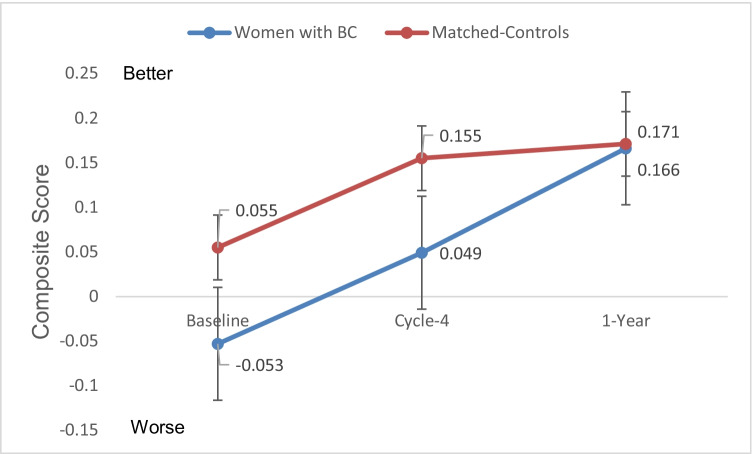
Neuropsychological test battery composite (mean+SE). Higher scores indicate better cognitive functioning. There was a significant time effect for WBC (p < 0.015) and for the matched controls (p < 0.001). Post hoc analysis showing that the neuropsychological composite score for WBC showed no change from Baseline to Cycle-4 (p = 0.330), but increased scores (i.e., improved scores) from Baseline to 1-Year (p = 0.004) and from Cycle-4 to 1-Year (p = 0.041). Matched controls (NC) scores increased (i.e., improved) from Baseline to Cycle-4 (p = 0.012) and 1-Year (p < 0.0001). There was no significant group effect (p = 0.22) or group-by-time interaction (p = 0.13). Age and education were controlled in the mixed models. NP Neuropsychological test battery. Baseline, before the start of chemotherapy; Cycle-4, at the end of cycle 4 chemotherapy; 1-Year, 1 year after the start of chemotherapy
Fig. 5
Fig. 5
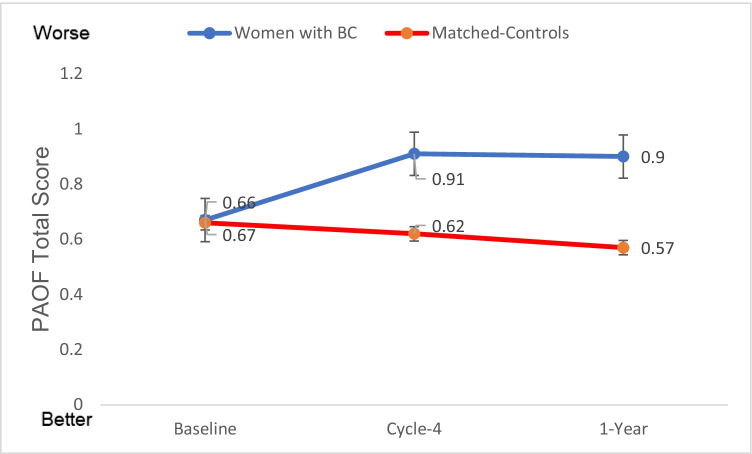
PAOF total score (mean+SE). Higher scores indicate more neurocognitive complaints. Analysis showed no difference between the groups at baseline (p = 0.79), but compared to matched-controls, WBC reported significantly higher total PAOF scores at Cycle-4 (p = 0.0054) and 1-Year (p = 0.022). There was also a significant time effect for WBC (p < 0.0001) with post hoc analysis showing that compared to Baseline, these women reported significantly higher scores at Cycle-4 (p < 0.001) and at 1-Year (p = 0.0008) than matched-controls. There was no significant time effect for the matched-controls (p = 0.59). However, there was a significant group-by-time interaction (p = 0.0005), with the increases from Baseline to Cycle-4 and 1-Year being significantly higher in WBC compared to the matched-controls (p < .001, p < 0.001, respectively. Baseline, before the start of chemotherapy; Cycle-4, at the end of cycle 4 chemotherapy; 1-Year, 1 year after the start chemotherapy. Total PAOF score: marginal group effect (p = 0.052), significant time effect for WBC (p < 0.0001), significant group-by-time interaction (p = 0.0005). Age and education were controlled in the mixed models

References

    1. Janelsins MC, Kesler SR, Ahles TA, Morrow GR. Prevalence, mechanisms, and management of cancer-related cognitive impairment. International Review of Psychiatry. 2014;26(1):102–113. doi: 10.3109/09540261.2013.864260. - DOI - PMC - PubMed
    1. Wefel JS, Saleeba AK, Buzdar AU, Meyers CA. Acute and late onset cognitive dysfunction associated with chemotherapy in women with breast cancer. Cancer. 2010;116(14):3348–3356. doi: 10.1002/cncr.25098. - DOI - PubMed
    1. Joly F, Lange M, Dos Santos M, Vaz-Luis I (1896) Di Meglio A (2019) Long-term fatigue and cognitive disorders in breast cancer survivors. Cancers 11(12) - PMC - PubMed
    1. van Dam FS, Boogerd W, Schagen SB, Muller MJ, Droogleever Fortuyn ME, Ev W, Rodenhuis S. Impairment of cognitive function in women receiving adjuvant treatment for high-risk breast cancer: high-dose versus standard-dose chemotherapy. JNCI: Journal of the National Cancer Institute. 1998;90(3):210–218. doi: 10.1093/jnci/90.3.210. - DOI - PubMed
    1. Collins B, MacKenzie J, Tasca GA, Scherling C, Smith A. Cognitive effects of chemotherapy in breast cancer patients: a dose–response study. Psycho-Oncology. 2013;22(7):1517–1527. doi: 10.1002/pon.3163. - DOI - PubMed