


Medical-Grade Honey Outperforms Conventional Treatments for Healing Cold Sores-A Clinical Study
- PMID: 34959664
- PMCID: PMC8706154
- DOI: 10.3390/ph14121264
Medical-Grade Honey Outperforms Conventional Treatments for Healing Cold Sores-A Clinical Study
Abstract
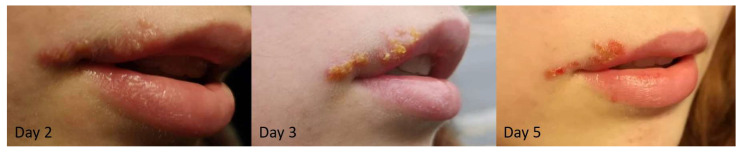
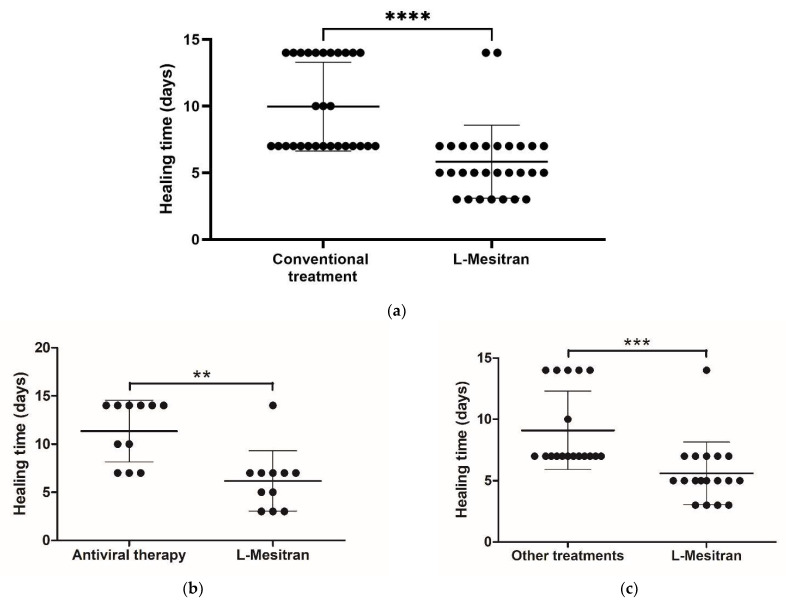
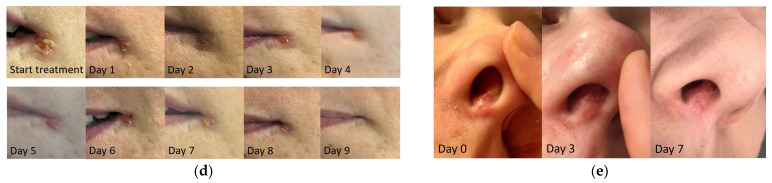
Cold sores are nasolabial blisters caused by herpes simplex virus (HSV) infections. Novel therapies demonstrating simultaneously antiviral activity and improved wound healing are warranted. The aim of this study was to investigate the efficacy of medical-grade honey (MGH) for treating HSV-induced cold sores. A crossover trial was performed in patients with recurrent cold sores (n = 29). The majority (65.6%) of these patients experience four or more episodes per year, thus forming a valid self-control group. In this study, patients applied an MGH-based formulation (L-Mesitran Soft) on their cold sore at the onset of symptoms (62.1%) or appearing of blister (37.9%) and compared it to their conventional treatments. After complete healing, patients filled in a questionnaire evaluating healing, pain, and itching. The average absolute healing time was 72.4% slower with conventional treatment (10.0 days) compared to MGH (5.8 days). After MGH treatment, 86.2% of all patients experienced faster objective healing (6.9% similar and 6.9% slower) and the subjective healing score was higher in 79.3% of the patients (20.7% similar). If the patients normally experience pain and itching during their cold sores, these levels were lower with MGH therapy compared to conventional treatment in 72.7% and 71.4% of the patients, respectively. Moreover, 100% of the patients prefer MGH treatment over conventional treatment and will use it again on future cold sores. MGH is a promising alternative treatment for cold sores, likely by combining both increased antiviral and wound healing activities while alleviating pain and itching.
Keywords: cold sores; herpes simplex virus; itch; medical-grade honey; pain; wounds.
Conflict of interest statement
P.N. is employed by LERAM pharmaceuticals s.r.o., the distributor of L-Mesitran products in the Czech Republic. N.A.J.C. is employed by Triticum Exploitatie BV, the manufacturer of L-Mesitran products. P.N. and N.A.J.C. provided the products free of charge for the participating patients of this study, and were not involved in the treatment of the patients and did not have any influence on the outcome of the study, such as the analyses, interpretation, or presentation of the data. All other authors declare no conflict of interest.
Figures
References
-
- Looker K.J., Welton N.J., Sabin K.M., Dalal S., Vickerman P., Turner K.M.E., Boily M.C., Gottlieb S.L. Global and regional estimates of the contribution of herpes simplex virus type 2 infection to HIV incidence: A population attributable fraction analysis using published epidemiological data. Lancet Infect. Dis. 2020;20:240–249. doi: 10.1016/S1473-3099(19)30470-0. - DOI - PMC - PubMed
LinkOut - more resources
Full Text Sources
Medical
Research Materials
