. 2021 Dec 5;13(12):4368.
doi: 10.3390/nu13124368.

Antioxidant and Anti-Inflammatory Activity of Coffee Brew Evaluated after Simulated Gastrointestinal Digestion

Affiliations

Antioxidant and Anti-Inflammatory Activity of Coffee Brew Evaluated after Simulated Gastrointestinal Digestion

Luigi Castaldo et al. Nutrients. .

Abstract

Coffee contains human health-related molecules, namely polyphenols that possess a wide range of pharmacological functions, and their intake is associated with reduced colon cancer risk. This study aimed to assess the changes in the anti-inflammatory and antioxidant activity of coffee after simulated gastrointestinal digestion. The evaluation of intracellular reactive oxygen species (ROS) levels in the HT-29 human colon cancer cell line and three in vitro spectrophotometric assays were performed to determine the antioxidant activity of the samples. Characterization of coffee composition was also assessed through a Q-Orbitrap high-resolution mass spectrometry analysis. The results highlighted that the levels of polyphenols in the digested coffee brews were higher than those of the non-digested ones. All assayed samples decreased the levels of intracellular ROS when compared to untreated cells, while digested coffee samples exhibited higher antioxidant capacity and total phenolic content than not-digested coffee samples. Digested coffee samples showed a higher reduction in interleukin-6 levels than the not-digested samples in lipopolysaccharide-stimulated HT-29 cells treated for 48 h and fewer cytotoxic effects in the MTT assay. Overall, our findings suggest that coffee may exert antioxidant and anti-inflammatory properties, and the digestion process may be able to release compounds with higher bioactivity.

Keywords: chlorogenic acids; food-derived bioactive compounds; inflammation; polyphenols.


Conflict of interest statement

The authors declare no conflict of interest.

Figures
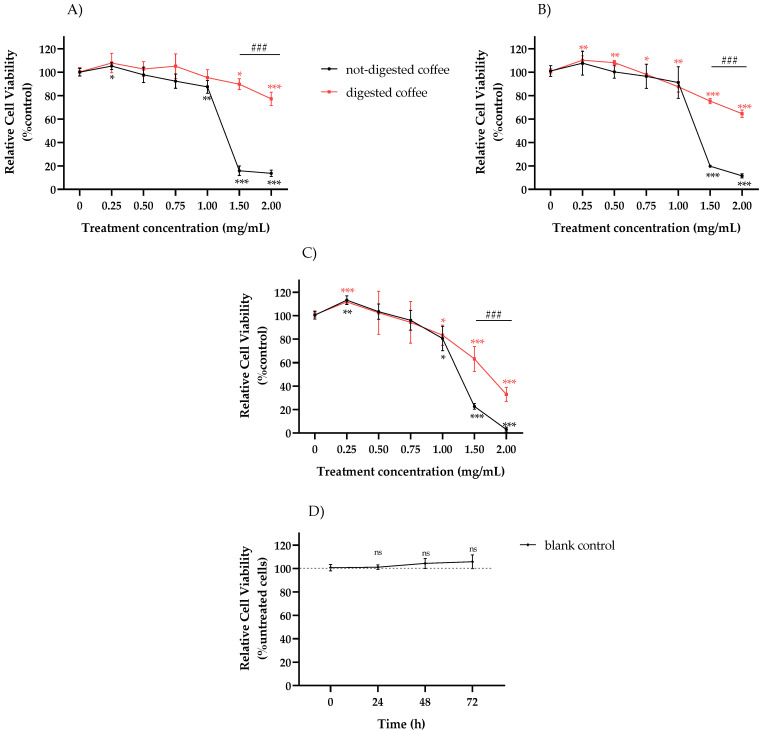
Figure 1
Figure 1
Evaluation of response to digested or not-digested coffee samples in HT-29 cells. The effect of treatment with not-digested or digested coffee extract at 0.25, 0.50, 0.75, 1.00, 1.50, and 2.00 mg/mL on cell viability was estimated by MTT assay after 24 h (A), 48 h (B), and 72 h (C) as compared to untreated control. The effect of treatment with vehicle (blank control) resulting from in vitro digestion on cell viability was evaluated by MTT assay after 24 h, 48 h, and 72 h (D), as compared to untreated cells. No significant differences were observed between blank control and untreated cells. ns: not statistically significant. Mean ± SD of three independent experiments were plotted on the graph. Differences were considered significant when p-value ≤ 0.05 and p-value ≤ 0.01 and highly significant when p-value ≤ 0.001. * p ≤ 0.05, ** p ≤ 0.01, and *** p ≤ 0.001 versus untreated control (calculated as fold-change relative to untreated cells, arbitrarily set at 100%); ### p ≤ 0.001 not-digested coffee versus digested coffee.
Figure 2
Figure 2
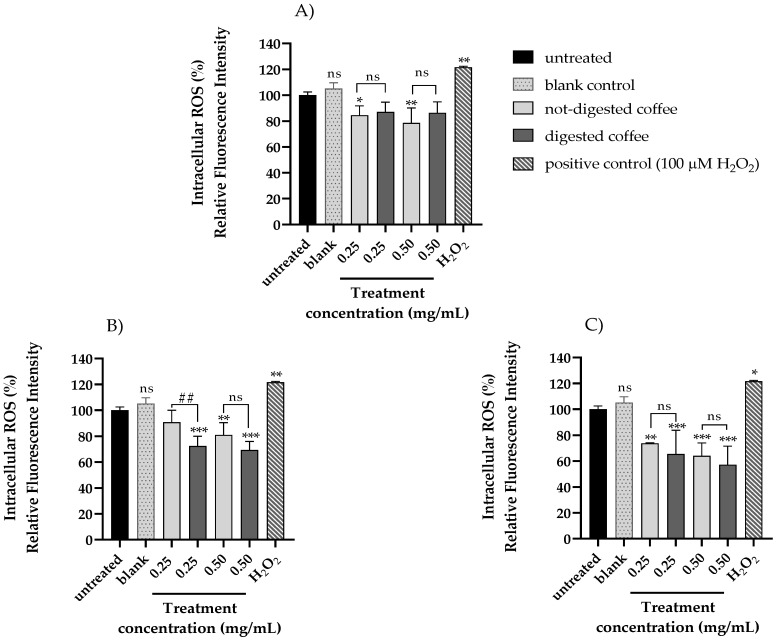
Evaluation of intracellular ROS level in HT-29 cells treated with not-digested or digested coffee samples. Intracellular ROS level was assessed by H2DCF-DA assay on HT-29 cells treated for 24 h (A), 48 h (B), and 72 h (C) with different concentrations of digested and not-digested coffee samples (0.25 and 0.5 mg/mL) and with vehicle (blank control) resulting from in vitro digestion related to untreated cells. Cells treated with 100 µM H2O2 were used as positive control. Mean ± SD of three independent experiments were plotted on the graph. Differences were considered significant when p-value ≤ 0.05 and p-value ≤ 0.01 and highly significant when p-value ≤ 0.001. * p ≤ 0.05, ** p ≤ 0.01, and *** p ≤ 0.001 versus untreated control (calculated as fold-change relative to untreated cells, arbitrarily set at 100%); ## p ≤ 0.01 not-digested coffee versus digested coffee. No significant differences were observed between blank control and untreated cells at 24 h, 48 h, and 72 h. ns: not statistically significant.
Figure 3
Figure 3
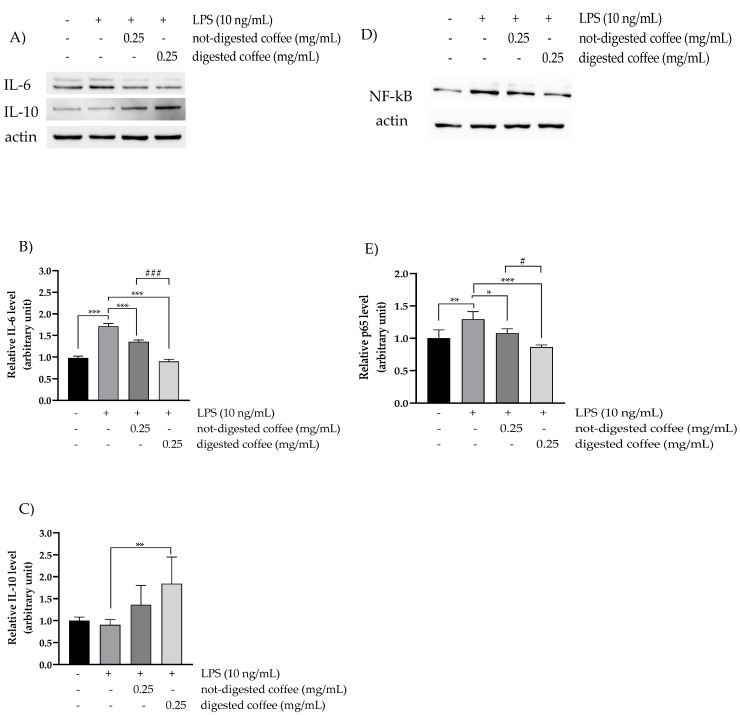
Anti-inflammatory effects of digested coffee samples in LPS-stimulated HT-29 cells. Western blot analysis of the expression levels of interleukin-6 (IL-6) (A), interleukin-10 (IL-10) (A), and NF-kB (p65 subunit) (D) in total cell lysates from untreated control and LPS-stimulated HT-29 cells treated for 48 h with not-digested coffee or digested coffee samples loading. (B,C,E) Densitometric analysis of Western blots. Band intensities were quantified and normalized to actin used as control. All data were analyzed for statistical significance by two-way ANOVA, followed by Dunnett’s multiple comparison test where appropriate. Differences were considered significant when p-value ≤ 0.05 and p-value ≤ 0.01 and highly significant when p-value ≤ 0.001. * p ≤ 0.05, ** p ≤ 0.01, and *** p ≤ 0.001 versus untreated control (calculated as fold-change relative to untreated cells, arbitrarily set at 1); # p ≤ 0.05, and ### p ≤ 0.001 not-digested coffee versus digested coffee. Differences were considered significant when p-value ≤ 0.05 and highly significant when p-value ≤ 0.0001. * p-value ≤ 0.05, ** p-value ≤ 0.0001 versus LPS-stimulated control; # p-value ≤ 0.05, ### p ≤ 0.001 not-digested coffee versus digested coffee.
Figure 4
Figure 4
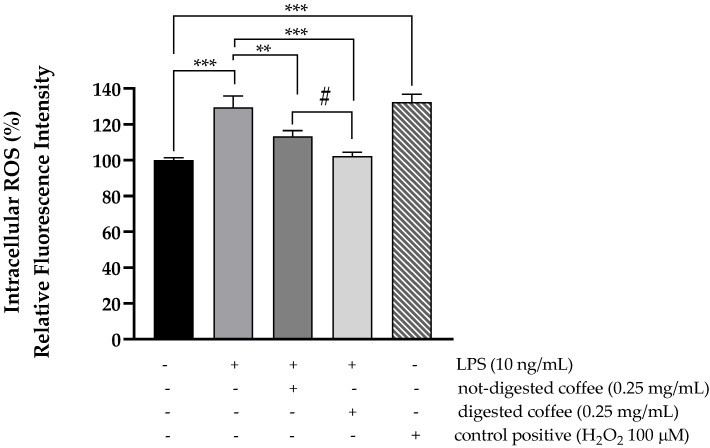
Evaluation of intracellular ROS level in HT-29 cells treated with not-digested and digested coffee after LPS treatments. Intracellular ROS levels were assessed by H2DCF-DA assay in LPS-stimulated HT-29 cells treated for 48h with digested and not-digested coffee samples (0.25 mg/mL) compared with untreated cells. H2O2 (100 µM) was used as positive control. Mean ± SD of three independent experiments were plotted on the graph. Differences were considered significant when p-value ≤ 0.05, p-value ≤ 0.01 and highly significant when p-value ≤ 0.001. ** p ≤ 0.01, and *** p ≤ 0.001 versus untreated control (calculated as fold-change relative to untreated cells, arbitrarily set at 100%) and/or LPS-stimulated cells; # p ≤ 0.05, not-digested coffee versus digested coffee.

References

    1. Castaldo L., Narváez A., Izzo L., Graziani G., Ritieni A. In Vitro Bioaccessibility and Antioxidant Activity of Coffee Silverskin Polyphenolic Extract and Characterization of Bioactive Compounds Using UHPLC-Q-Orbitrap HRMS. Molecules. 2020;25:2132. doi: 10.3390/molecules25092132. - DOI - PMC - PubMed
    1. Lim D., Chang J., Ahn J., Kim J. Conflicting effects of coffee consumption on cardiovascular diseases: Does coffee consumption aggravate pre-existing risk factors? Processes. 2020;8:438. doi: 10.3390/pr8040438. - DOI
    1. Granby K., Fagt S. Analysis of acrylamide in coffee and dietary exposure to acrylamide from coffee. Anal. Chim. Acta. 2004;520:177–182. doi: 10.1016/j.aca.2004.05.064. - DOI
    1. Cano-Marquina A., Tarín J., Cano A. The impact of coffee on health. Maturitas. 2013;75:7–21. doi: 10.1016/j.maturitas.2013.02.002. - DOI - PubMed
    1. Mure K., Maeda S., Mukoubayashi C., Mugitani K., Iwane M., Kinoshita F., Mohara O., Takeshita T. Habitual coffee consumption inversely associated with metabolic syndrome-related biomarkers involving adiponectin. Nutrition. 2013;29:982–987. doi: 10.1016/j.nut.2013.01.011. - DOI - PubMed

MeSH terms