


The Australian Feeding Infants and Toddlers Study (OzFITS) 2021: Study Design, Methods and Sample Description
- PMID: 34960074
- PMCID: PMC8708463
- DOI: 10.3390/nu13124524
The Australian Feeding Infants and Toddlers Study (OzFITS) 2021: Study Design, Methods and Sample Description
Abstract
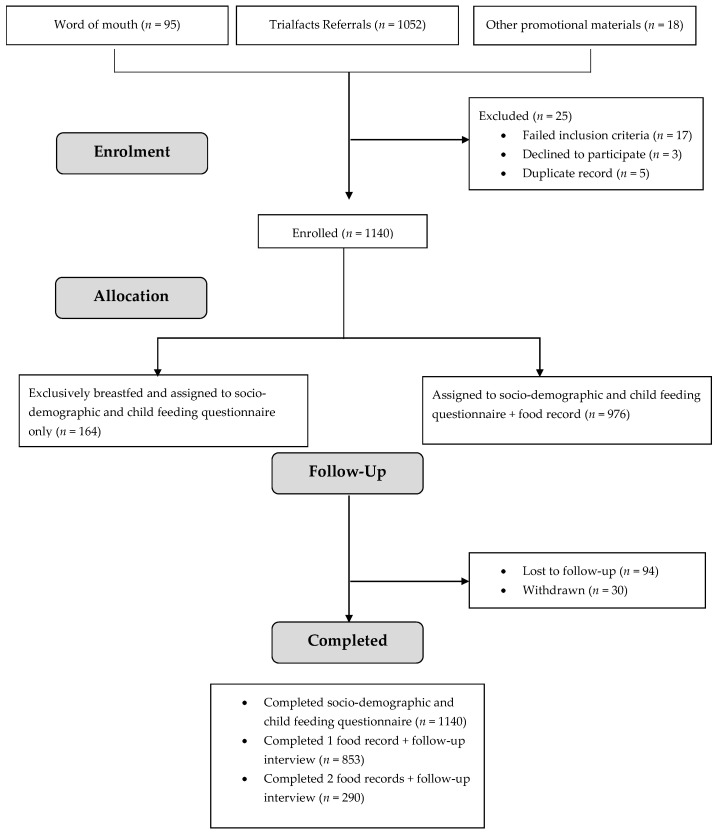
(1) Background: Caregiver feeding practices during the first two years of a child's life influence nutrition, growth, and development, as well as long term taste preferences and dietary patterns. Suboptimal feeding practices lead to poorer health outcomes, such as obesity, that persist into adulthood. Although the importance of early life nutrition is well-established, there are no Australia-wide surveys of dietary intakes of children under two years of age. The 2021 Australian Feeding Infants and Toddlers Study (OzFITS) aims to fill this gap. This paper describes the methods and study sample of OzFITS 2021. (2) Methods: OzFITS 2021 is a cross-sectional study of children aged 0 to 23.9 months of age and their caregiver across Australia. Data were collected between April 2020 and April 2021. A telephone-based survey was completed with a caregiver to obtain information on child and caregiver characteristics and feeding practices. For exclusively breastfed infants, the number of breastfeeds in a 24 h period was reported. Dietary intakes for mixed fed children were estimated using a one-day food record, with 30% of caregivers completing a second food record on a non-consecutive day. (3) Results: We enrolled 1140 caregiver and child dyads. Of those eligible to complete a food record, 853 (87%) completed the food record. Compared to the Australian population, caregivers were more likely to be university-educated (>75%), married or in a de facto relationship (94%), and have a household income >$100,000/y (60%). (4) Conclusions: OzFITS 2021 is the first national study to examine food and nutrient intake in Australian children aged under 2 years. The study will provide information on breastfeeding rates and duration, use of breast milk substitutes, and timing of solid food introduction. Dietary intake data will allow the comparison of core food groups and discretionary food intake to Australian guidelines and estimate the prevalence of inadequate intake of key nutrients, like iron. Healthcare practitioners and policymakers can use the study findings as a source of evidence to inform the next iteration of infant feeding guidelines.
Keywords: Australian feeding infants and toddlers study; complementary feeding; feeding practices; nutrient intakes.
Conflict of interest statement
Honoraria from talks have been paid to Netting’s institution to support professional development by the Nestlé Nutrition Institute. Green reports a grant from the Nestlé Nutrition Institute and honoraria from Nestlé Dubai for an invited talk that was paid to his institute. Makrides reports serving on a board for Trajan Nutrition until November 2020. Moumin reports an educational grant in aid from the Nestlé Nutrition Institute. There are no other financial disclosures or conflicts of interest to report. The funder, Nestlé Nutrition Institute, had no role in the design of this study nor in its execution, analyses, interpretation, or decision to submit results.
Figures
References
-
- Netting J.M., Makrides M. Complementary Foods: Guidelines and Practices. In: Black R.E., Makrides M., Ong K.K., editors. Complementary Feeding: Building the Foundations for a Healthy Life. Nestec Ltd. and S. Karger AG; Vevey, Switzerland: 2017.
-
- Ross E.S. Flavor and Taste Development in the First Years of Life. In: Black R.E., Makrides M., Ong K.K., editors. Complementary Feeding: Building the Foundations for a Healthy Life. Nestec Ltd. and S. Karger AG; Vevey, Switzerland: 2017.
-
- Tang M., Dewey K.G., Krebs N.F. Nutritional Requirements in the Life Stages. In: Kraemer K., editor. The Biology of the First 1000 Days. CRC Press; Boca Raton, FL, USA: 2018. pp. 75–86.
-
- Black R.E., Allen L.H., Bhutta Z.A., Caulfield L.E., de Onis M., Ezzati M., Mathers C., Rivera J., Maternal and Child Undernutrition Study Group Maternal and child undernutrition: Global and regional exposures and health consequences. Lancet. 2008;371:243–260. doi: 10.1016/S0140-6736(07)61690-0. - DOI - PubMed
MeSH terms
Grants and funding
LinkOut - more resources
Full Text Sources
Miscellaneous
