


Microbiome and Human Aging: Probiotic and Prebiotic Potentials in Longevity, Skin Health and Cellular Senescence
- PMID: 34960102
- PMCID: PMC8705837
- DOI: 10.3390/nu13124550
Microbiome and Human Aging: Probiotic and Prebiotic Potentials in Longevity, Skin Health and Cellular Senescence
Abstract
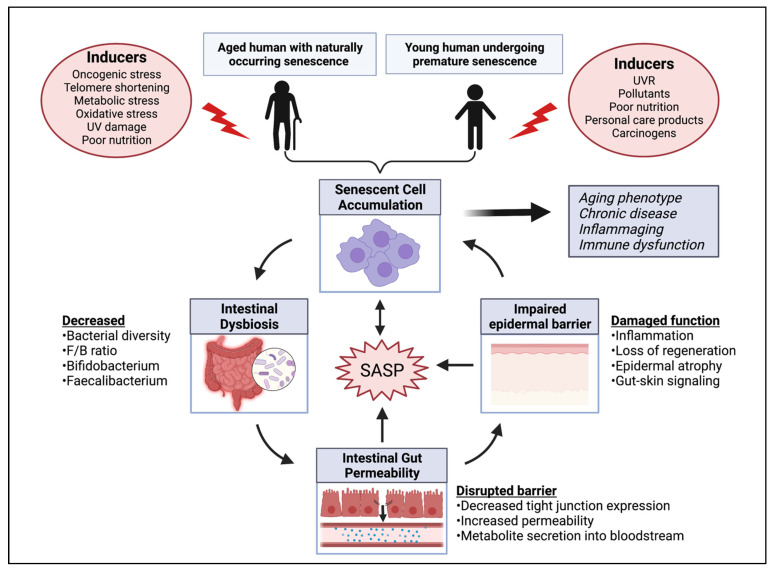
The role of the microbiome in human aging is important: the microbiome directly impacts aging through the gastrointestinal system. However, the microbial impact on skin has yet to be fully understood. For example, cellular senescence is an intrinsic aging process that has been recently associated with microbial imbalance. With age, cells become senescent in response to stress wherein they undergo irreversible growth arrest while maintaining high metabolic activity. An accumulation of senescent cells has been linked to various aging and chronic pathologies due to an overexpression of the senescence-associated secretory phenotype (SASP) comprised of proinflammatory cytokines, chemokines, growth factors, proteases, lipids and extracellular matrix components. In particular, dermatological disorders may be promoted by senescence as the skin is a common site of accumulation. The gut microbiota influences cellular senescence and skin disruption through the gut-skin axis and secretion of microbial metabolites. Metabolomics can be used to identify and quantify metabolites involved in senescence. Moreover, novel anti-senescent therapeutics are warranted given the poor safety profiles of current pharmaceutical drugs. Probiotics and prebiotics may be effective alternatives, considering the relationship between the microbiome and healthy aging. However, further research on gut composition under a senescent status is needed to develop immunomodulatory therapies.
Keywords: cellular senescence; disease; dysbiosis; gut microbiome; microbial metabolites; nutrition; prebiotics; probiotics; skin.
Conflict of interest statement
The authors declare no conflict of interest.
Figures

References
-
- Thevaranjan N., Puchta A., Schulz C., Naidoo A., Szamosi J.C., Verschoor C.P., Loukov D., Schenck L.P., Jury J., Foley K.P., et al. Age-Associated Microbial Dysbiosis Promotes Intestinal Permeability, Systemic Inflammation, and Macrophage Dysfunction. Cell Host Microbe. 2017;21:455–466.e4. doi: 10.1016/j.chom.2017.03.002. - DOI - PMC - PubMed
Publication types
MeSH terms
Substances
Grants and funding
LinkOut - more resources
Full Text Sources
Medical
