. 2021 Dec 15;10(12):2768.
doi: 10.3390/plants10122768.

Gibberellic Acid and Jasmonic Acid Improve Salt Tolerance in Summer Squash by Modulating Some Physiological Parameters Symptomatic for Oxidative Stress and Mineral Nutrition

Affiliations

Gibberellic Acid and Jasmonic Acid Improve Salt Tolerance in Summer Squash by Modulating Some Physiological Parameters Symptomatic for Oxidative Stress and Mineral Nutrition

Mashael M Al-Harthi et al. Plants (Basel). .

Abstract

Gibberellic acid (GA) and jasmonic acid (JA) are considered to be endogenous regulators that play a vital role in regulating plant responses to stress conditions. This study investigated the ameliorative role of GA, JA, and the GA + JA mixture in mitigating the detrimental effect of salinity on the summer squash plant. In order to explore the physiological mechanisms of salt stress alleviation carried out by exogenous GA and JA, seed priming with 1.5 mM GA, 0.005 mM JA, and their mixture was performed; then the germinated summer squash seedlings were exposed to 50 mM NaCl. The results showed that a 50 mM NaCl treatment significantly reduced shoot and root fresh and dry weight, water content (%), the concentration of carotenoid (Car), nucleic acids, K+, and Mg++, the K+/Na+ ratio, and the activity of catalase (CAT) and ascorbate peroxidase (APX), while it increased the concentration of proline, thiobarbituric acid reactive substances (TBARS), Na+, and Cl- in summer squash plants, when compared with the control. However, seed priming with GA, JA and the GA + JA mixture significantly improved summer squash salt tolerance by reducing the concentration of Na+ and Cl-, TBARS, and the Chl a/b ratio and by increasing the activity of superoxide dismutase, CAT, and APX, the quantities of K+ and Mg++, the K+/Na+ ratio, and the quantities of RNA, DNA, chlorophyll b, and Car, which, in turn, ameliorated the growth of salinized plants. These findings suggest that GA and JA are able to efficiently defend summer squash plants from salinity destruction by adjusting nutrient uptake and increasing the activity of antioxidant enzymes in order to decrease reactive oxygen species accumulation due to salinity stress; these findings offer a practical intervention for summer squash cultivation in salt-affected soils. Synergistic effects of the GA and JA combination were not clearly observed, and JA alleviated most of the studied traits associated with salinity stress induced in summer squash more efficiently than GA or the GA + JA mixture.

Keywords: Cucurbita pepo (L.); antioxidant enzymes; lipid peroxidation; mineral uptake; nucleic acids; phytohormones; proline; salinity.


Conflict of interest statement

The authors declare no conflict of interest.

Figures
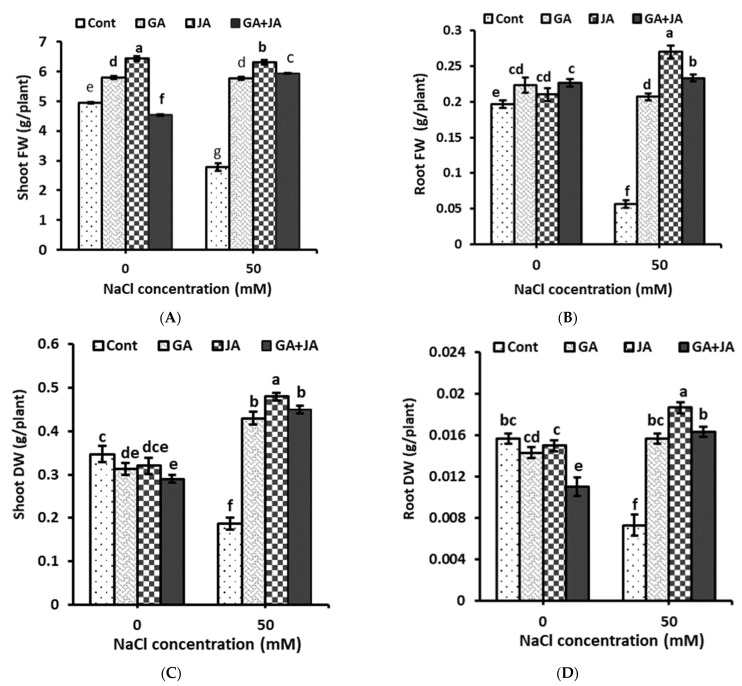
Figure 1
Figure 1
Biomass—(A) shoot fresh weight (FW); (B) root FW; (C) shoot dry weight (DW); and (D) root DW—of non-salinized and salinized summer squash plants, as affected by seed priming with 1.5 mM GA, 0.005 mM JA, and mixture of them. Data represent mean of three replicates (n = 3) with error bars indicating standard error of the mean. Bars carrying different lowercase letters are significantly different at p < 0.05 according to Duncan’s multiple range test. p values for two-way ANOVA are reported in Table 1.
Figure 2
Figure 2
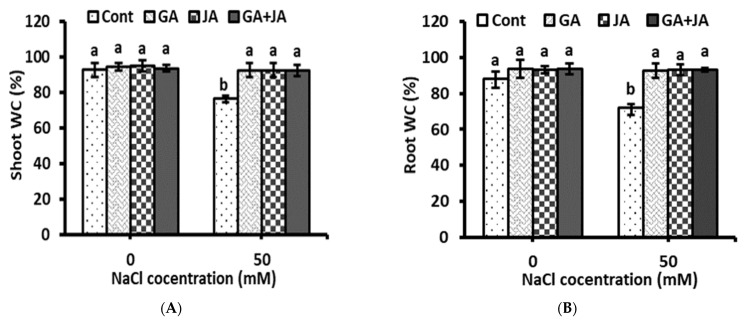
Percentage of water content (WC) in (A) shoot and (B) root of non-salinized and salinized summer squash plants, as affected by seed priming with 1.5 mM GA, 0.005 mM JA, and mixture of them. Data represent mean of three replicates (n = 3) with error bars indicating standard error of the mean. Bars carrying different lowercase letters are significantly different at p < 0.05 according to Duncan’s multiple range test. p values for two-way ANOVA are reported in Table 1.
Figure 3
Figure 3
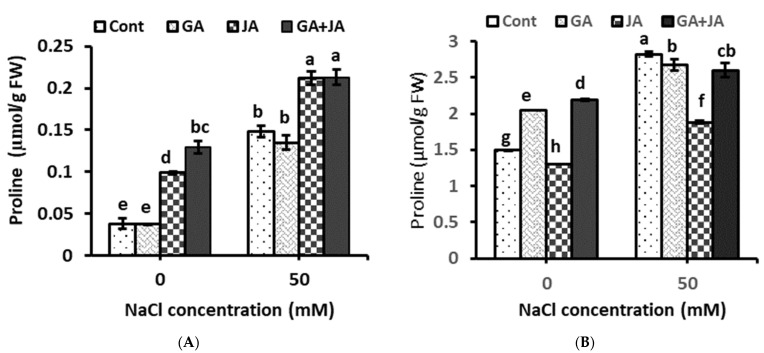
Proline concentration in (A) shoot and (B) root of non-salinized and salinized summer squash plant as affected by seed priming with 1.5 mM GA, 0.005 mM JA, and mixture of them. Data represent mean of three replicates (n = 3) with error bars indicating standard error of the mean. Bars carrying different lowercase letters are significantly different at p < 0.05 according to Duncan’s multiple range test. p values for two-way ANOVA are reported in Table 1.
Figure 4
Figure 4
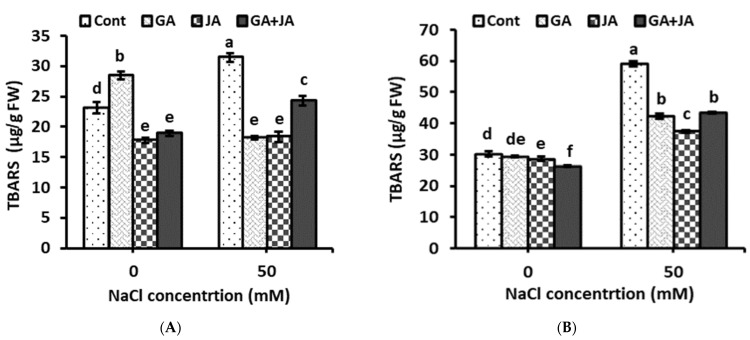
Concentrations of thiobarbituric acid reactive substances (TBARS) in (A) shoot and (B) root of non-salinized and salinized summer squash plants, as affected by seed priming with 1.5 mM GA, 0.005 mM JA, and mixture of them. Data represent mean of three replicates (n = 3) with error bars indicating standard error of the mean. Bars carrying different lowercase letters are significantly different at p < 0.05 according to Duncan’s multiple range test. p values for two-way ANOVA are reported in Table 1.
Figure 5
Figure 5
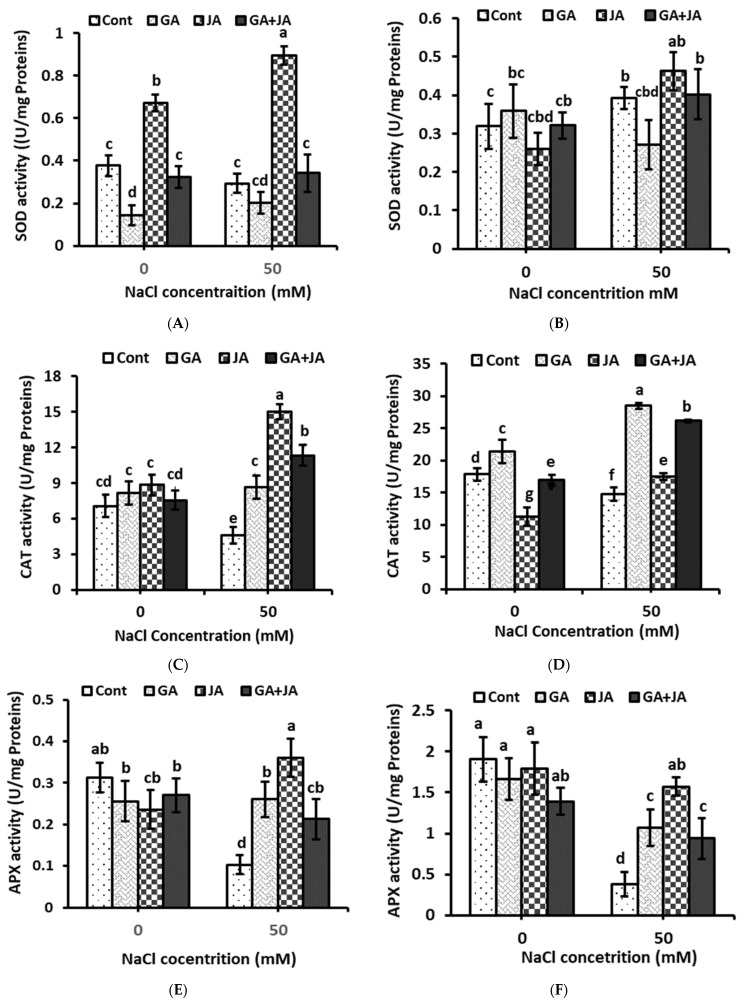
Antioxidant enzyme activity—(A) Superoxide dismutase (SOD) in shoot; (B) SOD in root; (C) Catalase (CAT) in shoot; (D) CAT in root; (E) Ascorbate peroxidase (APX) in shoot; and (F) APX in root—of non-salinized and salinized summer squash plants, as affected by seed priming with 1.5 mM GA, 0.005 mM JA, and mixture of them. Data represent mean of three replicates (n = 3) with error bars indicating standard error of the mean. Bars carrying different lowercase letters are significantly different at p < 0.05 according to Duncan’s multiple range Test. p values for two-way ANOVA are reported in Table 1.
Figure 6
Figure 6
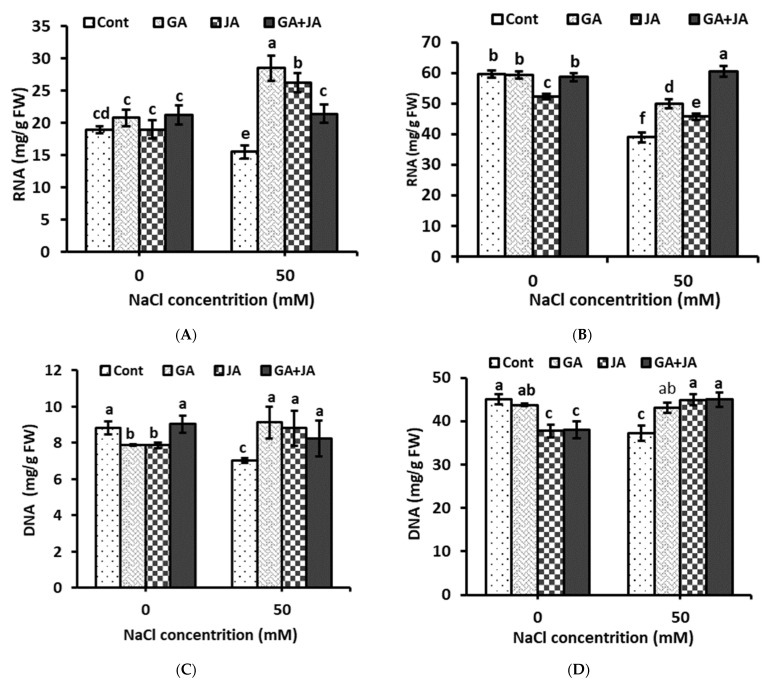
Concentration of nucleic acids—(A) RNA in shoot; (B) RNA in root; (C) DNA in shoot; and (D) DNA in root—of non-salinized and salinized summer squash plants, as affected by seed priming with 1.5 mM GA, 0.005 mM JA, and mixture of them. Data represent mean of three replicates (n = 3) with error bars indicating standard error of the mean. Bars carrying different lowercase letters are significantly different at p < 0.05 according to Duncan’s multiple range Test. p values for two-way ANOVA are reported in Table 1.

References

    1. Evelin H., Devi T.S., Gupta S., Kapoor R. Mitigation of salinity stress in plants by arbuscular mycorrhizal symbiosis: Current understanding and new challenges. Front. Plant Sci. 2019;10:470. doi: 10.3389/fpls.2019.00470. - DOI - PMC - PubMed
    1. Castillo-Campohermoso M.A., Broetto F., Rodríguez-Hernández A.M., Soriano-Melgar L.D.A.A., Mounzer O., Sánchez-Blanco M.J. Plant-available water, stem diameter variations, chlorophyll fluorescence, and ion content in Pistacia lentiscus under salinity stress. Terra Latinoam. 2020;38:103–111. doi: 10.28940/terra.v38i1.510. - DOI
    1. Abdel-Hamid A.M. Physiological and molecular markers for salt tolerance in four barley cultivars. Eur. Sci. J. 2014;10:252–272.
    1. Sahin O., Karlik E., Meric S., Ari S., Gozukirmizi N. Genome organization changes in GM and non-GM soybean [Glycine max (L.) Merr.] under salinity stress by retro-transposition events. Genet. Resour. Crop Evol. 2020;67:1551–1566. doi: 10.1007/s10722-020-00928-1. - DOI
    1. Augé R.M., Toler H.D., Saxton A.M. Arbuscular mycorrhizal symbiosis and osmotic adjustment in response to NaCl stress: A meta-analysis. Front. Plant Sci. 2014;5:562. - PMC - PubMed

LinkOut - more resources