


Impact of Pharmacist-Driven Transitions of Care Interventions on Post-hospital Outcomes Among Patients With Coronary Artery Disease: A Systematic Review
- PMID: 34962844
- PMCID: PMC9427131
- DOI: 10.1177/08971900211064155
Impact of Pharmacist-Driven Transitions of Care Interventions on Post-hospital Outcomes Among Patients With Coronary Artery Disease: A Systematic Review
Abstract
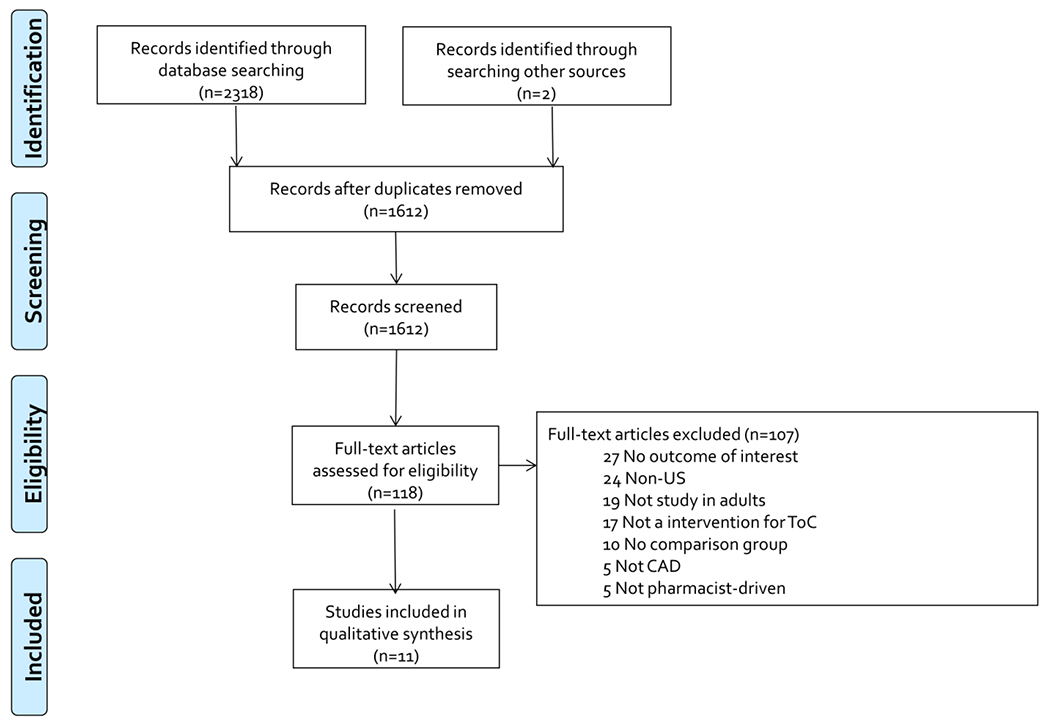
Background: Transitions of care (ToC) aim to provide continuity while preventing loss of information that may result in poor outcomes such as hospital readmission. Readmissions not only burden patients, they also increase costs. Given the high prevalence of coronary artery diseases (CAD) in the United States (US), patients with CAD often make up a significant portion of hospital readmissions. Objective: To conduct a systematic review evaluating the impact of pharmacist-driven ToC interventions on post-hospital outcomes for patients with CAD. Methods: MEDLINE, Scopus, and CINAHL were searched from database inception through 03/2020 using key words for CAD and pharmacists. Studies were included if they: (1) identified adults with CAD at US hospitals, (2) evaluated pharmacist-driven ToC interventions, and (3) assessed post-discharge outcomes. Outcomes were summarized qualitatively. Results: Of the 1612 citations identified, 11 met criteria for inclusion. Pharmacist-driven ToC interventions were multifaceted and frequently included medication reconciliation, medication counseling, post-discharge follow-up and initiatives to improve medication adherence. Hospital readmission and emergency room visits were numerically lower among patients receiving vs not receiving pharmacist-driven interventions, with statistically significant differences observed in 1 study. Secondary prevention measures and adherence tended to be more favorable in the pharmacist-driven intervention groups. Conclusion: Eleven studies of multifaceted, ToC interventions led by pharmacists were identified. Readmissions were numerically lower and secondary prevention measures and adherence were more favorable among patients receiving pharmacist-driven interventions. However, sufficiently powered studies are still required to confirm these benefits.
Keywords: acute coronary syndrome; cardiology; discharge planning; medication therapy management; myocardial infarction; pharmaceutical care.
Conflict of interest statement
Figures
References
-
- Transitions of Care: The Need for a More Effective Approach to Continuing Patient Care. The Joint Commission, 2012, www.jointcommission.org/-/media/deprecated-unorganized/imported-assets/t.... Accessed 10 Aug. 2020.
-
- Naylor MD, Aiken LH, Kurtzman ET, Olds DM, Hirschman KB. The importance of transitional care in achieving Health Reform. Health Affairs 2011;30:746–754. - PubMed
-
- Community-Based Care Transitions Program. Centers for Medicare and Medicaid Services, 2012, https://innovation.cms.gov/innovation-models/cctp. Accessed 10 Aug. 2020.
-
- Readmission Measures Overview. Centers for Medicare and Medicaid Services, https://www.qualitynet.org/inpatient/measures/readmission. Accessed 10 Aug. 2020.
Publication types
MeSH terms
Grants and funding
LinkOut - more resources
Full Text Sources
Medical
Miscellaneous
