


Clonal Hematopoiesis-Associated Gene Mutations in a Clinical Cohort of 448 Patients With Ovarian Cancer
- PMID: 34963005
- PMCID: PMC9002281
- DOI: 10.1093/jnci/djab231
Clonal Hematopoiesis-Associated Gene Mutations in a Clinical Cohort of 448 Patients With Ovarian Cancer
Abstract
Background: Cancer patients are at risk of secondary therapy-related myeloid neoplasms (t-MNs). Acquired blood-specific mutations in clonal hematopoiesis (CH)-associated genes are t-MN risk factors, and their occurrence associated with cancer therapy and age. Patients with ovarian cancer (OC) showed a particularly high prevalence of CH-associated gene mutations, which may additionally be explained by the high proportion of a hereditary disease cause in this cancer entity.
Methods: We performed a retrospective analysis of 448 OC patients enrolled in the AGO-TR1 study; 249 were enrolled at primary diagnosis and 199 at platinum-sensitive recurrence. Analyses included the most frequently altered CH-associated genes (ASXL1, DNMT3A, GNAS, JAK2, PPM1D, SF3B1, SH2B3, SRSF2, TET2, TP53). Results were analyzed according to the BRCA1/2 germline (gBRCA1/2) mutation status. All statistical tests were 2-sided.
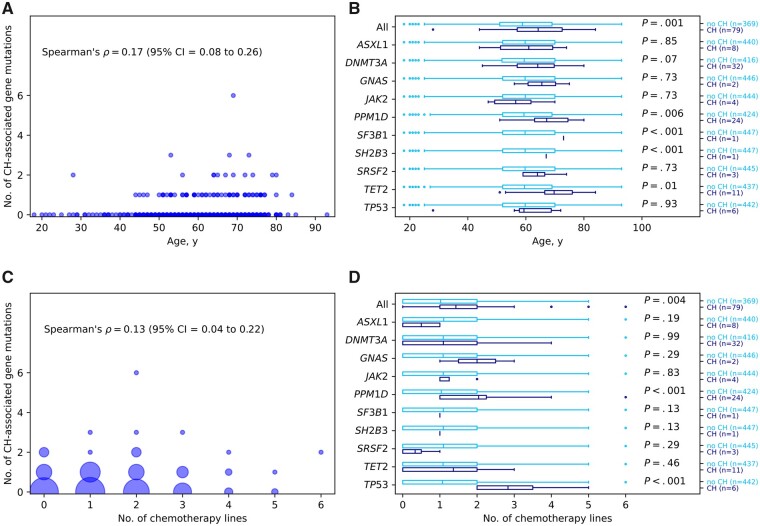
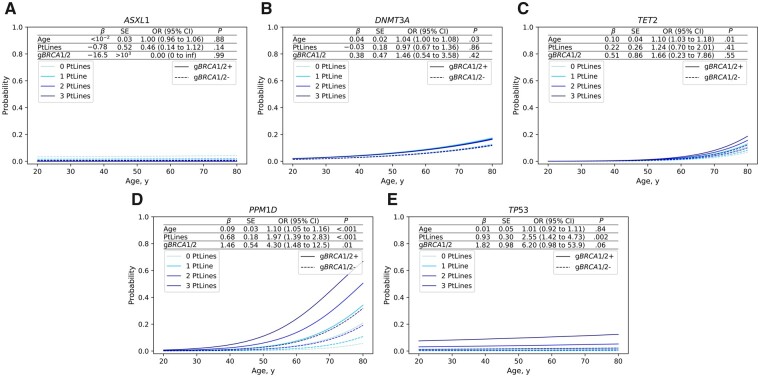
Results: Advanced age at blood draw and a high number of prior platinum-based chemotherapy lines were risk factors to acquire CH-associated gene mutations, with gene-specific effects observed. Binomial logistic regression suggested increased probabilities for gBRCA1/2 mutation carriers to acquire CH-associated PPM1D and TP53 gene mutations (PPM1D: odds ratio = 4.30, 95% confidence interval = 1.48 to 12.46, P = .007; TP53: odds ratio = 6.20, 95% confidence interval = 0.98 to 53.9, P = .06). This observation was due to a statistically significantly increased number of platinum-based chemotherapy lines in gBRCA1/2 mutation carriers vs noncarriers (PPM1D: mean [SD] = 2.04 [1.27] vs 1.04 [0.99], P < .001; TP53: mean [SD] = 2.83 [1.33] vs 1.07 [1.01], P < .001). No interaction between platinum-based chemotherapy and gBRCA1/2 mutation status with the occurrence of CH-associated gene mutations was observed.
Conclusions: A positive gBRCA1/2 mutation status is not a risk factor to acquire CH-associated gene mutations. OC patients may benefit from monitoring CH-associated gene mutations, especially following carboplatin exposure. Future clinical studies are required to assess whether treatment regimen should be adapted according to individual t-MN risks.
© The Author(s) 2021. Published by Oxford University Press. All rights reserved. For permissions, please email: journals.permissions@oup.com.
Figures
Comment in
-
Untangling the Relationship Between Clonal Hematopoiesis and Ovarian Cancer Therapies.J Natl Cancer Inst. 2022 Apr 11;114(4):487-488. doi: 10.1093/jnci/djab234. J Natl Cancer Inst. 2022. PMID: 34963009 Free PMC article. No abstract available.
References
-
- Arts-de Jong M, de Bock GH, van Asperen CJ, et al. Germline BRCA1/2 mutation testing is indicated in every patient with epithelial ovarian cancer: a systematic review. Eur J Cancer. 2016;61:137–145. - PubMed
Publication types
MeSH terms
LinkOut - more resources
Full Text Sources
Medical
Research Materials
Miscellaneous
