


Why do women consume alcohol during pregnancy or while breastfeeding?
- PMID: 34963039
- PMCID: PMC9305227
- DOI: 10.1111/dar.13425
Why do women consume alcohol during pregnancy or while breastfeeding?
Abstract
Issue: Alcohol consumption during pregnancy and breastfeeding cause adverse health outcomes to the mother and child, including Fetal Alcohol Spectrum Disorder (FASD).
Approach: Systematic literature review and thematic synthesis. Original studies that contained reasons for alcohol consumption in pregnancy and while breastfeeding were included. The Mixed Methods Appraisal Tool (MMAT) and the Confidence in the Evidence of Reviews of Qualitative Research (CerQUAL) approach were utilised. The review protocol is available on PROSPERO (registration number: CRD42018116998).
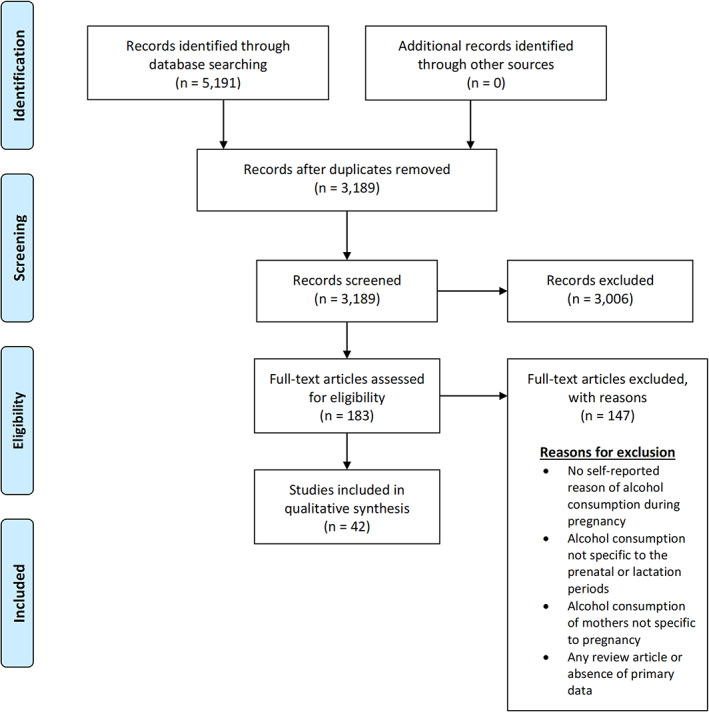
Key findings: Forty-two eligible studies comprising women from 16 countries were included. Most commonly reported reasons of alcohol use in pregnancy were societal pressure and the belief that only "strong" alcohol and alcohol in large quantities is harmful. Other reasons were: a lack of awareness of adverse effects on the fetus; coping with adverse life experiences; consumption based on intuitive decision-making and influenced by personal/peer experiences; belief in the beneficial properties of alcohol; advice from medical practitioners; unwanted or unplanned pregnancy; alcohol dependence; and consumption as a cultural/traditional custom. Reasons for alcohol use during breastfeeding included the belief that alcohol stimulates breast milk production, unclear advice from medical practitioners, unawareness of the risks of infant exposure and to improve mood and celebrate events.
Implications: Understanding the context of reasons for alcohol use in pregnancy is crucial for implementing prenatal health education, and preventing FASD and other adverse maternal and child health outcomes.
Conclusion: Individual beliefs, knowledge/advice, culture and personal circumstances influence alcohol use in pregnancy. Data are limited for reasons surrounding alcohol use while breastfeeding.
Keywords: Fetal Alcohol Spectrum Disorder; alcohol; breastfeeding; pregnancy; reasons.
© 2021 The Authors. Drug and Alcohol Review published by John Wiley & Sons Australia, Ltd on behalf of Australasian Professional Society on Alcohol and other Drugs.
Conflict of interest statement
All authors declare that they do not have any financial, personal, political, intellectual or religious competing interests relevant to this article to disclose.
Figures
References
-
- World Health Organization . Guidelines for the identification and management of substance use and substance use disorders in pregnancy. Geneva: World Health Organization, 2014. - PubMed
-
- Graves L, Carson G, Poole N et al. Guideline no. 405: screening and counselling for alcohol consumption during pregnancy. J Obstet Gynaecol Can 2020;42:1158–1173.e1. - PubMed
-
- Popova S, Lange S, Probst C, Gmel G, Rehm J. Estimation of national, regional, and global prevalence of alcohol use during pregnancy and fetal alcohol syndrome: a systematic review and meta‐analysis. Lancet Glob Health 2017;5:e290–9. - PubMed
-
- Henriksen TB, Hjollund NH, Jensen TK et al. Alcohol consumption at the time of conception and spontaneous abortion. Am J Epidemiol 2004;160:661–7. - PubMed
