. 2022 Jan 15;225(2):jeb242850.
doi: 10.1242/jeb.242850. Epub 2022 Jan 20.

Maternal food restriction during pregnancy affects offspring development and swimming performance in a placental live-bearing fish

Affiliations

Maternal food restriction during pregnancy affects offspring development and swimming performance in a placental live-bearing fish

Andres Hagmayer et al. J Exp Biol. .

Abstract

How pregnant mothers allocate limited resources to different biological functions such as maintenance, somatic growth, and reproduction can have profound implications for early life development and survival of offspring. Here, we examined the effects of maternal food restriction during pregnancy on offspring in the matrotrophic (i.e. mother-nourishment throughout gestation) live-bearing fish species Phalloptychus januarius (Poeciliidae). We fed pregnant females with either low or high food levels for 6 weeks and quantified the consequences for offspring size and body fat at birth and 1 week after birth. We further measured fast-start escape performance of offspring at birth, as well as swimming kinematics during prey capture at 0, 2 and 7 days after birth. We found that the length of maternal food restriction during pregnancy negatively affected offspring dry mass and lean dry mass at birth, as well as body fat gain during the first week after birth. Moreover, it impacted the locomotor performance of offspring during prey capture at birth and during the first week after birth. We did not observe an effect of food restriction on fast-start escape performance of offspring. Our study suggests that matrotrophic poeciliid fish are maladapted to unpredictably fluctuating resource environments, because sudden reductions in maternal food availability during pregnancy result in smaller offspring with slower postnatal body fat gain and an inhibition of postnatal improving swimming skills during feeding, potentially leading to lower competitive abilities after birth.

Keywords: Life-history; Matrotrophy; Placenta; Placentotrophy; Poeciliidae; Viviparity.


Conflict of interest statement

Competing interests The authors declare no competing or financial interests.

Figures
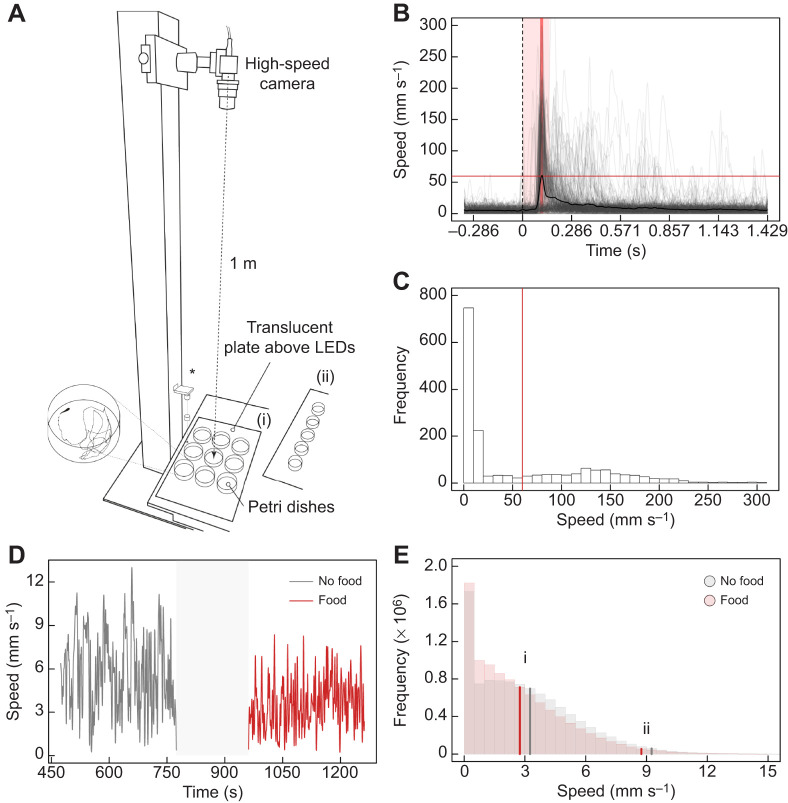
Fig. 1.
Fig. 1.
Experimental set-up to record swimming kinematics during feeding and fast-start escape performance. (A) Fish were filmed at high speed from the dorsal side. For (i) a maximum of 9 Petri dishes, each with a single fish, were placed on pre-defined positions on the plate (arranged in a 3×3 pattern). For (ii), a maximum of 5 dishes were placed on the plate (arranged in a 1×5 pattern). Fast-start escapes were initiated by dropping a weight on the plate (*). (B) Speed profiles of all fast-start escapes (n=270 fast starts). Dashed vertical line indicates the time at which the weight was released to trigger an escape maneuver. Solid black curve shows the overall mean speed. Mean and maximum performance parameters were extracted from a period that was sufficiently long to perform a fast start (light red rectangle). Fish were considered as having ‘responded’ if their speed during a 7 frame window around the maximum of the overall mean speed (thick red line) exceeded the threshold of 60 mm s−1 (thin red line). (C) Histogram of all instant fast-start speeds observed in the light red rectangle shown in B. The histogram shows two peaks, which correspond to individuals that have either responded to the stimulus or not. The response threshold for a fast start (thin red line in B and C) was defined as the speed observed at the minimum frequency in between the two peaks (60 mm s−1). (D) Example time trace of speed during an individual measurement of swimming kinematics while feeding. Mean and maximum locomotor performance parameters were extracted from the 5 min control period (grey line; no food available), and 5 min with available food (red line). The period during which food was supplied (grey rectangle) was filtered out to remove disturbances due to the experimenter. (E) Histogram of all instant speeds observed during the measurements of swimming kinematics while feeding. Grey: 5 min control period (no food present; n=162 fish); red: 5 min feeding period (n=161 fish). Solid lines correspond to the (i) overall mean speed and (ii) mean of speeds above 95% quantile.
Fig. 2.
Fig. 2.
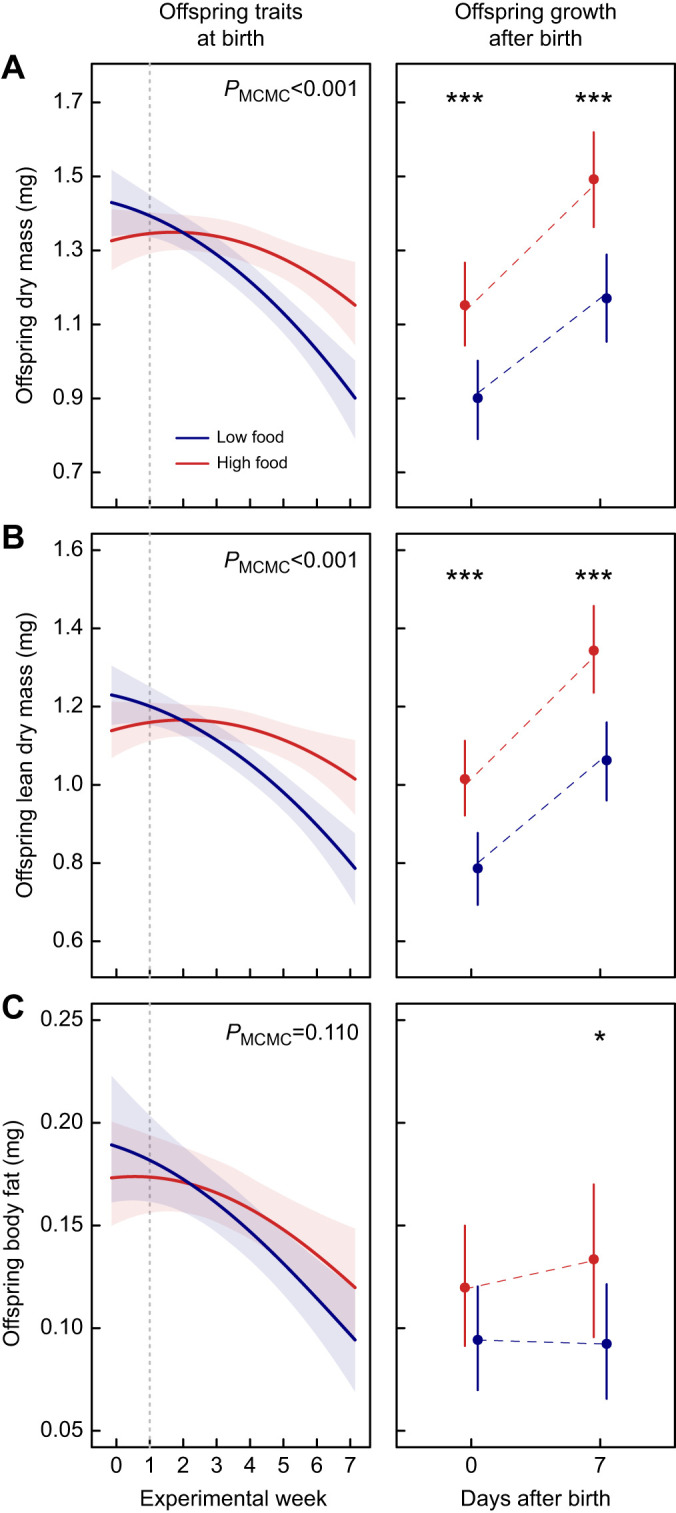
The effect of maternal food treatment in Phalloptychus januarius during pregnancy on offspring phenotypic traits. (A) Dry mass, (B) lean dry mass and (C) body fat (±95% CI) (nLF=300, nHF=287). Left panels in A–C show effect of the length of maternal food treatment during pregnancy on offspring traits at birth for offspring born during the 7-week experiment [in the first week, all females received ad libitum food, the dashed vertical line indicates the start of the 6-week food treatment; blue: low food (LF); red: high food (HF)]. PMCMC-values for the interaction between experimental day and treatment are given at the top. Right panels in A–C show increase in offspring dry mass, lean dry mass and body fat during the first week after birth, predicted for offspring that were born at the end of the 7-week experiment for both food treatments. Estimates are based on fish that were held in the laboratory for 1 week to measure swimming kinematics during feeding. Dashed lines represent linear fits throughout the posterior samples of a given food treatment. ***PMCMC≤0.001, *PMCMC≤0.05, PMCMC>0.05, n.s.
Fig. 3.
Fig. 3.
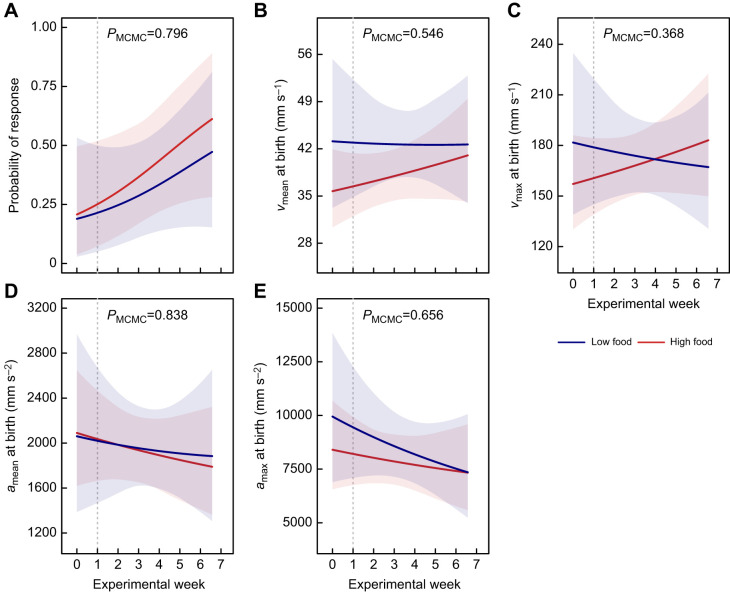
The effect of the length of maternal food treatment in P. januarius during pregnancy on offspring fast-start performance at birth. (A) Probability of newborn offspring response to the stimulus during fast-start trials (±95% CI) (nLF=94, nHF=113). The responsiveness is predicted for both food treatments (blue: low food; red: high food) and throughout the experiment. The dashed vertical line indicates the start of the 6-week food treatment. PMCMC-value for the interaction between experimental day and food treatment is given at the top. (B–E) Swimming performance of newborn offspring during fast-start escape response (nLF=24, nHF=31). During the 7-week experiment, newborns were collected weekly to assess 4 swimming kinematic parameters: mean speed (B), maximum speed (C), mean acceleration (D) and maximum acceleration (E) (±95% CI) at birth. These parameters are predicted for both food treatments (blue: low food; red: high food) and throughout the experiment. The dashed vertical line indicates the start of the 6-week food treatment. PMCMC-values for the interaction between experimental day and treatment are given at the top.
Fig. 4.
Fig. 4.
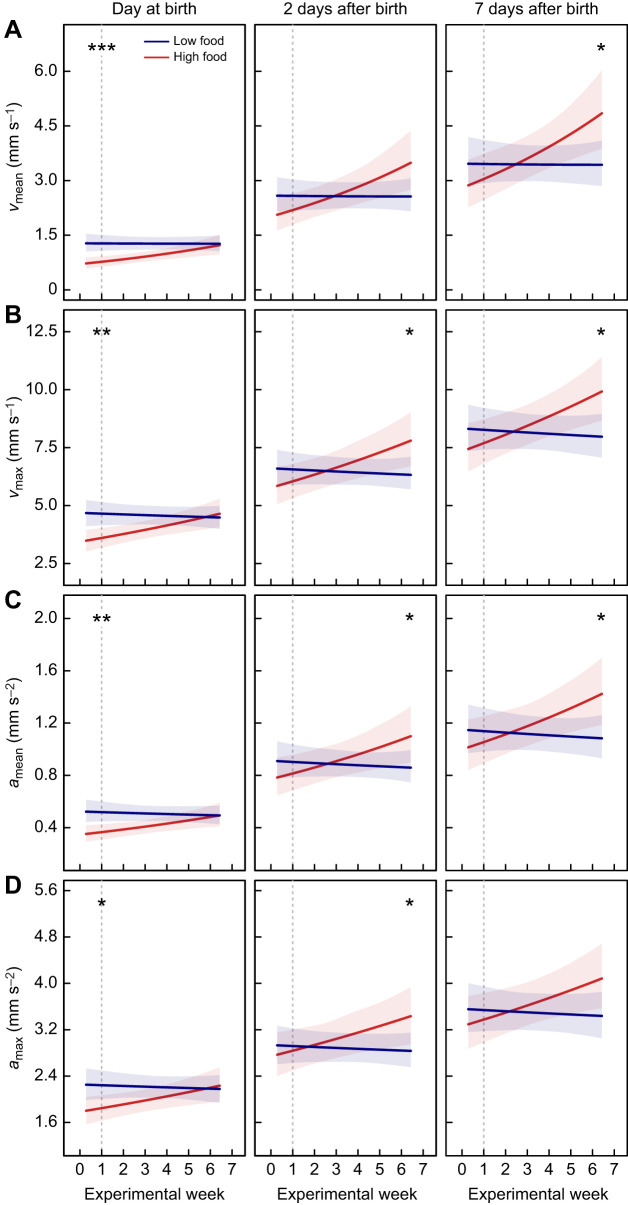
The effect of the length of maternal food treatment in P. januarius during pregnancy on the swimming kinematics of offspring while feeding. During the 7-week experiment, newborns were collected weekly to assess 4 swimming kinematic parameters: mean speed (A), maximum speed (B), mean acceleration (C) and maximum acceleration (D) (±95% CI). These parameters are predicted throughout the experiment for both food treatments (blue: low food; red: high food) at 3 different ages: at birth (0 days, left panels), 2 days (middle panels) and 7 days (right panels). The dashed vertical line indicates the start of the 6-week food treatment. Significance codes are given at the top for the difference between both food treatments at the start of the food treatment and at the end of the experiment. nLF=183, nHF=135; ***PMCMC≤0.001, **PMCMC<0.01, *PMCMC≤0.05, PMCMC>0.05, n.s.

References

    1. Andreata, J. V. (2012). Ictiofauna da lagoa Rodrigo de Freitas, estado do Rio de Janeiro: Composição e aspectos ecológicos. Oecologia Aust. 16, 467-500. 10.4257/oeco.2012.1603.10 - DOI
    1. Auer, S. K., Arendt, J. D., Chandramouli, R. and Reznick, D. N. (2010). Juvenile compensatory growth has negative consequences for reproduction in Trinidadian guppies (Poecilia reticulata). Ecol. Lett. 13, 998-1007. 10.1111/j.1461-0248.2010.01491.x - DOI - PubMed
    1. Banet, A. I. and Reznick, D. N. (2008). Do placental species abort offspring? Testing an assumption of the Trexler-DeAngelis model. Funct. Ecol. 22, 323-331. 10.1111/j.1365-2435.2007.01367.x - DOI
    1. Banet, A. I., Au, A. G. and Reznick, D. N. (2010). Is mom in charge? Implications of resource provisioning on the evolution of the placenta. Evolution (N. Y) 64, 3172-3182. 10.1111/j.1558-5646.2010.01059.x - DOI - PubMed
    1. Bashey, F. (2006). Cross-generational environmental effects and the evolution of offspring size in the Trinidadian Guppy Poecilia reticulata. Evolution (N. Y) 60, 348-361. 10.1111/j.0014-3820.2006.tb01111.x - DOI - PubMed

Publication types