


Understanding key implementation determinants for a school-based universal prevention intervention: a qualitative study
- PMID: 34964893
- PMCID: PMC8929750
- DOI: 10.1093/tbm/ibab162
Understanding key implementation determinants for a school-based universal prevention intervention: a qualitative study
Abstract
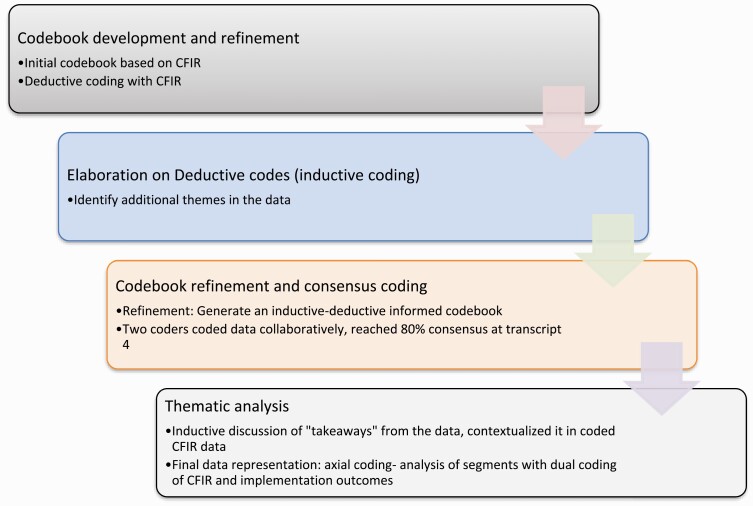
This study examined how teachers discuss various factors as impacting their ability to execute with fidelity the Michigan Model for Health (MMH), an evidence-based health universal prevention curriculum widely adopted throughout Michigan. Researchers have found a robust relationship between fidelity and participant outcomes, including in schools. While previous studies have identified barriers that inhibit fidelity, few have focused on identifying key barriers and deepening our understanding of how these factors influence intervention fidelity. We conducted a thematic analysis using the reflexive thematic approach to identify key barriers and facilitators and deepen our understanding of how these factors influence MMH implementation. Guided by the Consolidated Framework for Implementation Research (CFIR) and the Implementation Outcomes Framework, we conducted semistructured interviews with 23 high school health teachers across Michigan. Teachers identified intervention characteristics (e.g., design quality, packaging, and program adaptability), student needs (e.g., trauma exposure, substances), and the fit between the intervention and the context as factors that contributed to acceptability. They also discussed the curriculum and its alignment with their teaching style and/or experiences as contributing to fidelity. Teachers shared how they would often go "off protocol" to improve intervention-context fit and meet students' needs. Our results identified acceptability, a perceptual implementation outcome, as demonstrating an important role in shaping the relationship between CFIR factors and fidelity. Results provide guidance for systematically designing implementation strategies that address key barriers to improve acceptability, enhance fidelity, and ultimately achieve desired public health objectives.
Keywords: Adolescent health; Community health; Education; Implementation science; School health promotion.
© Society of Behavioral Medicine 2021. All rights reserved. For permissions, please e-mail: journals.permissions@oup.com.
Figures

References
-
- Herrenkohl T. Cross-system collaboration and engagement of the public health model to promote the well-being of children and families. J Soc Social Work Res. 2019;10(3):319–332.
-
- Greenberg M, Abenavoli R. Universal interventions: Fully exploring their impacts and potential to produce population-level impacts. J Res Educ Effect. 2017;10(1):40–67.
-
- Greenberg M. School‐based prevention: Current status and future challenges. Effect Educ. 2010;2(1):27–52.
-
- Shope JT, Copeland LA, Maharg R, Dielman TE. Effectiveness of a high school alcohol misuse prevention program. Alcohol Clin Exp Res. 1996;20(5):791–798. - PubMed
Publication types
MeSH terms
Grants and funding
LinkOut - more resources
Full Text Sources
Medical
Research Materials
Miscellaneous
