. 2021 Mar 9;13(1):32-38.
doi: 10.1136/flgastro-2020-101713. eCollection 2022.

Widespread gaps in the quality of care for primary biliary cholangitis in UK

Affiliations

Widespread gaps in the quality of care for primary biliary cholangitis in UK

Mathuri Sivakumar et al. Frontline Gastroenterol. .

Abstract

Objective: Primary biliary cholangitis (PBC) is a progressive, autoimmune, cholestatic liver disease affecting approximately 15 000 individuals in the UK. Updated guidelines for the management of PBC were published by The European Association for the Study of the Liver (EASL) in 2017. We report on the first national, pilot audit that assesses the quality of care and adherence to guidelines.

Design: Data were collected from 11 National Health Service hospitals in England, Wales and Scotland between 2017 and 2020. Data on patient demographics, ursodeoxycholic acid (UDCA) dosing and key guideline recommendations were captured from medical records. Results from each hospital were evaluated for target achievement and underwent χ2 analysis for variation in performance between trusts.

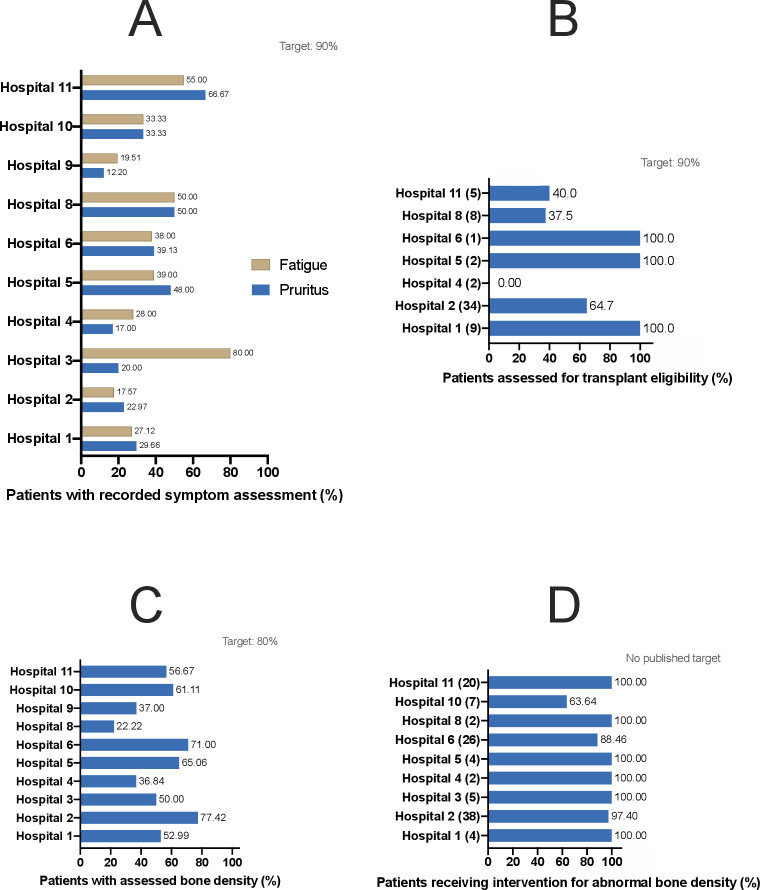
Results: 790 patients' medical records were reviewed. The data demonstrated that the majority of hospitals did not meet all of the recommended EASL standards. Standards with the lowest likelihood of being met were identified as optimal UDCA dosing, assessment of bone density and assessment of clinical symptoms (pruritus and fatigue). Significant variations in meeting these three standards were observed across UK, in addition to assessment of biochemical response to UDCA (all p<0.0001) and assessment of transplant eligibility in high-risk patients (p=0.0297).

Conclusion: Our findings identify a broad-based deficiency in 'real-world' PBC care, suggesting the need for an intervention to improve guideline adherence, ultimately improving patient outcomes. We developed the PBC Review tool and recommend its incorporation into clinical practice. As the first audit of its kind, it will be used to inform a future wide-scale reaudit.

Keywords: autoimmune biliary disease; autoimmune liver disease; cholestatic liver diseases; chronic liver disease; liver cirrhosis.


Conflict of interest statement

Competing interests: None declared.

Figures
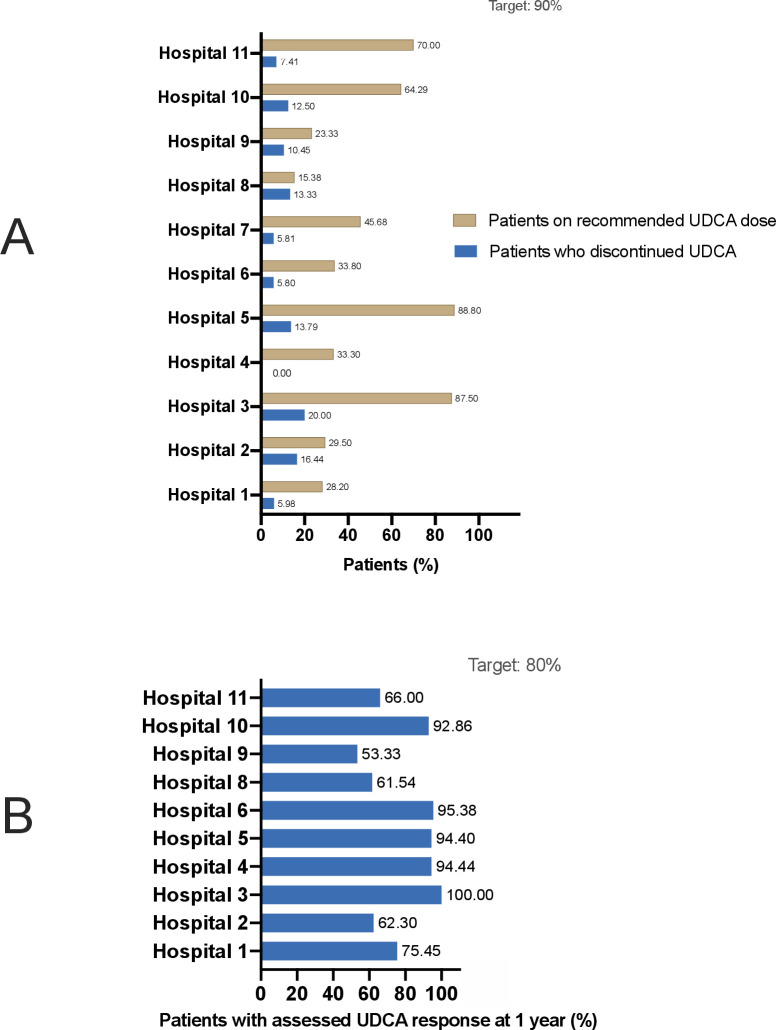
Figure 1
Figure 1
(A) Bar chart showing (a) percentages of the total number of patients with PBC initially prescribed UDCA who discontinued treatment and (b) percentages of the patients with ongoing UDCA treatment who were prescribed the recommended dose of 13–15 mg/kg daily. Data were available from all 11 hospitals, as displayed on the y axis. (B) Bar chart showing the percentages of patients with PBC with ongoing UDCA treatment that underwent a biochemical assessment of UDCA response following 1 year of treatment. Data were available from 10 hospitals, as displayed on the y axis. PBC, primary biliary cholangitis; UDCA, ursodeoxycholic acid.
Figure 2
Figure 2
(A) Bar chart showing percentages of all patients with PBC with a recorded assessment of (a) fatigue and (b) pruritus. Data were available from 10 hospitals, as displayed on the y axis. (B) Bar chart showing the percentages of high-risk patients undergoing assessment for liver transplant eligibility. Data were available from seven hospitals, as displayed on the y axis. The number of patients classified as high-risk is shown in brackets for individual hospitals. (C) Bar chart showing the percentages of all patients with PBC undergoing assessment of bone density within 5 years of PBC diagnosis. Data were available from 10 hospitals, as displayed on the y axis. (D) Bar chart showing the percentages of patients with PBC with abnormal bone density findings that received an appropriate intervention. Data were available from nine hospitals, as displayed on the y axis. Number of patients with abnormal bone density readings is shown in brackets for individual hospitals. PBC, primary biliary cholangitis.
Figure 3
Figure 3
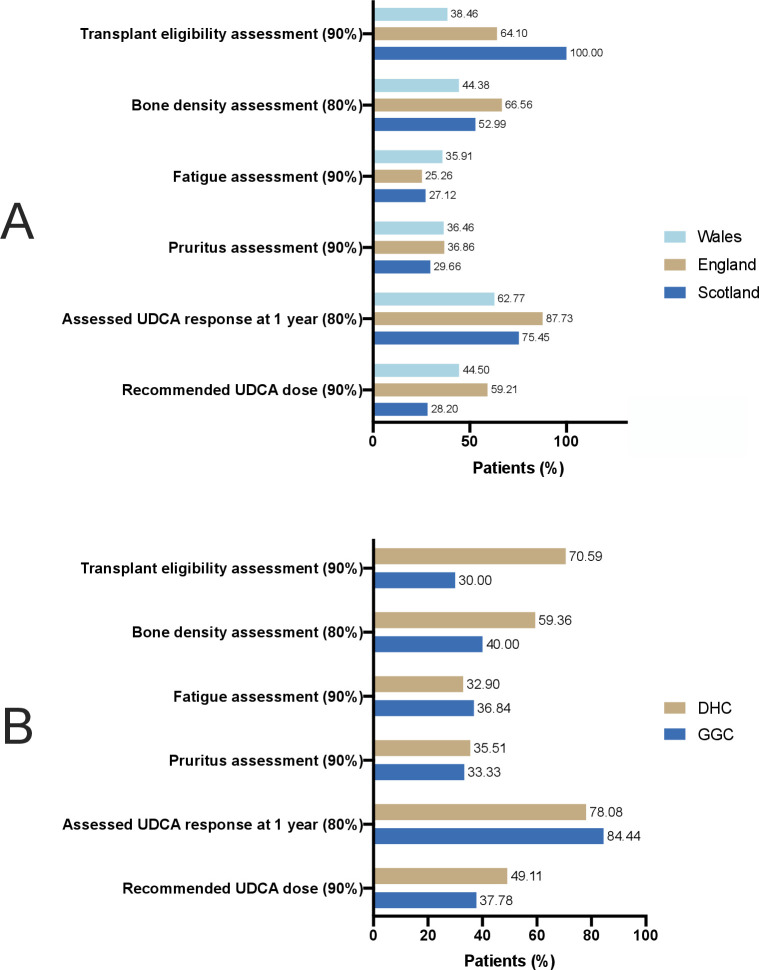
(A) Bar chart showing the performance of England (five hospitals), Wales (four to five hospitals) and Scotland (one hospital) for all assessed targets, as displayed on the y axis. One Welsh hospital provided data for recommended UDCA dosing only and for no other standards. Data on assessment of transplant eligibility were available from four English and two Welsh hospitals. (B) Bar chart showing the performance of GGC (two to three hospitals) and DHC (eight hospitals) for all assessed targets, as displayed on the y axis. One DHC hospital provided data for recommended UDCA dosing only and for no other standards. Data on assessment of transplant eligibility were available from two GGC hospitals and five DHC hospitals. DHC, dedicated hepatology clinics; GGC, general gastroenterology clinics; PBC, primary biliarycholangitis; UDCA, ursodeoxycholic acid.

References

    1. European Association for the Study of the Liver. Electronic address: easloffice@easloffice.eu, European Association for the Study of the Liver . EASL clinical practice guidelines: the diagnosis and management of patients with primary biliary cholangitis. J Hepatol 2017;67:145–72. 10.1016/j.jhep.2017.03.022 - DOI - PubMed
    1. Hirschfield GM, Dyson JK, Alexander GJM, et al. The British Society of Gastroenterology/UK-PBC primary biliary cholangitis treatment and management guidelines. Gut 2018;67:1568–94. 10.1136/gutjnl-2017-315259 - DOI - PMC - PubMed
    1. Onofrio FQ, Hirschfield GM, Gulamhusein AF. A practical review of primary biliary cholangitis for the gastroenterologist. Gastroenterol Hepatol 2019;15:145–54. - PMC - PubMed
    1. Jacoby A, Rannard A, Buck D, et al. Development, validation, and evaluation of the PBC-40, a disease specific health related quality of life measure for primary biliary cirrhosis. Gut 2005;54:1622–9. 10.1136/gut.2005.065862 - DOI - PMC - PubMed
    1. Mells GF, Pells G, Newton JL, et al. Impact of primary biliary cirrhosis on perceived quality of life: the UK-PBC national study. Hepatology 2013;58:273–83. 10.1002/hep.26365 - DOI - PubMed