


The Contribution of Epigenetic Inheritance Processes on Age-Related Cognitive Decline and Alzheimer's Disease
- PMID: 34968302
- PMCID: PMC8594669
- DOI: 10.3390/epigenomes5020015
The Contribution of Epigenetic Inheritance Processes on Age-Related Cognitive Decline and Alzheimer's Disease
Abstract
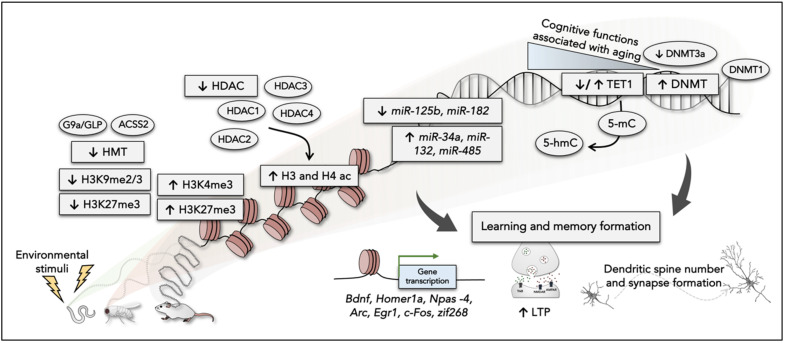
During the last years, epigenetic processes have emerged as important factors for many neurodegenerative diseases, such as Alzheimer's disease (AD). These complex diseases seem to have a heritable component; however, genome-wide association studies failed to identify the genetic loci involved in the etiology. So, how can these changes be transmitted from one generation to the next? Answering this question would allow us to understand how the environment can affect human populations for multiple generations and explain the high prevalence of neurodegenerative diseases, such as AD. This review pays particular attention to the relationship among epigenetics, cognition, and neurodegeneration across generations, deepening the understanding of the relevance of heritability in neurodegenerative diseases. We highlight some recent examples of EI induced by experiences, focusing on their contribution of processes in learning and memory to point out new targets for therapeutic interventions. Here, we first describe the prominent role of epigenetic factors in memory processing. Then, we briefly discuss aspects of EI. Additionally, we summarize evidence of how epigenetic marks inherited by experience and/or environmental stimuli contribute to cognitive status offspring since better knowledge of EI can provide clues in the appearance and development of age-related cognitive decline and AD.
Keywords: AD; cognitive decline; epigenetic mechanisms; intergenerational epigenetic inheritance; learning process; memory formation; transgenerational epigenetic inheritance.
Conflict of interest statement
The authors declare no conflict of interest.
Figures

References
-
- Lardenoije R., Pishva E., Lunnon K., van den Hove D.L. Neuroepigenetics of Aging and Age-Related Neurodegenerative Disorders. 1st ed. Volume 158. Elsevier Inc.; Amsterdam, The Netherlands: 2018. - PubMed
Publication types
Grants and funding
LinkOut - more resources
Full Text Sources
