


The Impact of Co-occurring Post-traumatic Stress Disorder and Substance Use Disorders on Craving: A Systematic Review of the Literature
- PMID: 34970169
- PMCID: PMC8712572
- DOI: 10.3389/fpsyt.2021.786664
The Impact of Co-occurring Post-traumatic Stress Disorder and Substance Use Disorders on Craving: A Systematic Review of the Literature
Abstract
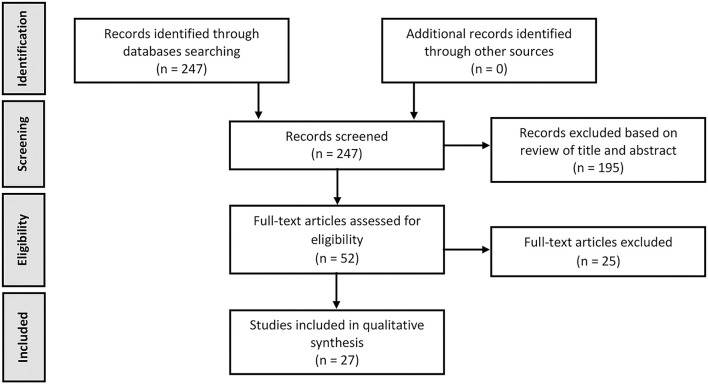
The frequent co-occurrence of post-traumatic stress disorder (PTSD) and substance use disorders (SUDs) leads to manifestations of both conditions that are more severe and more resistance to treatment than single disorders. One hypothesis to explain this synergy is the impact of intrusive memories on craving which, in turn, increases the risk of relapse among patients with substance use disorders. The aim of this systematic review is to examine this possibility by assessing the impact of PTSD and its symptoms on craving among dual disorder patients. Using PRISMA criteria, four databases were comprehensively searched up to June, 2021, in order to identify all candidate studies based on broad key words. Resulting studies were then selected if they examined the impact of PTSD or PTSD symptoms on craving, and if they used standardized assessments of PTSD, SUD, and craving. Twenty-seven articles matched the selection criteria and were included in this review. PTSD was found to be significantly associated with increased craving levels among patients with alcohol, cannabis, cocaine, tobacco, and other substance use disorders. Exposition to traumatic cues among dual disorder patients was also shown to trigger craving, with an additive effect on craving intensity when exposure to substance-related cues occurred. In addition, certain studies observed a correlation between PTSD symptom severity and craving intensity. Concerning mechanisms underlying these associations, some findings suggest that negative emotional states or emotion dysregulation may play a role in eliciting craving after traumatic exposure. Moreover, these studies suggest that PTSD symptoms may, independently of emotions, act as powerful cues that trigger craving. These findings argue for the need of dual disorder treatment programs that integrate PTSD-focused approaches and emotion regulation strategies, in addition to more traditional interventions for craving management.
Keywords: craving; dual disorder (DD); integrated treatment; post-traumatic stress disorder (PSTD); substance use disorder; systematic (literature) review.
Copyright © 2021 Renaud, Jakubiec, Swendsen and Fatseas.
Conflict of interest statement
The authors declare that the research was conducted in the absence of any commercial or financial relationships that could be construed as a potential conflict of interest.
Figures
References
-
- American Psychiatric Association, Task Task Force on Nomenclature Statistics. Pichot P, Guelfi JD. Manuel Diagnostique et Statistique des Troubles Mentaux. Paris: Masson; (1983).
-
- American Psychiatric Association eds. Diagnostic and Statistical Manual of Mental Disorders: DSM-5, 5th Edn. Washington, DC: American Psychiatric Association; (2013).
Publication types
LinkOut - more resources
Full Text Sources
