


Post-traumatic Stress Disorder and Risk Factors in Patients With Acute Myocardial Infarction After Emergency Percutaneous Coronary Intervention: A Longitudinal Study
- PMID: 34970178
- PMCID: PMC8712448
- DOI: 10.3389/fpsyg.2021.694974
Post-traumatic Stress Disorder and Risk Factors in Patients With Acute Myocardial Infarction After Emergency Percutaneous Coronary Intervention: A Longitudinal Study
Abstract
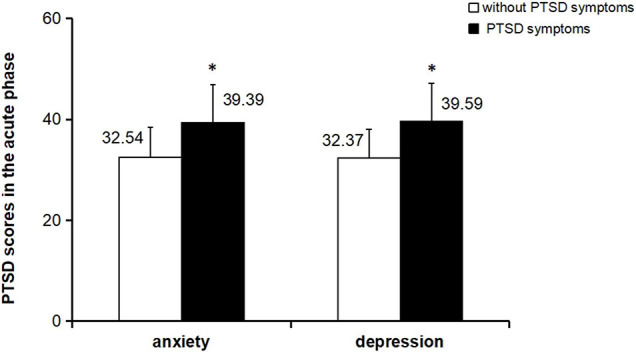
This study aimed to investigate the status and risk factors of post-traumatic stress disorder (PTSD) in patients with acute myocardial infarction (AMI) after emergency percutaneous coronary intervention (PCI) in acute and convalescence phases. A longitudinal study design was used. Two questionnaire surveys were conducted in the acute stage of hospitalization, and 3 months after onset in patients. Logistic regression was used to analyze the risk factors for PTSD in AMI patients. The incidence of PTSD was 33.1 and 20.4% in acute and convalescent patients, respectively. The risk factors related to PTSD were door-to-balloon time (DTB) (≥92.6 min), left ventricular ejection fraction (LVEF) (<50%), smoking, anxiety, and depression. AMI patients after PCI had PTSD in the acute and convalescent stage. The findings indicate that tailored measures should be developed and carried out to prevent PTSD and improve the mental health of patients with AMI after undergoing PCI.
Keywords: acute myocardial infarction; anxiety; depression; percutaneous coronary intervention; post-traumatic stress disorder.
Copyright © 2021 Cao, Wu, Gu, Liu, Deng and Ma.
Conflict of interest statement
The authors declare that the research was conducted in the absence of any commercial or financial relationships that could be construed as a potential conflict of interest.
Figures

References
-
- Birk J., Kronish I., Chang B., Cornelius T., Abdalla M., Schwartz J., et al. (2019). The Impact of Cardiac-induced Post-traumatic Stress Disorder Symptoms on Cardiovascular Outcomes: Design and Rationale of the Prospective Observational Reactions to Acute Care and Hospitalizations (ReACH) Study. Health Psychol. Bull. 2019 310–320. 10.5334/hpb.16 - DOI - PMC - PubMed
-
- Burg M. M., Soufer R. (2016). "Post-traumatic Stress Disorder and Cardiovascular Disease". Curr. Cardiol. Rep. 18:94. - PubMed
LinkOut - more resources
Full Text Sources
Miscellaneous
