


Bifidobacterium animalis subsp. lactis HN019 Effects on Gut Health: A Review
- PMID: 34970580
- PMCID: PMC8712437
- DOI: 10.3389/fnut.2021.790561
Bifidobacterium animalis subsp. lactis HN019 Effects on Gut Health: A Review
Abstract
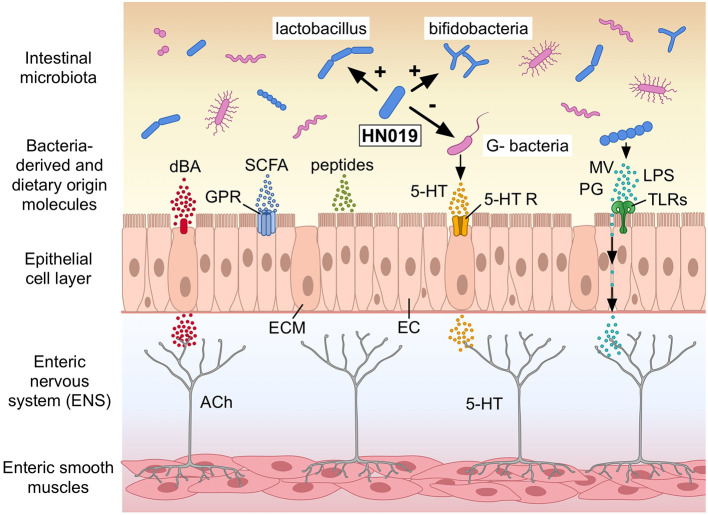
Optimal gut motility is central to bowel function and gut health. The link between the gut dysmotility related disorders and dysfunctional-intestinal barriers has led to a hypothesis that certain probiotics could help in normalizing gut motility and maintain gut health. This review investigates the roles of Bifidobacterium animalis subsp. lactis HN019 (B. lactis HN019™) on gut health, and its mechanisms of action in various pre-clinical and clinical studies. Research supports the hypothesis that B. lactis HN019™ has a beneficial role in maintaining intestinal barrier function during gastrointestinal infections by competing and excluding potential pathogens via different mechanisms; maintaining normal tight junction function in vitro; and regulating host immune defense toward pathogens in both in vitro and human studies. This has been observed to lead to reduced incidence of diarrhea. Interestingly, B. lactis HN019™ also supports normal physiological function in immunosenescent elderly and competes and excludes potential pathogens. Furthermore, B. lactis HN019™ reduced intestinal transit time and increased bowel movement frequency in functional constipation, potentially by modulating gut-brain-microbiota axis, mainly via serotonin signaling pathway, through short chain fatty acids derived from microbial fermentation. B. lactis HN019™ is thus a probiotic that can contribute to relieving gut dysmotility related disorders.
Keywords: Bifidobacterium animalis subsp. lactis HN019; bowel function; diarrhea; gut motility; gut–brain; intestinal barrier; probiotic.
Copyright © 2021 Cheng, Laitila and Ouwehand.
Conflict of interest statement
At the time of writing, the authors were employed by International Flavors & Fragrances Inc. (IFF). IFF manufactures and markets Bifidobacterium animalis subsp. lactis HN019.
Figures
References
Publication types
LinkOut - more resources
Full Text Sources
Other Literature Sources
