


Evaluation of serological anti-SARS-CoV-2 chemiluminescent immunoassays correlated to live virus neutralization test, for the detection of anti-RBD antibodies as a relevant alternative in COVID-19 large-scale neutralizing activity monitoring
- PMID: 34971839
- PMCID: PMC8714258
- DOI: 10.1016/j.clim.2021.108918
Evaluation of serological anti-SARS-CoV-2 chemiluminescent immunoassays correlated to live virus neutralization test, for the detection of anti-RBD antibodies as a relevant alternative in COVID-19 large-scale neutralizing activity monitoring
Abstract
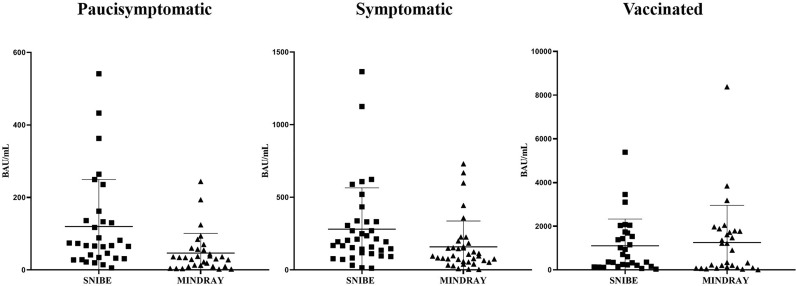
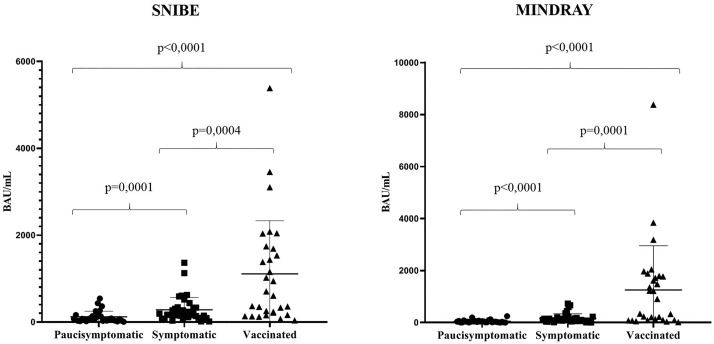
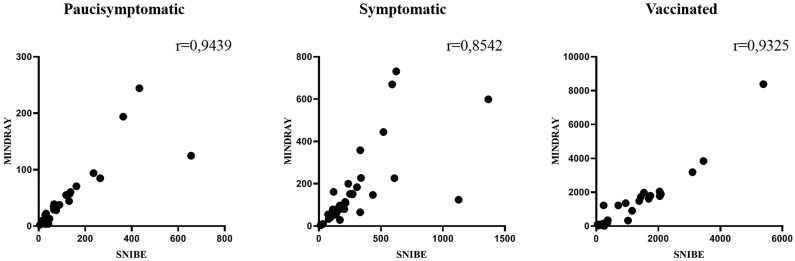
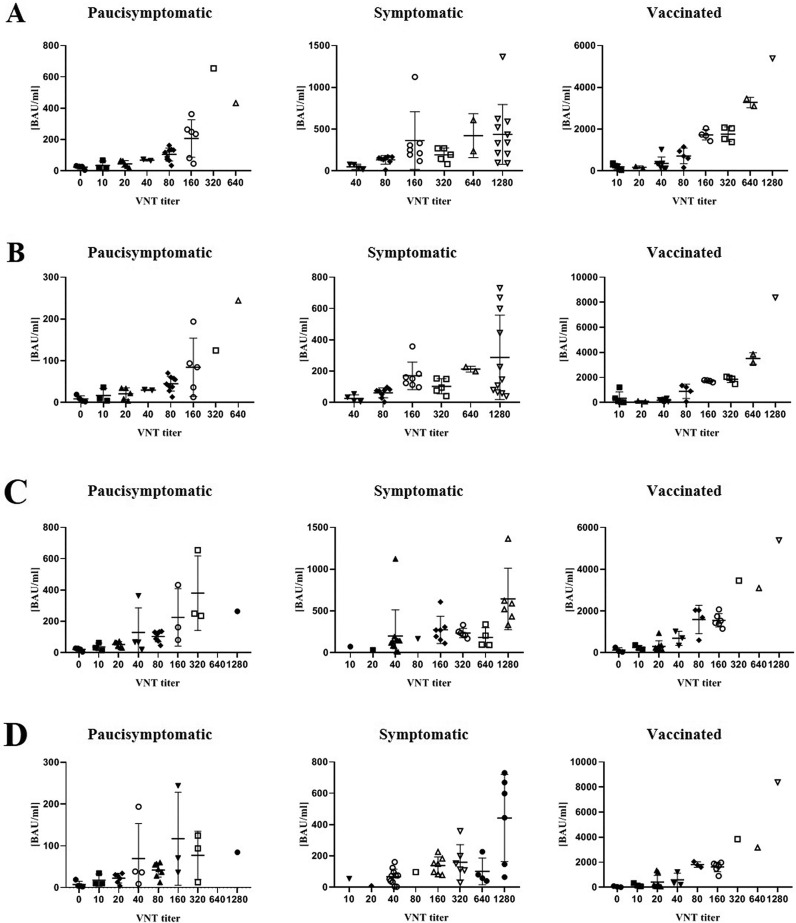
The Spike-Receptor Binding Domain (S-RBD) is considered the most antigenic protein in SARS-CoV-2 and probably the key player in SARS-CoV-2 immune response. Quantitative immunoassays may help establish an anti-RBD Abs threshold as an indication of protective immunity. Since different immunoassays are commercial, the standard reference method for the neutralizing activity is the live Virus Neutralization Test (VNT). In this study, anti-RBD IgG levels were detected with two chemiluminescent immunoassays in paucisymptomatic, symptomatic and vaccinated subjects, and their neutralizing activity was correlated to VNT titer, using SARS-CoV-2 original and British variant strains. Both immunoassays confirmed higher anti-RBD Abs levels in vaccinated subjects. Furthermore, despite different anti-RBD Abs median concentrations between the immunoassays, a strong positive correlation with VNT was observed. In conclusion, although the SARS-CoV-2 immune response heterogeneity, the use of immunoassays can help in large-scale monitoring of COVID-19 samples, becoming a valid alternative to VNT test for diagnostic routine laboratories.
Keywords: Anti-SARS-CoV-2 antibodies; COVID-19; Live virus neutralization test; SARS-CoV-2; Serological immunoassays.
Copyright © 2021 Elsevier Inc. All rights reserved.
Conflict of interest statement
The Authors declare that they have no conflict of interest.
Figures
References
-
- Wu F., Zhao S., Yu B., Chen Y.M., Wang W., Song Z.G., Hu Y., Tao Z.W., Tian J.H., Pei Y.Y., Yuan M.L., Zhang Y.L., Dai F.H., Liu Y., Wang Q.M., Zheng J.J., Xu L., Holmes E.C., Zhang Y.Z. A new coronavirus associated with human respiratory disease in China. Nature. 2020 Mar;579(7798):265–269. doi: 10.1038/s41586-020-2008-3. - DOI - PMC - PubMed
-
- Zhou P., Yang X.L., Wang X.G., Hu B., Zhang L., Zhang W., Si H.R., Zhu Y., Li B., Huang C.L., Chen H.D., Chen J., Luo Y., Guo H., Jiang R.D., Liu M.Q., Chen Y., Shen X.R., Wang X., Zheng X.S., Zhao K., Chen Q.J., Deng F., Liu L.L., Yan B., Zhan F.X., Wang Y.Y., Xiao G.F., Shi Z.L. A pneumonia outbreak associated with a new coronavirus of probable bat origin. Nature. 2020 Mar;579(7798):270–273. doi: 10.1038/s41586-020-2012-7. - DOI - PMC - PubMed
-
- Wu A., Peng Y., Huang B., Ding X., Wang X., Niu P., Meng J., Zhu Z., Zhang Z., Wang J., Sheng J., Quan L., Xia Z., Tan W., Cheng G., Jiang T. Genome composition and divergence of the novel coronavirus (2019-nCoV) originating in China. Cell Host Microbe. 2020 Mar 11;27(3):325–328. doi: 10.1016/j.chom.2020.02.001. - DOI - PMC - PubMed
MeSH terms
Substances
LinkOut - more resources
Full Text Sources
Medical
Miscellaneous
