


Comparative performance of WANTAI ELISA for total immunoglobulin to receptor binding protein and an ELISA for IgG to spike protein in detecting SARS-CoV-2 antibodies in Kenyan populations
- PMID: 34973474
- PMCID: PMC8711170
- DOI: 10.1016/j.jcv.2021.105061
Comparative performance of WANTAI ELISA for total immunoglobulin to receptor binding protein and an ELISA for IgG to spike protein in detecting SARS-CoV-2 antibodies in Kenyan populations
Abstract
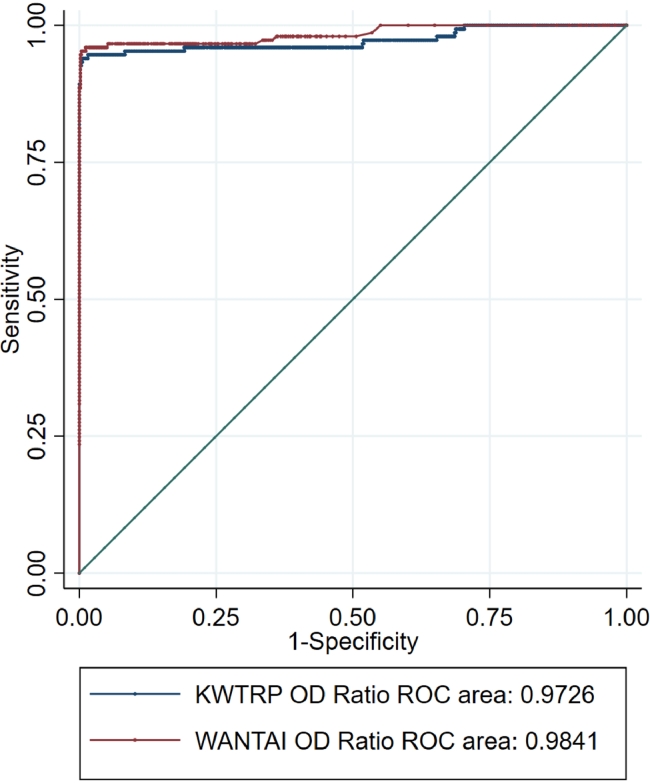
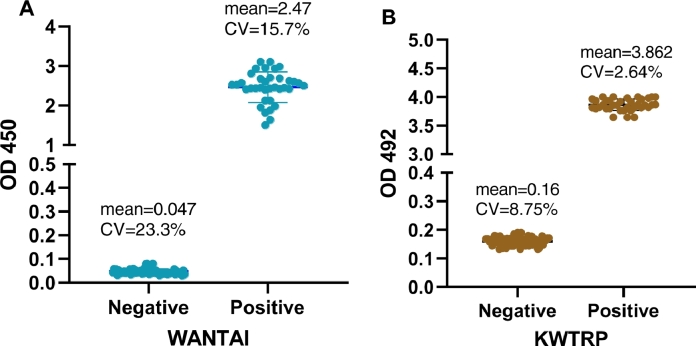
Many SARS-CoV-2 antibody detection assays have been developed but their differential performance is not well described. In this study we compared an in-house (KWTRP) ELISA which has been used extensively to estimate seroprevalence in the Kenyan population with WANTAI, an ELISA which has been approved for widespread use by the WHO. Using a wide variety of sample sets including pre-pandemic samples (negative gold standard), SARS-CoV-2 PCR positive samples (positive gold standard) and COVID-19 test samples from different periods (unknowns), we compared performance characteristics of the two assays. The overall concordance between WANTAI and KWTRP was 0.97 (95% CI, 0.95-0.98). For WANTAI and KWTRP, sensitivity was 0.95 (95% CI 0.90-0.98) and 0.93 (95% CI 0.87-0.96), respectively. Specificity for WANTAI was 0.98 (95% CI, 0.96-0.99) and 0.99 (95% CI 0.96-1.00) while KWTRP specificity was 0.99 (95% CI, 0.98-1.00) and 1.00 using pre-pandemic blood donors and pre-pandemic malaria cross-sectional survey samples respectively. Both assays show excellent characteristics to detect SARS-CoV-2 antibodies.
Keywords: IgG; Immunoassay; SARS-CoV-2; Serology; Total immunoglobulin.
Copyright © 2021. Published by Elsevier B.V.
Conflict of interest statement
The authors declare that they have no known competing financial interests or personal relationships that could have appeared to influence the work reported in this paper.
Figures

References
-
- Mattiuzzo, G., et al. Establishment of the WHO International Standard and Reference Panel for anti-SARS-CoV-2 antibody 2020; Available from: https://www.who.int/publications/m/item/WHO-BS-2020.2403.
-
- Etyang, A.O., et al., Seroprevalence of antibodies to SARS-CoV-2 among health care workers in Kenya. Clinical Infectious Diseases, 2021.
Publication types
MeSH terms
Substances
Grants and funding
LinkOut - more resources
Full Text Sources
Medical
Miscellaneous
