. 2021 Dec 16:15:762097.
doi: 10.3389/fnins.2021.762097. eCollection 2021.

Practical Closed-Loop Strategies for Deep Brain Stimulation: Lessons From Chronic Pain

Affiliations

Practical Closed-Loop Strategies for Deep Brain Stimulation: Lessons From Chronic Pain

Jordan Prosky et al. Front Neurosci. .

Abstract

Deep brain stimulation (DBS) is a plausible therapy for various neuropsychiatric disorders, though continuous tonic stimulation without regard to underlying physiology (open-loop) has had variable success. Recently available DBS devices can sense neural signals which, in turn, can be used to control stimulation in a closed-loop mode. Closed-loop DBS strategies may mitigate many drawbacks of open-loop stimulation and provide more personalized therapy. These devices contain many adjustable parameters that control how the closed-loop system operates, which need to be optimized using a combination of empirically and clinically informed decision making. We offer a practical guide for the implementation of a closed-loop DBS system, using examples from patients with chronic pain. Focusing on two research devices from Medtronic, the Activa PC+S and Summit RC+S, we provide pragmatic details on implementing closed- loop programming from a clinician's perspective. Specifically, by combining our understanding of chronic pain with data-driven heuristics, we describe how to tune key parameters to handle feature selection, state thresholding, and stimulation artifacts. Finally, we discuss logistical and practical considerations that clinicians must be aware of when programming closed-loop devices.

Keywords: chronic pain; closed-loop; control; deep brain stimulation (DBS); summit RC+S.


Conflict of interest statement

The authors declare that the research was conducted in the absence of any commercial or financial relationships that could be construed as a potential conflict of interest.

Figures
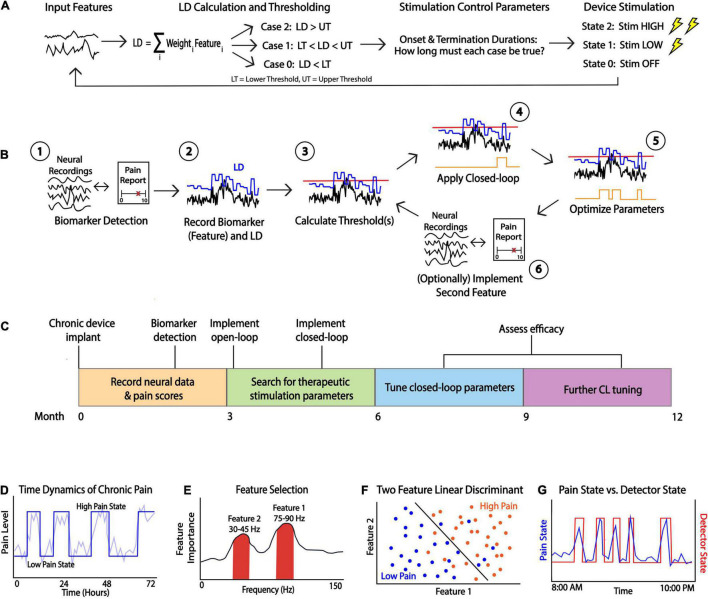
FIGURE 1
FIGURE 1
Considerations for Closed-loop Programming. (A) A schematic of closed-loop DBS. Neural features are fed into a linear discriminant which outputs a value that is then is thresholded. Stimulation control parameters control the device stimulation state which is determined by the length of time the LD is above or below a threshold. (B) A general schematic of closed-loop programming. After recording neural signals and identifying a biomarker which reliably tracks symptom states (e.g., by comparing to pain reports (1), the clinician must determine various parameters such as feature weights to apply to a linear discriminant (LD, (2) and the threshold (red line, (3). This preliminary closed loop is then applied and state changes in real-time can be observed (state changes in orange line, (4). Parameters must be adjusted iteratively (5) and a second feature can be added to optimize closed-loop behavior (6). (C) Proposed timeline of the closed-loop pipeline development process. For novel indications such as chronic pain, biomarker discovery, stimulation adjustment and parameter tuning can take many months. (D) Example simulated data showing time dynamics of the symptom (pain label) which can be dichotomized for deployment in a LD classifier. (E) A general method for power spectrum based feature selection. Useful biomarkers may include frequency bands showing high feature importance which can be found in a variety of ways. For example, a clinician can calculate correlations between powers and symptom states and consider the strength of the correlation as a proxy for feature importance. (F) Simulated data showing scatterplot of feature 1 vs. feature 2 with an optimal LD separating high/low symptom states. Selecting appropriate threshold(s) should result in a function which successfully separates symptom states. (G) Example of optimal closed-loop algorithm function. If a reliable biomarker is found and optimal thresholds are determined, then the detector state (red line) should closely follow a patient’s symptom state (blue line).
FIGURE 2
FIGURE 2
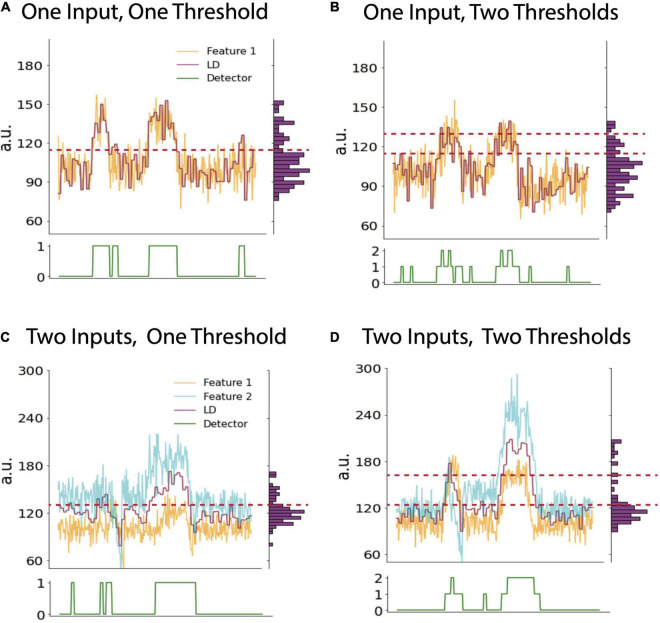
Cases with variable numbers of inputs and thresholds. Example timeseries plots of biomarker feature (yellow), LD (purple) and detector state (green, lower panel) using one input into the LD and one (A) or two thresholds (B), respectively. Note vertical histogram on right side of each panel shows binned counts of LD values. This histogram can be used to calculate LD percentile values which may inform threshold selection (see text). (C) and (D) show example timeseries using two inputs into the LDA and one or two thresholds, respectively. The LD value in all panels is a moving average of features as defined by averaging parameters described in the text. Data shown is simulated.

References

    1. Adams J. E., Hosobuchi Y., Fields H. L. (1974). Stimulation of internal capsule for relief of chronic pain. J. Neurosurg. 41 740–744. 10.3171/jns.1974.41.6.0740 - DOI - PubMed
    1. Bin-Mahfoodh M., Hamani C., Sime E., Lozano A. M. (2003). Longevity of batteries in internal pulse generators used for deep brain stimulation. Stereotact. Funct. Neurosurg. 80 56–60. 10.1159/000075161 - DOI - PubMed
    1. Castaño-Candamil S., Ferleger B. I., Haddock A., Cooper S. S., Herron J., Ko A., et al. (2020). A pilot study on data-driven adaptive deep brain stimulation in chronically implanted essential tremor patients. Front. Hum. Neurosci. 14:541625. 10.3389/fnhum.2020.541625 - DOI - PMC - PubMed
    1. Coffey R. J. (2001). Deep brain stimulation for chronic pain: results of two multicenter trials and a structured review. Pain Med. 2 183–192. 10.1046/j.1526-4637.2001.01029.x - DOI - PubMed
    1. Frizon L. A., Yamamoto E. A., Nagel S. J., Simonson M. T., Hogue O., Machado A. G. (2020). Deep brain stimulation for pain in the modern era: a systematic review. Neurosurgery 86, 191–202. 10.1093/neuros/nyy552 - DOI - PubMed