


The Effect of Anatomical Reduction on Functional Outcomes in Femoral Neck Fracture: A Novel Modified Garden Index
- PMID: 34976490
- PMCID: PMC8712223
- DOI: 10.7759/cureus.19863
The Effect of Anatomical Reduction on Functional Outcomes in Femoral Neck Fracture: A Novel Modified Garden Index
Abstract
Background: Femoral neck fracture is a common cause of morbidity in the younger population with potentially poor prognosis and functional results. The purpose of this study was to evaluate how the success of anatomic reduction affects hip functional outcomes by using a new numerical index modified from the Garden index.
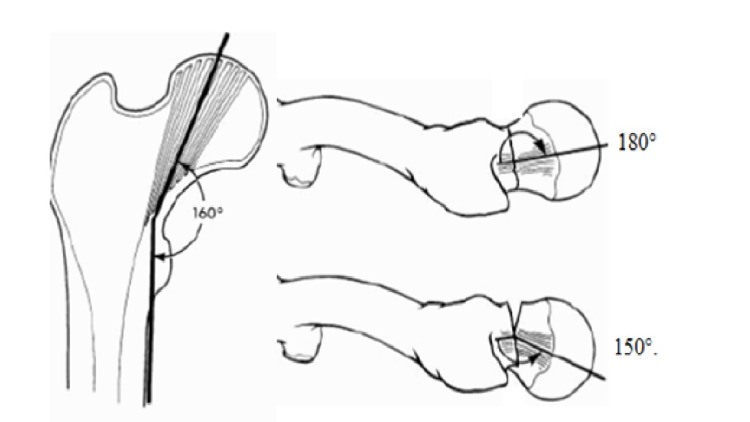
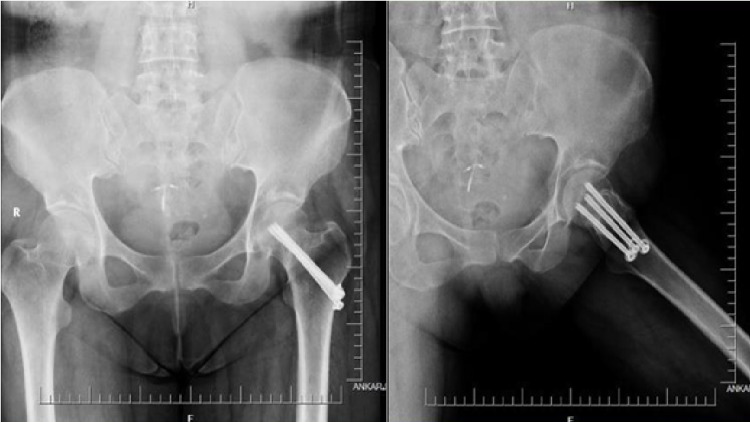
Methods: Twenty-six patients who underwent closed reduction and internal fixation by means of three cannulated screws due to femoral neck fracture between 2010 and 2014 were scanned retrospectively and included in the study. Harris hip scores of the patients at nine to 12 months were evaluated using the new index modified from Garden which is the sum of the differences from the ideal Garden index calculated on early postoperative anteroposterior and lateral pelvis radiographs.
Results: The mean hip score was 73.1 (± 16.4), the minimum score was 32, the maximum score was 93. Postoperative anteroposterior radiographs revealed a mean Garden alignment index of 153.6°, the lowest value was 135° and the highest value was 168°. In the lateral radiographs, the mean Garden alignment index was 173.1°, the lowest value was 160° and the highest value was 178°. The mean value of the novel index was found as 14.2°, the lowest value was 2°, and the highest value was 40°. There was an inverse correlation between the novel index we defined and the Harris hip score (p<0.01).
Conclusion: In femoral neck fractures, the success of anatomic reduction is an important factor affecting the patient's functional outcome. We believe the new reduction index we proposed will contribute to literature comparing the success of reduction in femoral neck fractures.
Keywords: anatomical reduction; cannulated screw; femoral neck fracture; garden alignment index; harris hip score.
Copyright © 2021, Agar et al.
Conflict of interest statement
The authors have declared that no competing interests exist.
Figures
References
-
- Epidemiology of hip fractures in Göteborg, Sweden, 1940-1983. Zetterberg C, Elmerson S, Andersson GB. https://pubmed.ncbi.nlm.nih.gov/6499323/ Clin Orthop Relat Res. 1984:43–52. - PubMed
-
- Hip fracture incidence is decreasing in the high incidence area of Oslo, Norway. Støen RO, Nordsletten L, Meyer HE, Frihagen JF, Falch JA, Lofthus CM. Osteoporos Int. 2012;23:2527–2534. - PubMed
-
- Optimal treatment of femoral neck fractures according to patient's physiologic age: an evidence-based review. Lowe JA, Crist BD, Bhandari M, Ferguson TA. Orthop Clin North Am. 2010;41:157–166. - PubMed
-
- Optimal internal fixation for femoral neck fractures: multiple screws or sliding hip screws? Bhandari M, Tornetta P 3rd, Hanson B, Swiontkowski MF. J Orthop Trauma. 2009;23:403–407. - PubMed
-
- Surgical management of hip fractures: an evidence-based review of the literature. I: femoral neck fractures. Miyamoto RG, Kaplan KM, Levine BR, Egol KA, Zuckerman JD. J Am Acad Orthop Surg. 2008;16:596–607. - PubMed
LinkOut - more resources
Full Text Sources