


A Review on Deep Learning Techniques for the Diagnosis of Novel Coronavirus (COVID-19)
- PMID: 34976571
- PMCID: PMC8675557
- DOI: 10.1109/ACCESS.2021.3058537
A Review on Deep Learning Techniques for the Diagnosis of Novel Coronavirus (COVID-19)
Abstract
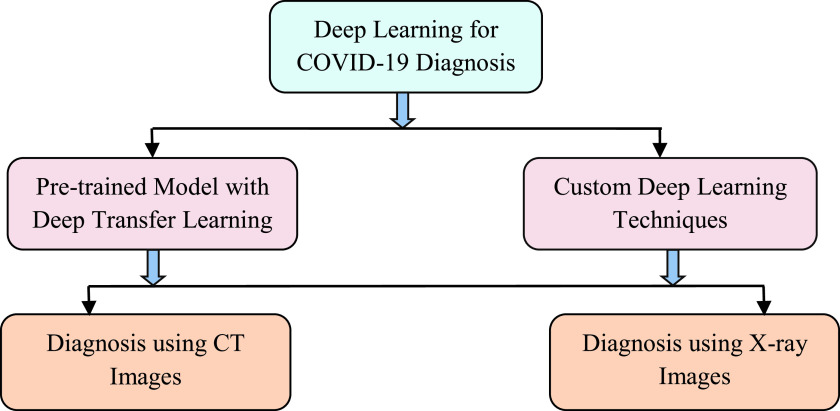
Novel coronavirus (COVID-19) outbreak, has raised a calamitous situation all over the world and has become one of the most acute and severe ailments in the past hundred years. The prevalence rate of COVID-19 is rapidly rising every day throughout the globe. Although no vaccines for this pandemic have been discovered yet, deep learning techniques proved themselves to be a powerful tool in the arsenal used by clinicians for the automatic diagnosis of COVID-19. This paper aims to overview the recently developed systems based on deep learning techniques using different medical imaging modalities like Computer Tomography (CT) and X-ray. This review specifically discusses the systems developed for COVID-19 diagnosis using deep learning techniques and provides insights on well-known data sets used to train these networks. It also highlights the data partitioning techniques and various performance measures developed by researchers in this field. A taxonomy is drawn to categorize the recent works for proper insight. Finally, we conclude by addressing the challenges associated with the use of deep learning methods for COVID-19 detection and probable future trends in this research area. The aim of this paper is to facilitate experts (medical or otherwise) and technicians in understanding the ways deep learning techniques are used in this regard and how they can be potentially further utilized to combat the outbreak of COVID-19.
Keywords: COVID-19; Coronavirus; computer tomography; deep learning; deep transfer learning; diagnosis; x-ray.
This work is licensed under a Creative Commons Attribution 4.0 License. For more information, see https://creativecommons.org/licenses/by/4.0/.
Figures
References
-
- Worldometers. Accessed: Feb. 11, 2021. [Online]. Available: https://www.worldometers.info/coronavirus/
-
- Vetter P., Vu D. L., L’Huillier A. G., Schibler M., Kaiser L., and Jacquerioz F., “Clinical features of COVID-19,” BMJ, vol. 4, Apr. 2020, Art. no. m1470. - PubMed
LinkOut - more resources
Full Text Sources
Miscellaneous