Review
. 2021 Dec 17:9:770655.
doi: 10.3389/fbioe.2021.770655. eCollection 2021.

Strategies for Articular Cartilage Repair and Regeneration

Affiliations
Review

Strategies for Articular Cartilage Repair and Regeneration

Yanxi Liu et al. Front Bioeng Biotechnol. .

Abstract

Articular cartilage is an avascular tissue, with limited ability to repair and self-renew. Defects in articular cartilage can induce debilitating degenerative joint diseases such as osteoarthritis. Currently, clinical treatments have limited ability to repair, for they often result in the formation of mechanically inferior cartilage. In this review, we discuss the factors that affect cartilage homeostasis and function, and describe the emerging regenerative approaches that are informing the future treatment options.

Keywords: articular cartilage; articular cartilage repair; chondrocyte; microenvironment; osteoarthritis; regenerative medicine.


Conflict of interest statement

The authors declare that the research was conducted in the absence of any commercial or financial relationships that could be construed as a potential conflict of interest.

Figures
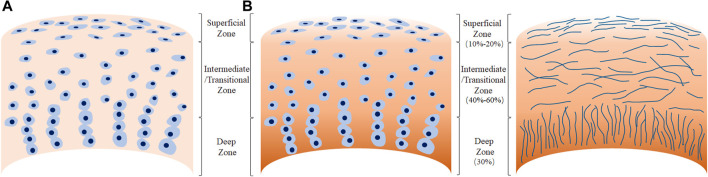
FIGURE 1
FIGURE 1
Morphology of human adult articular cartilage. (A), chondrocytes organization in the different tissue zones. (B), arrangement of collagen fibers.
FIGURE 2
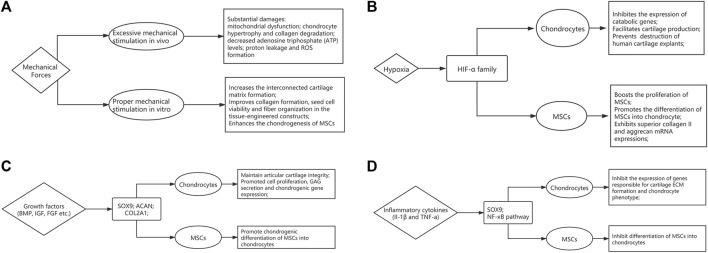
FIGURE 2
The influence of microenvironmental factors on articular cartilage homeostasis and function. The flow-chart describes the effects of (A) mechanical forces, (B) Oxygen tension, (C) growth factors and (D) inflammatory cytokines.

References

    1. Abrams G. D., Frank R. M., Fortier L. A., Cole B. J. (2013). Platelet-rich Plasma for Articular Cartilage Repair. Sports Med. Arthrosc. Rev. 21, 213–219. 10.1097/JSA.0b013e3182999740 - DOI - PubMed
    1. Alcaraz M. J., Compañ A., Guillén M. I. (2019). Extracellular Vesicles from Mesenchymal Stem Cells as Novel Treatments for Musculoskeletal Diseases. Cells 9, 98. 10.3390/cells9010098 - DOI - PMC - PubMed
    1. Armiento A. R., Alini M., Stoddart M. J. (2019). Articular Fibrocartilage - Why Does Hyaline Cartilage Fail to Repair? Adv. Drug Deliv. Rev. 146, 289–305. 10.1016/j.addr.2018.12.015 - DOI - PubMed
    1. Arzi B., Duraine G. D., Lee C. A., Huey D. J., Borjesson D. L., Murphy B. G., et al. (2015). Cartilage Immunoprivilege Depends on Donor Source and Lesion Location. Acta Biomater. 23, 72–81. 10.1016/j.actbio.2015.05.025 - DOI - PMC - PubMed
    1. Athanasiou K. A., Eswaramoorthy R., Hadidi P., Hu J. C. (2013). Self-organization and the Self-Assembling Process in Tissue Engineering. Annu. Rev. Biomed. Eng. 15, 115–136. 10.1146/annurev-bioeng-071812-152423 - DOI - PMC - PubMed