


Experiences and practices of caregiving for older persons living with dementia in African countries: A qualitative scoping review
- PMID: 34978956
- PMCID: PMC9499190
- DOI: 10.1177/14713012211065398
Experiences and practices of caregiving for older persons living with dementia in African countries: A qualitative scoping review
Abstract
Background: The increasing awareness and diagnosis of dementia in Africa necessitate documentation of caregiving practices to understand local patterns and improve the quality of care. Caregiving in African communities is rooted in informal-communal social organization. This scoping review analyses caregiver characteristics and experiences, and practices of caregiving for persons living with dementia in Africa.
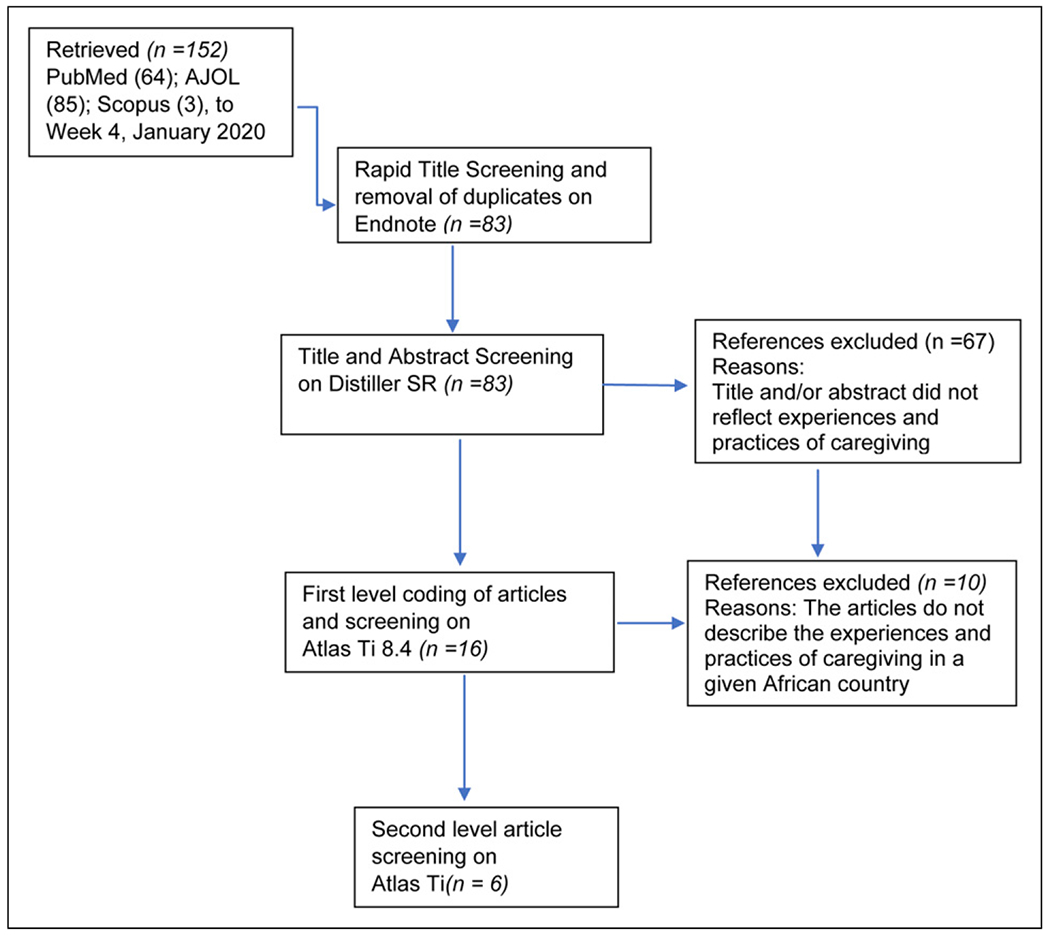
Methods: A total of 152 references were retrieved, with 64 references obtained from PubMed, 85 from AJOL, and three from Scopus. Based on the relevance of titles, 83 references were further retained from PubMed (64), AJOL (16), and Scopus (3). A rapid review of abstracts was done in Distiller SR, and finally, six relevant articles were content-analyzed using Atlas ti 8.4 qualitative analysis software.
Results: All six included studies were published between 2003 and 2018. Four themes were identified: article characteristics, caregiver characteristics, caregiver in context, and caregiver potentialities (challenges and opportunities). Studies reported findings from research conducted in four African countries: three from Nigeria, and one each from South Africa, Egypt, and Tanzania. Caregivers of persons living with dementia typically had eight years or less of formal education, were unpaid, and spent a daily average of 13 hours in caregiving. Cultural thresholds and individual caregiver differences underlie the interpretation of stressors across cultures. Caregivers lack the right training and information as well as support systems to improve their role performance and reduce accumulated stress.
Conclusion: In African countries, informational and educational platforms are essential for improved individual dementia caregiving, vis-à-vis strengthened roles of governments, and religious/traditional leaders and organizations.
Keywords: Africa; caregivers; caregiving; dementia; geriatric; older persons.
Conflict of interest statement
Declaration of conflicting interests
The author(s) declared no potential conflicts of interest with respect to the research, authorship, and/or publication of this article.
Figures
References
-
- Baiyewu O, Smith-Gamble V, Akinbiyi A, Lane KA, Hall KS, Ogunniyi A, & Hendrie HC (2003). Behavioral and caregiver reaction of dementia as measured by the neuropsychiatric inventory in Nigerian community residents. International Psychogeriatrics, 15(4), 399–409. 10.1017/s1041610203009645 - DOI - PubMed
-
- Brown S (2016). Global Aging. In Morgan LA & Kunkel SR (Eds.), Aging, Society, and the life course (Fifth ed., pp. 271–298). Springer Publishing Company.
-
- Clarke C, Keyes S, Wilkinson H, & Alexjuk J (2013). Healthbridge: The national evaluation of peer support networks and dementia advisers in implementation of the national dementia strategy for England. Department of Health.
Publication types
MeSH terms
Grants and funding
LinkOut - more resources
Full Text Sources
Medical
Research Materials
