Review
. 2022 Jul;13(4):e1707.
doi: 10.1002/wrna.1707. Epub 2022 Jan 3.

Uncovering the impacts of alternative splicing on the proteome with current omics techniques

Affiliations
Review

Uncovering the impacts of alternative splicing on the proteome with current omics techniques

Marina Reixachs-Solé et al. Wiley Interdiscip Rev RNA. 2022 Jul.

Abstract

The high-throughput sequencing of cellular RNAs has underscored a broad effect of isoform diversification through alternative splicing on the transcriptome. Moreover, the differential production of transcript isoforms from gene loci has been recognized as a critical mechanism in cell differentiation, organismal development, and disease. Yet, the extent of the impact of alternative splicing on protein production and cellular function remains a matter of debate. Multiple experimental and computational approaches have been developed in recent years to address this question. These studies have unveiled how molecular changes at different steps in the RNA processing pathway can lead to differences in protein production and have functional effects. New and emerging experimental technologies open exciting new opportunities to develop new methods to fully establish the connection between messenger RNA expression and protein production and to further investigate how RNA variation impacts the proteome and cell function. This article is categorized under: RNA Processing > Splicing Regulation/Alternative Splicing Translation > Regulation RNA Evolution and Genomics > Computational Analyses of RNA.

Keywords: RNA processing; alternative splicing; proteome; transcriptomics; translatomics.


Conflict of interest statement

The authors declare no conflicts of interest.

Figures
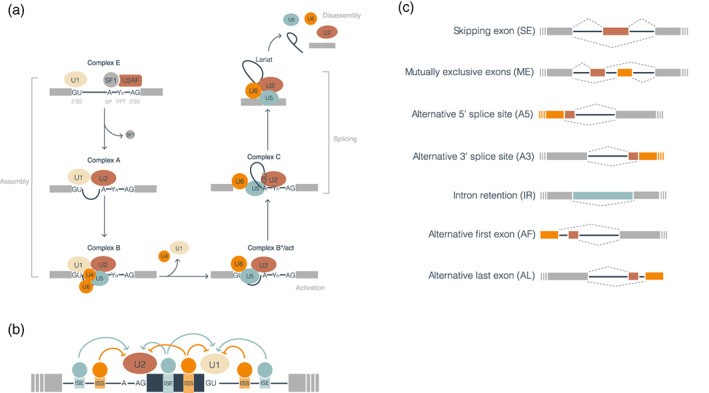
FIGURE 1
FIGURE 1
The mechanisms of splicing and alternative splicing. (a) The complexes and processing steps of splicing for the major spliceosome are depicted. In the assembly phase, U1, U2, U4, U5, and U6 are sequentially assembled in the mRNA molecule resulting in the formation of complex E, complex A, and finally, complex B. The activation phase consists of conformational and compositional rearrangements of complex B involving U2, U5, and U6. Two transesterifications occur as the catalytic complex C adapts its conformation: the first between the 5′ SS and the BP and the second between the 5′ end of the first exon and the 3′ end of the second exon. Finally, the snRNPs still attached to the mRNA disassemble to start a new cycle. (b) Illustration of the regulation of splicing by cis‐ and trans‐acting factors. Cis‐acting factors are represented as boxes in introns and exons. Trans‐acting factors are represented as circles bound to their corresponding cis‐acting elements: exonic splicing enhancer (ESE), exonic splicing silencer (ESS), intronic splicing enhancer (ISE), or intronic splicing silencer (ISS). Silencers are depicted in orange and enhancers in light blue. (c) Schematic representation of alternative splicing events. Gray boxes represent constitutive exons, red and orange boxes represent alternative exons, and a light blue box represents an exonized intron. Discontinuous ends in the exons indicate that the transcript continues in that direction. Thick blue lines represent introns in the transcript before processing, and dashed lines above and below represent the alternative processing of the exons
FIGURE 2
FIGURE 2
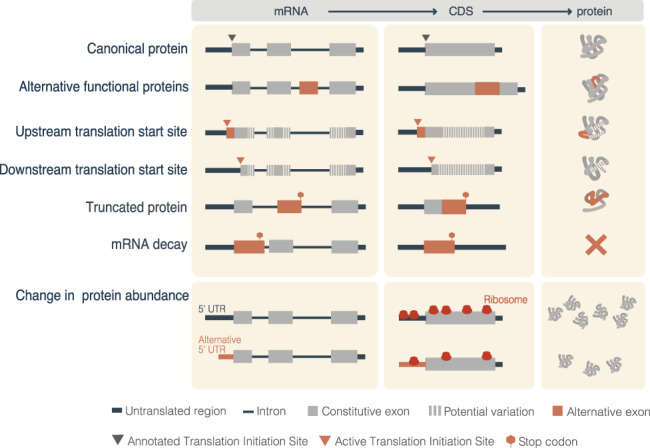
How alternative splicing potentially reshapes the protein products. Alternative splicing (AS) can reshape the proteome in diverse ways. These can be separated into two impacts: changing the protein sequence (upper panels) or altering the amount of protein produced (lower panels). Splicing changes affecting the coding sequences (CDS) can generate alternative proteins with different amino acid sequences, structures, and functions. Similarly, changes in the 5′ end of the mRNA molecule can lead to an alternative initiation site, which results in proteins with different amino‐terminal ends. Both mechanisms could also lead to a shift in the reading frame. Premature stop codons generated through a splicing change can translate into truncated proteins or lead to mRNA decay (Box 2). Finally, translation efficiency can be affected by the inclusion of alternative 5′UTRs through alternative splicing
FIGURE 3
FIGURE 3
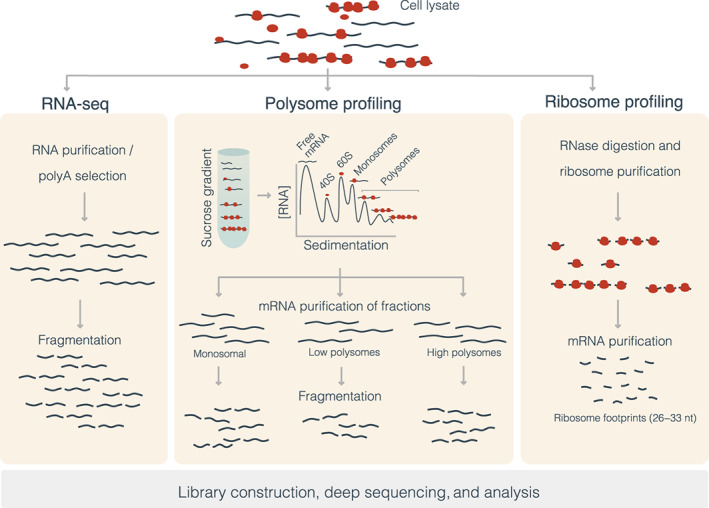
High‐throughput approaches to capture the translatome. RNA sequencing can capture all mRNAs in the cell lysate regardless of its translation status (left panel). Polysome profiling (middle panel) separates fractions of mRNAs according to the number of ribosomes attached to the mRNAs, which is assumed to correlate with the translation activity. Downstream sequencing of RNA in each polysomal fraction is performed as a standard RNA‐seq experiment, and the relative mRNAs abundances are interpreted as mRNA translation activities. In ribosome profiling or Ribo‐seq (right panel), mRNAs bound by the ribosomes are digested, producing footprints of approximately 30 nt representing the mRNA sites occupied by the ribosome. These fragments are then sequenced after detaching the ribosomes

References

    1. Abascal, F. , Ezkurdia, I. , Rodriguez‐Rivas, J. , Rodriguez, J. M. , del Pozo, A. , Vázquez, J. , Valencia, A. , & Tress, M. L. (2015). Alternatively spliced homologous exons have ancient origins and are highly expressed at the protein level. PLoS Computational Biology, 11, e1004325. - PMC - PubMed
    1. Aebersold, R. , & Mann, M. (2003). Mass spectrometry‐based proteomics. Nature, 422, 198–207. - PubMed
    1. Agirre, E. , Bellora, N. , Alló, M. , Pagès, A. , Bertucci, P. , Kornblihtt, A. R. , & Eyras, E. (2015). A chromatin code for alternative splicing involving a putative association between CTCF and HP1α proteins. BMC Biology, 13, 31. - PMC - PubMed
    1. Agirre, E. , Oldfield, A. J. , Bellora, N. , Segelle, A. , & Luco, R. F. (2021). Splicing‐associated chromatin signatures: A combinatorial and position‐dependent role for histone marks in splicing definition. Nature Communications, 12, 682. - PMC - PubMed
    1. Agosto, L. M. , Gazzara, M. R. , Radens, C. M. , Sidoli, S. , Baeza, J. , Garcia, B. A. , & Lynch, K. W. (2019). Deep profiling and custom databases improve detection of proteoforms generated by alternative splicing. Genome Research, 29, 2046–2055. - PMC - PubMed

Publication types

LinkOut - more resources