


Association analysis and functional annotation of imputed sequence data within genomic regions influencing resistance to gastro-intestinal parasites detected by an LDLA approach in a nucleus flock of Sarda dairy sheep
- PMID: 34979909
- PMCID: PMC8722200
- DOI: 10.1186/s12711-021-00690-7
Association analysis and functional annotation of imputed sequence data within genomic regions influencing resistance to gastro-intestinal parasites detected by an LDLA approach in a nucleus flock of Sarda dairy sheep
Abstract
Background: Gastroinestinal nematodes (GIN) are one of the major health problem in grazing sheep. Although genetic variability of the resistance to GIN has been documented, traditional selection is hampered by the difficulty of recording phenotypes, usually fecal egg count (FEC). To identify causative mutations or markers in linkage disequilibrium (LD) to be used for selection, the detection of quantitative trait loci (QTL) for FEC based on linkage disequilibrium-linkage analysis (LDLA) was performed on 4097 ewes (from 181 sires) all genotyped with the OvineSNP50 Beadchip. Identified QTL regions (QTLR) were imputed from whole-genome sequences of 56 target animals of the population. An association analysis and a functional annotation of imputed polymorphisms in the identified QTLR were performed to pinpoint functional variants with potential impact on candidate genes identified from ontological classification or differentially expressed in previous studies.
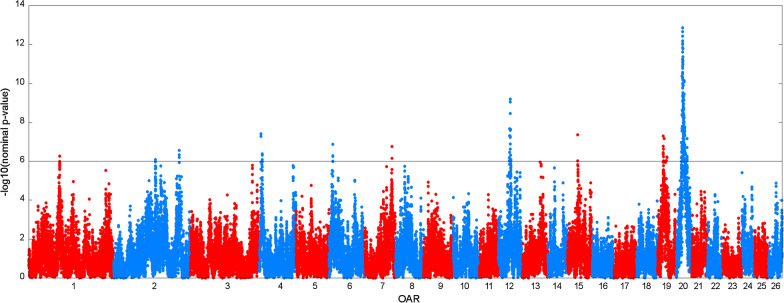
Results: After clustering close significant locations, ten QTLR were defined on nine Ovis aries chromosomes (OAR) by LDLA. The ratio between the ANOVA estimators of the QTL variance and the total phenotypic variance ranged from 0.0087 to 0.0176. QTL on OAR4, 12, 19, and 20 were the most significant. The combination of association analysis and functional annotation of sequence data did not highlight any putative causative mutations. None of the most significant SNPs showed a functional effect on genes' transcript. However, in the most significant QTLR, we identified genes that contained polymorphisms with a high or moderate impact, were differentially expressed in previous studies, contributed to enrich the most represented GO process (regulation of immune system process, defense response). Among these, the most likely candidate genes were: TNFRSF1B and SELE on OAR12, IL5RA on OAR19, IL17A, IL17F, TRIM26, TRIM38, TNFRSF21, LOC101118999, VEGFA, and TNF on OAR20.
Conclusions: This study performed on a large experimental population provides a list of candidate genes and polymorphisms which could be used in further validation studies. The expected advancements in the quality of the annotation of the ovine genome and the use of experimental designs based on sequence data and phenotypes from multiple breeds that show different LD extents and gametic phases may help to identify causative mutations.
© 2021. The Author(s).
Conflict of interest statement
The authors declare that they have no competing interests.
Figures
References
-
- Kaplan RM, Vidyashankar AN. An inconvenient truth: Global worming and anthelmintic resistance. Vet Parasitol. 2012;186:70–78. - PubMed
-
- Geurden T, Hoste H, Jacquiet P, Traversa D, Sotiraki S, Frangipane di Regalbono A, et al. Anthelmintic resistance and multidrug resistance in sheep gastro-intestinal nematodes in France, Greece and Italy. Vet Parasitol. 2014;201:59–66. - PubMed
-
- Aguiar de Oliveira P, Riet-Correa B, Estima-Silva P, Coelho ACB, dos Santos BL, Costa MAP, et al. Multiple anthelmintic resistance in Southern Brazil sheep flocks. Rev Bras Parasitol Vet. 2017;26:427–32. - PubMed
-
- Sargison ND, Jackson F, Bartley DJ, Wilson DJ, Stenhouse LJ, Penny CD. Observations on the emergence of multiple anthelmintic resistance in sheep flocks in the south-east of Scotland. Vet Parasitol. 2007;145:65–76. - PubMed
MeSH terms
LinkOut - more resources
Full Text Sources
Research Materials
