


Charting the evidence for climate change impacts on the global spread of malaria and dengue and adaptive responses: a scoping review of reviews
- PMID: 34980187
- PMCID: PMC8725488
- DOI: 10.1186/s12992-021-00793-2
Charting the evidence for climate change impacts on the global spread of malaria and dengue and adaptive responses: a scoping review of reviews
Abstract
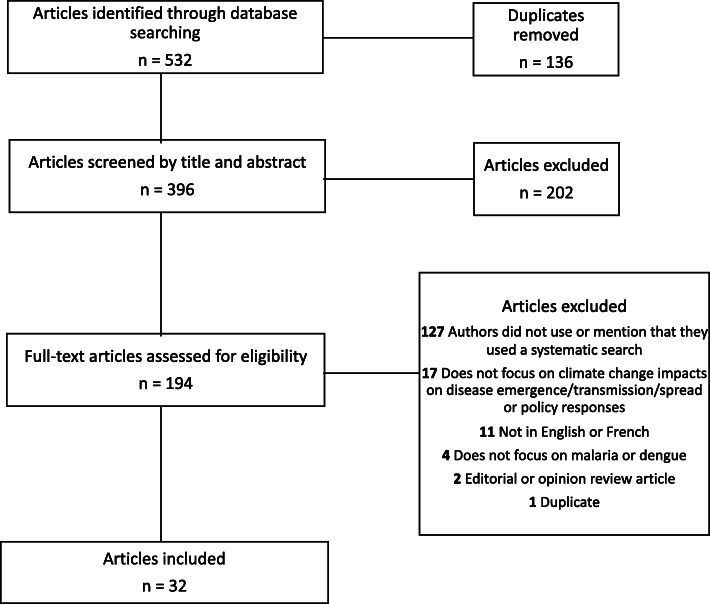
Background: Climate change is expected to alter the global footprint of many infectious diseases, particularly vector-borne diseases such as malaria and dengue. Knowledge of the range and geographical context of expected climate change impacts on disease transmission and spread, combined with knowledge of effective adaptation strategies and responses, can help to identify gaps and best practices to mitigate future health impacts. To investigate the types of evidence for impacts of climate change on two major mosquito-borne diseases of global health importance, malaria and dengue, and to identify the range of relevant policy responses and adaptation strategies that have been devised, we performed a scoping review of published review literature. Three electronic databases (PubMed, Scopus and Epistemonikos) were systematically searched for relevant published reviews. Inclusion criteria were: reviews with a systematic search, from 2007 to 2020, in English or French, that addressed climate change impacts and/or adaptation strategies related to malaria and/or dengue. Data extracted included: characteristics of the article, type of review, disease(s) of focus, geographic focus, and nature of the evidence. The evidence was summarized to identify and compare regional evidence for climate change impacts and adaptation measures.
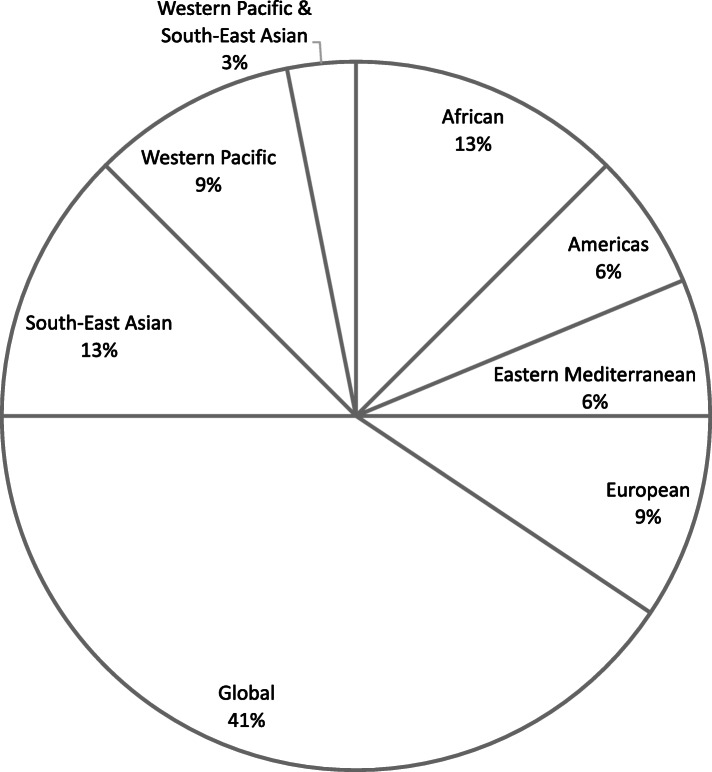
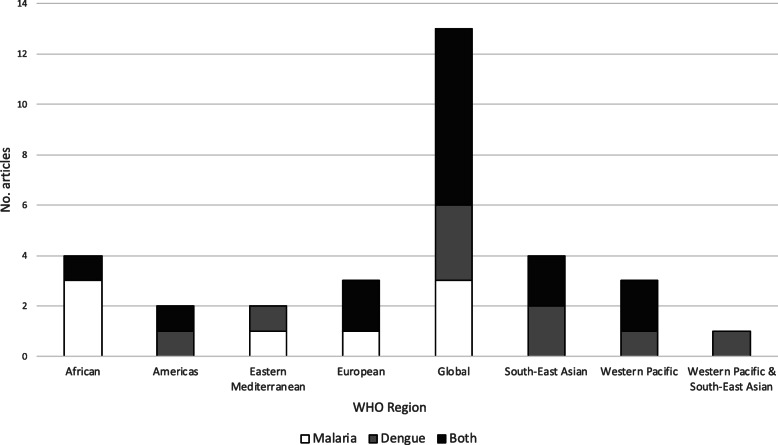
Results: A total of 32 reviews met the inclusion criteria. Evidence for the impacts of climate change (including climate variability) on dengue was greatest in the Southeast Asian region, while evidence for the impacts of climate change on malaria was greatest in the African region, particularly in highland areas. Few reviews explicitly addressed the implementation of adaptation strategies to address climate change-driven disease transmission, however suggested strategies included enhanced surveillance, early warning systems, predictive models and enhanced vector control.
Conclusions: There is strong evidence for the impacts of climate change, including climate variability, on the transmission and future spread of malaria and dengue, two of the most globally important vector-borne diseases. Further efforts are needed to develop multi-sectoral climate change adaptation strategies to enhance the capacity and resilience of health systems and communities, especially in regions with predicted climatic suitability for future emergence and re-emergence of malaria and dengue. This scoping review may serve as a useful precursor to inform future systematic reviews of the primary literature.
Keywords: Adaptation; Climate change; Dengue; Malaria; Vector-borne disease.
© 2021. The Author(s).
Conflict of interest statement
The authors declare that they have no competing interests.
Figures

References
-
- IPCC. Climate change 2014: Synthesis Report, Contribution of Working Groups I, II and III to the Fifth Assessment Report of the Intergovernmental Panel on Climate Change. [Core Writing Team, R.K. Pachauri and L.A. Meyer (eds.)]. IPCC, Geneva, Switzerland; 2014. 151 pp.
-
- IPCC. Summary for Policymakers. In: Climate change 2021: The Physical Science Basis. Contribution of Working Group I to the Sixth Assessment Report of the Intergovernmental Panel on Climate Change. [MassonDelmotte V, Zhai P, Pirani A, Connors SL, Péan C, Berger S, Caud N, Chen Y, Goldfarb L, Gomis MI, Huang M, Leitzell K, Lonnoy E, Matthews JBR, Maycock TK, Waterfield T, Yelekçi O, Yu R, BZ, editors]. Cambridge University Press, Cambridge, UK; 2021. In Press.
-
- IPCC. Summary for Policymakers. In: Global Warming of 1.5°C. An IPCC Special Report on the impacts of global warming of 1.5°C above pre-industrial levels and related global greenhouse gas emission pathways, in the context of strengthening the global response to the threat of climate change, sustainable development, and efforts to eradicate poverty. [Masson-Delmotte, V., P. Zhai, H.-O. Pörtner, D. Roberts, J. Skea, P.R. Shukla, A. Pirani, W. Moufouma-Okia, C. Péan, R. Pidcock, S. Connors, J.B.R. Matthews, Y. Chen, X. Zhou, M.I. Gomis, E. Lonnoy, T. Maycock, M. Tignor, and T. Waterfield (eds.)]. World Meteorological Organization, Geneva, Switzerland; 2018. 32 pp.
-
- WHO. World Malaria Report 2019. World Health Organization, Geneva, Switzerland; 2020.
Publication types
MeSH terms
LinkOut - more resources
Full Text Sources
Medical
Miscellaneous
