


Social Mobile Approaches to Reducing Weight (SMART) 2.0: protocol of a randomized controlled trial among young adults in university settings
- PMID: 34980208
- PMCID: PMC8721474
- DOI: 10.1186/s13063-021-05938-7
Social Mobile Approaches to Reducing Weight (SMART) 2.0: protocol of a randomized controlled trial among young adults in university settings
Abstract
Background: Excess weight gain in young adulthood is associated with future weight gain and increased risk of chronic disease. Although multimodal, technology-based weight-loss interventions have the potential to promote weight loss among young adults, many interventions have limited personalization, and few have been deployed and evaluated for longer than a year. We aim to assess the effects of a highly personalized, 2-year intervention that uses popular mobile and social technologies to promote weight loss among young adults.
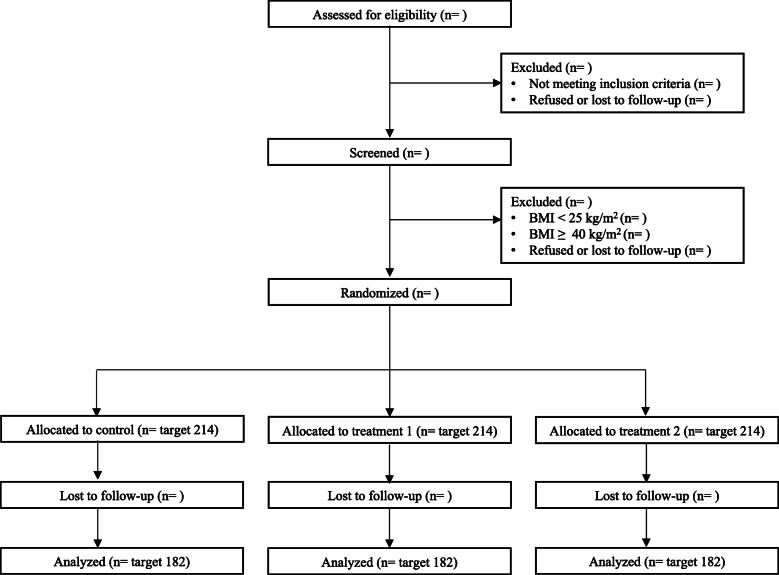
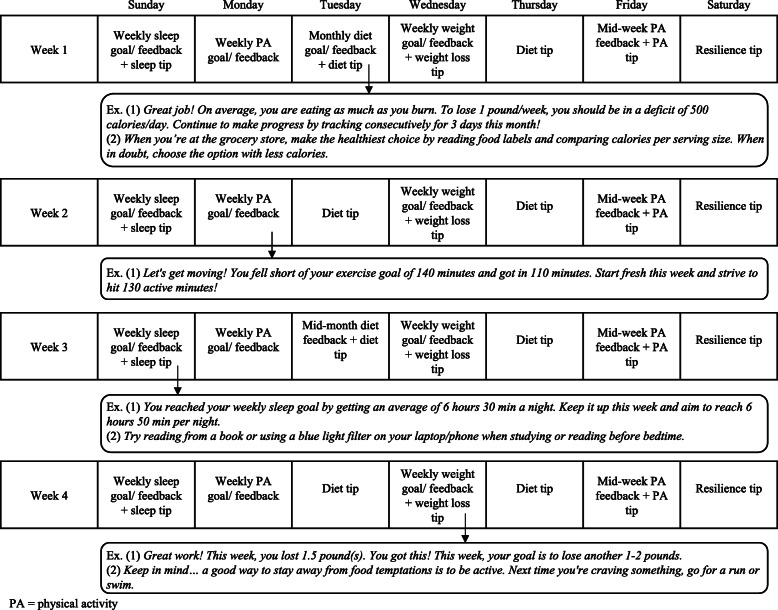
Methods: The Social Mobile Approaches to Reducing Weight (SMART) 2.0 Study is a 24-month parallel-group randomized controlled trial that will include 642 overweight or obese participants, aged 18-35 years, from universities and community colleges in San Diego, CA. All participants receive a wearable activity tracker, connected scale, and corresponding app. Participants randomized to one intervention group receive evidence-based information about weight loss and behavior change techniques via personalized daily text messaging (i.e., SMS/MMS), posts on social media platforms, and online groups. Participants in a second intervention group receive the aforementioned elements in addition to brief, technology-mediated health coaching. Participants in the control group receive a wearable activity tracker, connected scale, and corresponding app alone. The primary outcome is objectively measured weight in kilograms over 24 months. Secondary outcomes include anthropometric measurements; physiological measures; physical activity, diet, sleep, and psychosocial measures; and engagement with intervention modalities. Outcomes are assessed at baseline and 6, 12, 18, and 24 months. Differences between the randomized groups will be analyzed using a mixed model of repeated measures and will be based on the intent-to-treat principle.
Discussion: We hypothesize that both SMART 2.0 intervention groups will significantly improve weight loss compared to the control group, and the group receiving health coaching will experience the greatest improvement. We further hypothesize that differences in secondary outcomes will favor the intervention groups. There is a critical need to advance understanding of the effectiveness of multimodal, technology-based weight-loss interventions that have the potential for long-term effects and widespread dissemination among young adults. Our findings should inform the implementation of low-cost and scalable interventions for weight loss and risk-reducing health behaviors.
Trial registration: ClinicalTrials.gov NCT03907462 . Registered on April 9, 2019.
Keywords: Digital health; Health coaching; Randomized controlled trial; Social media; Wearables; Weight loss; Young adults.
© 2021. The Author(s).
Conflict of interest statement
The authors declare that they have no competing interests.
Figures
References
-
- Office of the Surgeon General (US), Office of Disease Prevention and Health Promotion (US), Centers for Disease Control and Prevention (US), National Institutes of Health (US) The surgeon general’s call to action to prevent and decrease overweight and obesity. US: Office of the Surgeon General; 2001. - PubMed
-
- Committee on Accelerating Progress in Obesity Prevention, Food and Nutrition Board, Institute of Medicine . In: Accelerating progress in obesity prevention: solving the weight of the nation. Glickman D, Parker L, Sim LJ, Del Valle Cook H, Miller EA, editors. US: National Academies Press; 2012. - PubMed
-
- Health, United States 2019: Table 26. National Center for Health Statistics; 2021:9. https://www.cdc.gov/nchs/hus/contents2019.htm. Accessed 28 July 2021. - PubMed
-
- U.S. Bureau of Labor Statistics. College enrollment and work activity of recent high school and college graduates summary. Published April 27, 2021. Accessed 10 May 2021. https://www.bls.gov/news.release/hsgec.nr0.htm
Publication types
MeSH terms
Associated data
Grants and funding
LinkOut - more resources
Full Text Sources
Medical
Miscellaneous
