Review
. 2022 Jan 4;132(1):e148559.
doi: 10.1172/JCI148559.

Addressing dyslipidemic risk beyond LDL-cholesterol

Affiliations
Review

Addressing dyslipidemic risk beyond LDL-cholesterol

Alan R Tall et al. J Clin Invest. .

Abstract

Despite the success of LDL-lowering drugs in reducing cardiovascular disease (CVD), there remains a large burden of residual disease due in part to persistent dyslipidemia characterized by elevated levels of triglyceride-rich lipoproteins (TRLs) and reduced levels of HDL. This form of dyslipidemia is increasing globally as a result of the rising prevalence of obesity and metabolic syndrome. Accumulating evidence suggests that impaired hepatic clearance of cholesterol-rich TRL remnants leads to their accumulation in arteries, promoting foam cell formation and inflammation. Low levels of HDL may associate with reduced cholesterol efflux from foam cells, aggravating atherosclerosis. While fibrates and fish oils reduce TRL, they have not been uniformly successful in reducing CVD, and there is a large unmet need for new approaches to reduce remnants and CVD. Rare genetic variants that lower triglyceride levels via activation of lipolysis and associate with reduced CVD suggest new approaches to treating dyslipidemia. Apolipoprotein C3 (APOC3) and angiopoietin-like 3 (ANGPTL3) have emerged as targets for inhibition by antibody, antisense, or RNAi approaches. Inhibition of either molecule lowers TRL but respectively raises or lowers HDL levels. Large clinical trials of such agents in patients with high CVD risk and elevated levels of TRL will be required to demonstrate efficacy of these approaches.


Conflict of interest statement

Conflict of interest: ART is on the scientific advisory board and is a cofounder of Staten Biotechnology and has consulted for Amgen, Commonwealth Serum Laboratories, the Medicines Company, AstraZeneca, and Foresite Labs. IJG has received laboratory support and consulting fees from Arrowhead Pharmaceuticals and has consulted for Ionis Pharmaceuticals/Akcea Therapeutics.

Figures

Figure 1
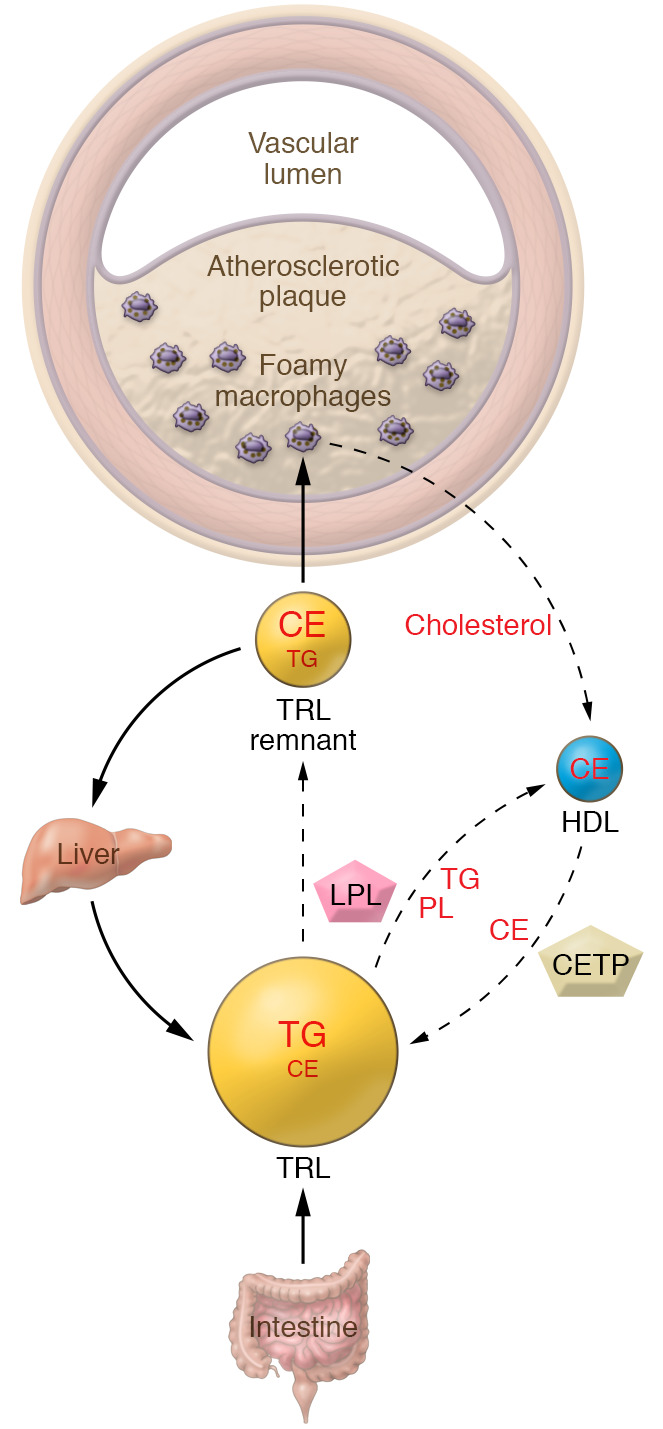
Figure 1. Lipoprotein modulation of atherosclerosis, beyond LDL.
Circulating lipoproteins other than LDL modulate the development of atherosclerosis. Animal and human data show that cholesteryl ester–rich lipoproteins derived from the partial catabolism of TRLs, referred to as remnants, are taken up by macrophage foam cells in arteries, promoting development of atherosclerotic plaques. The catabolism of TRLs also mediates enrichment of HDL with phospholipids, increasing their ability to promote efflux of cholesterol from foam cells and thus ameliorating atherosclerosis. The interchange of lipids between HDL and TRL is mediated by cholesteryl ester transfer protein (CETP) and phospholipid transfer protein (not shown). CE, cholesteryl ester; LPL, lipoprotein lipase; PL, phospholipids.
Figure 2
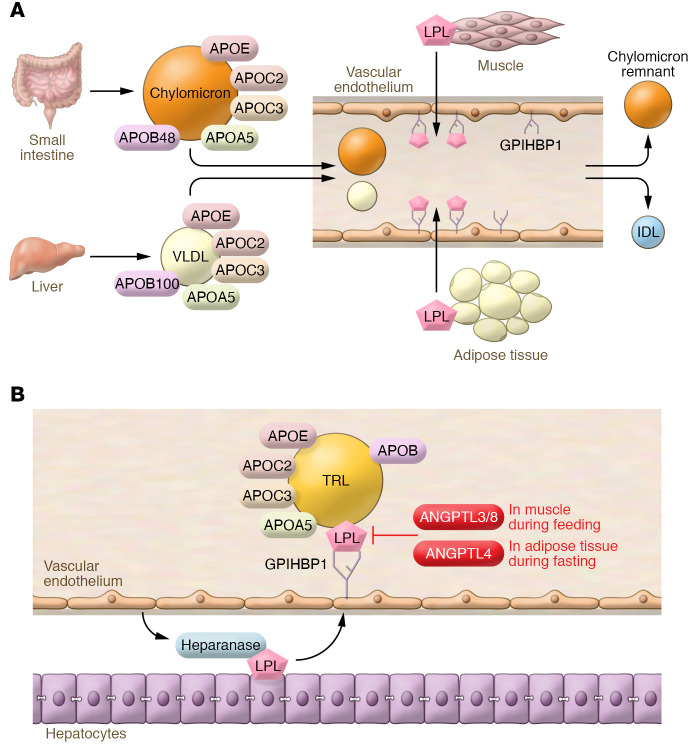
Figure 2. Lipolysis and TRL metabolism.
(A) Lipolysis of circulating TRLs. Chylomicrons assembled in the small intestine and VLDL assembled in the liver contain proteins that control their intravascular metabolism. APOC2 is the activator of LPL. APOA5 also acts to enhance lipolysis, while APOC3 inhibits lipolysis. LPL is predominantly synthesized in adipose tissue, skeletal muscle, and heart. LPL transfers to the capillary lumen, where it associates with glycosylphosphatidylinositol-anchored HDL-binding protein 1 (GPIHBP1), releases free fatty acids from TRLs, and creates chylomicron remnants and intermediate-density lipoproteins (IDLs). (B) Lipolysis reaction. TRLs associate with LPL in the capillary lumen, a process thought to be assisted by APOA5. APOC2 activates LPL; APOC3 inhibits LPL. ANGPTLs also inhibit LPL. ANGPTL3, primarily produced in the liver, is most active in complex with ANGPTL8. ANGPTL4, though widely expressed, modulates LPL activity especially in adipose tissue.
Figure 3
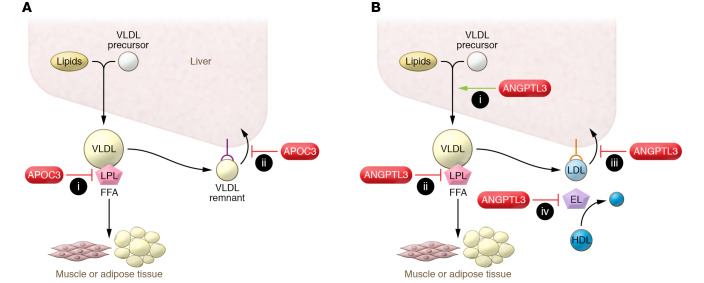
Figure 3. Two potential new therapies to reduce TRLs.
(A) APOC3 depletion via knockdown in the liver or antibody inhibition in the circulation reduces circulating TG levels via two mechanisms: (i) removal of APOC3 releases its inhibition of LPL and increases intravascular lipolysis, and (ii) loss of APOC3 promotes uptake of TRL in the liver. (B) ANGPTL3 depletion reduces TRLs and LDL via (i) reduced liver TG secretion; (ii) increased intravascular lipolysis; and increased hepatic removal via either (iii) LDLR-dependent, non–endothelial lipase–dependent or (iv) non–LDLR-dependent, endothelial lipase–dependent processes. HDL levels decrease with ANGPTL3 loss as a result of activation of endothelial lipase. EL, endothelial lipase; FFA, free fatty acid.

References

    1. Vallejo-Vaz AJ, et al. Triglyceride-rich lipoprotein cholesterol and risk of cardiovascular events among patients receiving statin therapy in the TNT trial. Circulation. 2018;138(8):770–781. doi: 10.1161/CIRCULATIONAHA.117.032318. - DOI - PubMed
    1. Cannon CP, et al. Ezetimibe added to statin therapy after acute coronary syndromes. N Engl J Med. 2015;372(25):2387–2397. doi: 10.1056/NEJMoa1410489. - DOI - PubMed
    1. Sabatine MS, et al. Evolocumab and clinical outcomes in patients with cardiovascular disease. N Engl J Med. 2017;376(18):1713–1722. doi: 10.1056/NEJMoa1615664. - DOI - PubMed
    1. Jun M, et al. Effects of fibrates on cardiovascular outcomes: a systematic review and meta-analysis. Lancet. 2010;375(9729):1875–1884. doi: 10.1016/S0140-6736(10)60656-3. - DOI - PubMed
    1. Bhatt DL, et al. Cardiovascular risk reduction with icosapent ethyl for hypertriglyceridemia. N Engl J Med. 2019;380(1):11–22. doi: 10.1056/NEJMoa1812792. - DOI - PubMed

Publication types

MeSH terms