Estimated Prevalence of Risk Factors for Preeclampsia Among Individuals Giving Birth in the US in 2019
- PMID: 34982156
- PMCID: PMC8728614
- DOI: 10.1001/jamanetworkopen.2021.42343
Estimated Prevalence of Risk Factors for Preeclampsia Among Individuals Giving Birth in the US in 2019
Abstract
Importance: Low-dose aspirin (LDA) is one of the few evidence-based interventions for preventing preeclampsia, which is a leading cause of maternal or fetal morbidity and mortality. Current guidelines recommend LDA based on the presence of risk factors for preeclampsia, but the population-based prevalence of these factors is unknown.
Objective: To estimate population-level prevalence of preeclampsia risk factors used in prophylactic LDA guidelines for pregnant patients and the association of these risk factors with reported rates of pregnancy-related hypertension.
Design, setting, and participants: A retrospective cohort study was conducted using National Center for Health Statistics birth certificate data to describe the frequency of pregnant individuals with moderate to high-risk factors for preeclampsia and pregnancy-related hypertension rates. The study used all birth records in the United States for the 2019 calendar year.
Exposures: Documentation of preeclampsia risk factors: multifetal gestation, pregestational diabetes, chronic hypertension (high-risk factors) and nulliparity, a body mass index greater than 30, African American race, a maternal age 35 years or older, an interval of more than 10-years since last birth, and having low socioeconomic status (moderate risk factors).
Main outcomes and measures: Prevalence of each risk factor alone and in combinations leading to a recommendation for LDA; incidence of pregnancy-related hypertension by risk factor and combinations of risk factors.
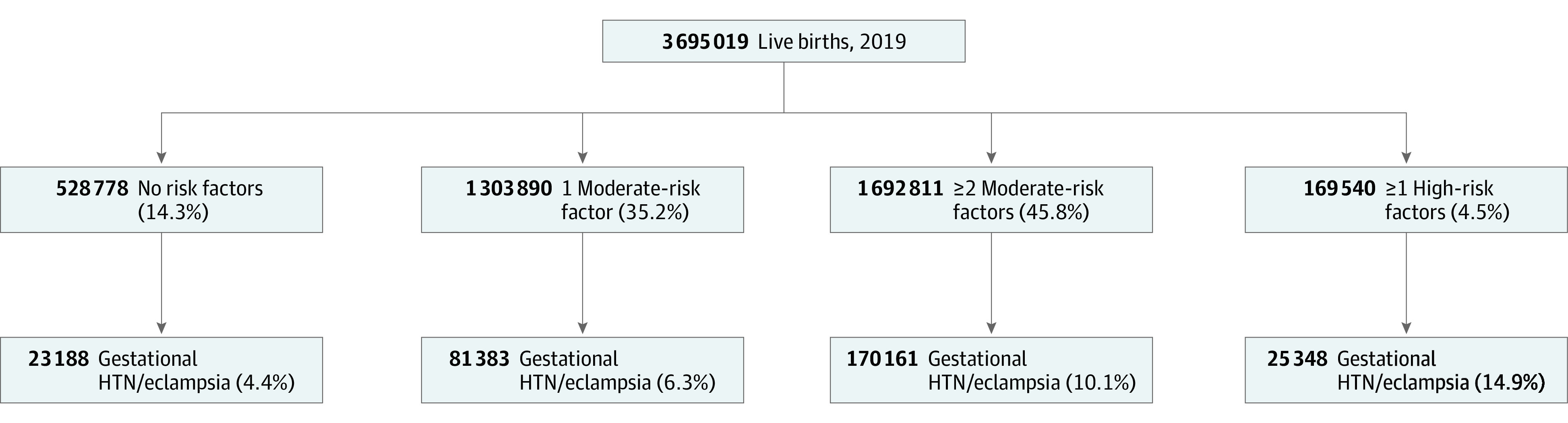
Results: There were 3 695 019 pregnancies in 2019, including 528 778 with no risk factors, 169 540 with 1 or more high-risk factors, and 2 996 701 with 1 or more moderate-risk factors. The mean (SD) of the cohort was 29.1 (5.8) years. Multifetal gestation was the most common high-risk factor and found in 123 995 pregnancies (3.4%), and low socioeconomic status was the most common moderate-risk factor and present in 1 732 729 pregnancies (46.9%). Based on 2021 criteria (a single high- or moderate-risk factors for preeclampsia), 3 166 241 pregnant patients (85.7%) were eligible for LDA. The incidence of pregnancy-related hypertension increased with the number of moderate-risk factors. The 2021 guidelines suggest considering or recommend LDA in 92.3% of pregnancies diagnosed with pregnancy-related hypertension.
Conclusions and relevance: These data support the recently published guidelines and suggest further simplified guidelines recommending LDA to patients with any single moderate-risk factors.
Conflict of interest statement
Figures