Review
. 2022 Mar;19(3):432-444.
doi: 10.1038/s41423-021-00781-x. Epub 2022 Jan 5.

Diet, lipids, and antitumor immunity

Affiliations
Review

Diet, lipids, and antitumor immunity

Hannah Prendeville et al. Cell Mol Immunol. 2022 Mar.

Abstract

Tumour growth and dissemination is largely dependent on nutrient availability. It has recently emerged that the tumour microenvironment is rich in a diverse array of lipids that increase in abundance with tumour progression and play a role in promoting tumour growth and metastasis. Here, we describe the pro-tumorigenic roles of lipid uptake, metabolism and synthesis and detail the therapeutic potential of targeting lipid metabolism in cancer. Additionally, we highlight new insights into the distinct immunosuppressive effects of lipids in the tumour microenvironment. Lipids threaten an anti-tumour environment whereby metabolic adaptation to lipid metabolism is linked to immune dysfunction. Finally, we describe the differential effects of commondietary lipids on cancer growth which may uncover a role for specific dietary regimens in association with traditional cancer therapies. Understanding the relationship between dietary lipids, tumour, and immune cells is important in the context of obesity which may reveal a possibility to harness the diet in the treatment of cancers.

Keywords: Lipids; anti-tumour immunity; cancer; obesity; β-oxidation.


Conflict of interest statement

The authors declare no competing interests.

Figures
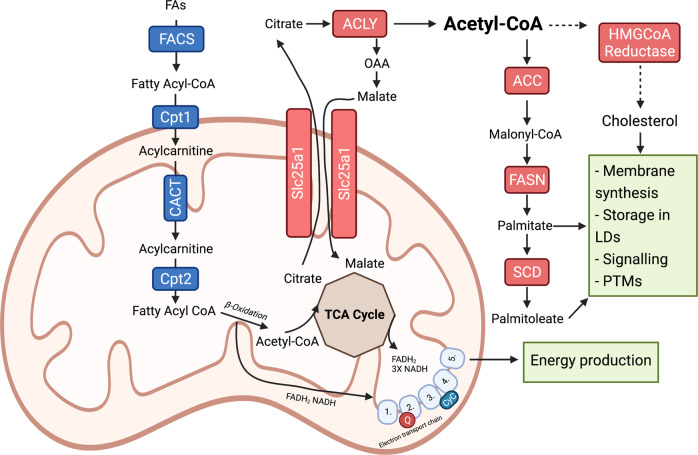
Fig. 1
Fig. 1
Overview of lipid metabolism. Lipid metabolism consists of two distinct arms, namely, fatty acid oxidation (β-oxidation) and lipid synthesis. The peroxisome proliferator-activated receptor (PPAR) family of transcription factors regulates the expression of genes involved in β-oxidation, as depicted in blue. However, the sterol regulatory element binding protein (SREBP) family of transcription factors controls the expression of enzymes and transport proteins required for fatty acid and cholesterol synthesis, as shown in red. Briefly, cytosolic fatty acids (FAs) are activated by fatty acyl-CoA synthetase (FACS), which introduces a CoA adduct, yielding fatty acyl-CoA. Long-chain fatty acyls enter the mitochondria for oxidation via the carnitine shuttle system. Carnitine palmitoyl-transferase 1 (Cpt1), located on the outer mitochondrial membrane, exchanges the CoA adduct for a carnitine molecule, forming acylcarnitine. Acylcarnitines are transported into the mitochondrial matrix through carnitine acyl-carnitine translocase (CACT), where they are reconverted back to fatty acyl-CoA by the action of Cpt2. Once inside the matrix, fatty acyl-CoA undergoes a series of dehydration, hydration and thiolysis reactions (β-oxidation), which generate NADH and FADH2 reducing equivalents and acetyl-CoA. NADH and FADH2 donate electrons to complexes 1 and 2 of the electron transport chain and acetyl-CoA enters the tricarboxylic acid (TCA) cycle. In the TCA cycle, acetyl-CoA is converted into citrate, which may be exported to the cytosol through Slc25a1. The enzyme ATP citrate lyase (ACLY) catalyses the conversion of cytosolic citrate to acetyl-CoA, which is an important step in endogenous lipid synthesis. Cytosolic acetyl-CoA is converted to malonyl-CoA through the action of acetyl-CoA carboxylase (ACC), which together form the major substrates for fatty acid synthesis by the multienzyme complex fatty acid synthase (FASN). FASN catalyzes the synthesis of palmitic acid, a 16 carbon saturated fatty acid, which may be converted into palmitoleic acid, a 16-carbon unsaturated fatty acid through the action of stearoyl-CoA desaturase (SCD). In addition, cytosolic acetyl-CoA may enter the mevalonate pathway, resulting in the production of cholesterol and other steroids. Together, fatty acids and cholesterol play an important role in membrane synthesis and signaling and can also be stored in lipid droplets to be later used as a fuel source
Fig. 2
Fig. 2
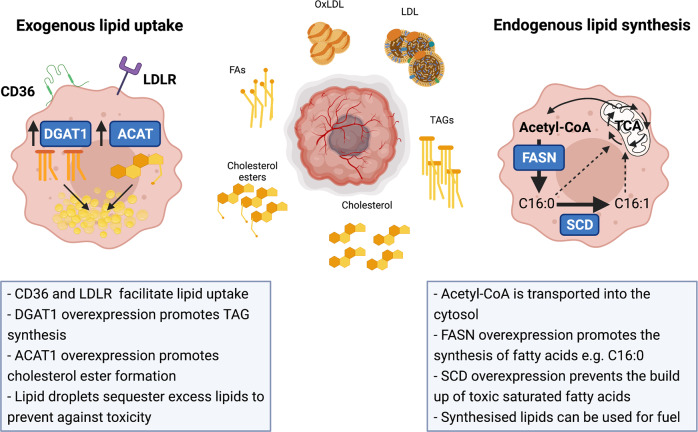
Tumor interstitial fluids (TIFs) contain a diverse array of lipids that promote tumor growth and metastasis. The tumor interstitial fluid is rich in a diverse array of lipids, including free fatty acids (FAs), low-density lipoproteins (LDLs), oxidized LDLs (OxLDLs), cholesterol, cholesterol esters and triacylglycerols (TAGs). Tumor cells express a range of cell surface receptors to facilitate the uptake of lipids, including the scavenger receptor CD36 and the LDL receptor. Overexpression of Diglyceride acetyltransferase 1 (DGAT1) is a common feature of many tumors. DGAT1 is responsible for the synthesis of TAGs from FAs, which can then be stored in lipid droplets (LDs). Acyl cholesterol acyltransferase (ACAT) is also overexpressed in many tumors. ACAT plays a key role in cholesterol homeostasis by catalyzing the formation of cholesterol esters from free cholesterol and FAs. Together, TAGs and cholesterol esters form the major components of LDs. LDs are a feature of many tumor cells and promote lipid homeostasis by sequestering excess intracellular lipids to prevent lipotoxicity, peroxidation and ferroptosis. Fatty acids may also be synthesised endogenously from cytosolic acetyl-CoA. Fatty acid synthase (FASN) expression is a feature of many cancers and catalyses the production of palmitic acid. Palmitic acid can be converted to the monounsaturated fatty acid (MUFA) palmitoleic acid to protect against the toxic effects of saturated fatty acids (SFAs) such as palmitic acid
Fig. 3
Fig. 3
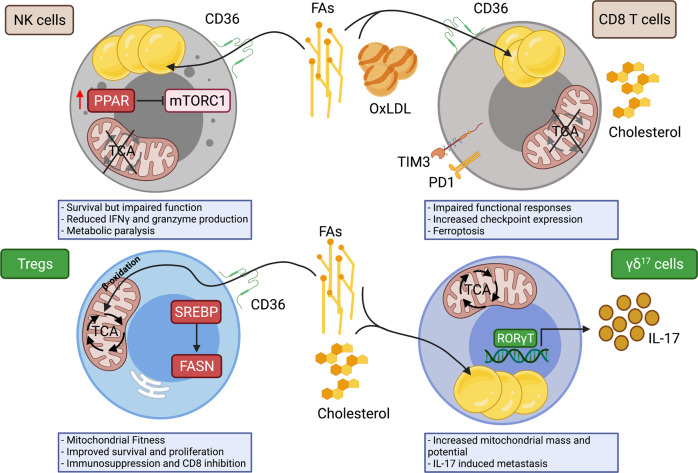
Lipids differentially affect immune populations while overall promoting an immunosuppressive phenotype. Lipids have emerged as an enemy of an antitumor environment because they suppress cytotoxic antitumor NK and CD8 T cells while promoting the survival and protumorigenic roles of Tregs and γδ17 cells. In the presence of FAs, NK cells display increased expression of the scavenger receptor CD36, which leads to the accumulation of intracellular lipids. In response to lipids, NK cells activate a PPAR-dependent lipid metabolism transcriptional program, which leads to the inhibition of the mTORC1 protein complex. Loss of mTORC1 signaling results in a state of metabolic paralysis, resulting in reduced cytotoxicity and impaired IFNγ and granzyme B production. CD8 T cells also display increased expression of CD36 and markers of functional exhaustion, including PD-1 and TIM-3, in lipid-rich tumor environments. In addition to FAs, CD8 T cells may also transport OxLDL through CD36, which enhances lipid peroxidation, resulting in ferroptosis. Together, these metabolic adaptations to a lipid-rich environment result in impaired functional responses and cultivate a protumorigenic environment. On the other hand, lipid uptake and synthesis have been shown to promote Treg immunosuppression in many tumor models. Intratumoral Tregs display heightened expression of CD36, which provides lipids to activate a PPAR-dependent lipid metabolism program that is essential for their survival, proliferation and protumor functions. Intratumoral Tregs also increase the expression of SREBPs, leading to the de novo synthesis of FAs and cholesterol. Similarly, protumorigenic γδ17 cells rely on lipid uptake and metabolism to regulate IL-17 production. γδ17 cells display increased mitochondrial mass and potential to support heightened rates of lipid metabolism. IL-17 is important for promoting neutrophil-mediated cancer metastasis, highlighting the role of lipids in promoting primary and metastatic cancer progression

References

    1. Otto AM. Metabolic constants and plasticity of cancer cells in a limiting glucose and glutamine microenvironment—A pyruvate perspective. Front Oncol. 2020;10:2542. - PMC - PubMed
    1. Reinfeld BI, Madden MZ, Wolf MM, Chytil A, Bader JE, Patterson AR, et al. Cellprogrammed nutrient partitioning in the tumour microenvironment. Nature. 2021;593:282–8. - PMC - PubMed
    1. Zhang Y, Kurupati R, Liu L, Zhou XY, Zhang G, Hudaihed A, et al. Enhancing CD8+ T cell fatty acid catabolism within a metabolically challenging tumor microenvironment increases the efficacy of melanoma immunotherapy. Cancer Cell. 2017;32:377–e9. - PMC - PubMed
    1. Xu S, Chaudhary O, Rodríguez-Morales P, Sun X, Chen D, Zappasodi R, et al. Uptake of oxidized lipids by the scavenger receptor CD36 promotes lipid peroxidation and dysfunction in CD8+ T cells in tumors. Immunity. 2021;54:10–1577.e7. - PMC - PubMed
    1. Bechmann LP, Hannivoort RA, Gerken G, Hotamisligil GS, Trauner M, Canbay A. The interaction of hepatic lipid and glucose metabolism in liver diseases. J Hepatol. 2012;56:952–64. - PubMed