Review
. 2021 Oct 11;1(12):2089-2099.
doi: 10.1021/jacsau.1c00352. eCollection 2021 Dec 27.

Toward Glycomaterials with Selectivity as Well as Affinity

Affiliations
Review

Toward Glycomaterials with Selectivity as Well as Affinity

Sarah-Jane Richards et al. JACS Au. .

Abstract

Multivalent glycosylated materials (polymers, surfaces, and particles) often show high affinity toward carbohydrate binding proteins (e.g., lectins) due to the nonlinear enhancement from the cluster glycoside effect. This affinity gain has potential in applications from diagnostics, biosensors, and targeted delivery to anti-infectives and in an understanding of basic glycobiology. This perspective highlights the question of selectivity, which is less often addressed due to the reductionist nature of glycomaterials and the promiscuity of many lectins. The use of macromolecular features, including architecture, heterogeneous ligand display, and the installation of non-natural glycans, to address this challenge is discussed, and examples of selectivity gains are given.


Conflict of interest statement

The authors declare no competing financial interest.

Figures
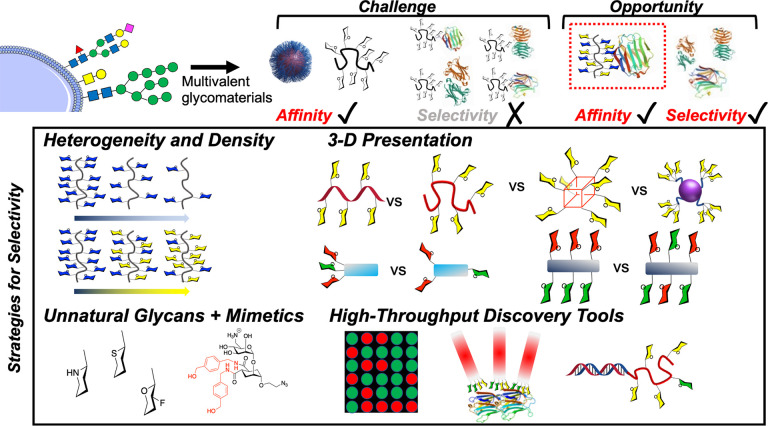
Figure 1
Figure 1
Scope of the Perspective on moving from high affinity to high affinity and high selectivity glycomaterials. The lower panel schematic shows strategies that are discussed here.
Figure 2
Figure 2
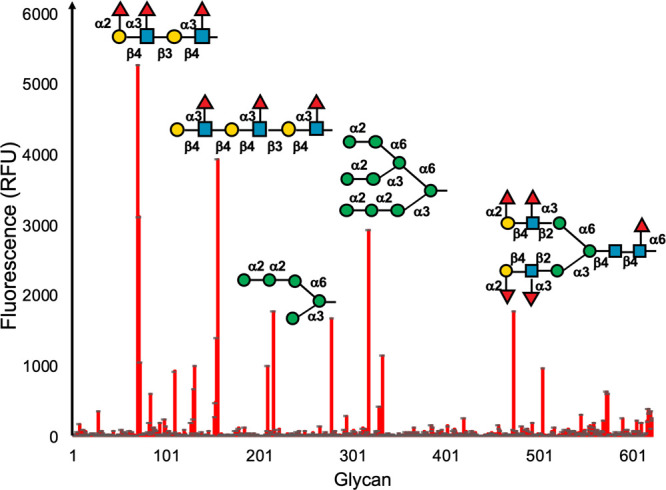
Extract of glycan-array data for DC-SIGN from the Consortium for Functional Glycomics (primscreen_5273, Human DC-SIGN-AF488 200 μg mL–1). Increased fluorescence shows more protein binding to the immobilized glycans, highlighting how the same lectin can bind structurally diverse glycans. Selected high-binding glycans are indicated.
Figure 3
Figure 3
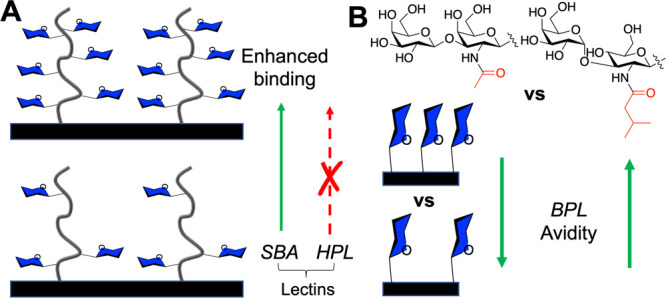
Effect of glycan density on lectin binding. (A) Glycopolymer surfaces show differential responses to SBA and HPL as a function of GalNAc side density. (B) Monolayers containing two distinct glycans show differential responses to BPL binding.
Figure 4
Figure 4
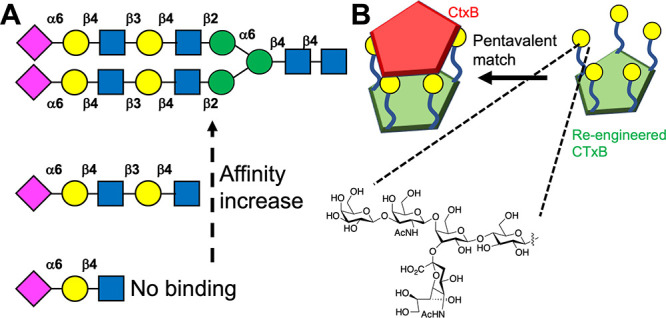
3D presentation of glycans affects binding. (A) Neu5Ac terminated glycans versus hemagglutinins, showing branching and sequence-length dependent binding. (B) A pentameric glycosylated cholera toxin B subunit (CTxB) has a 3D match to CTxB for nM inhibition.
Figure 5
Figure 5
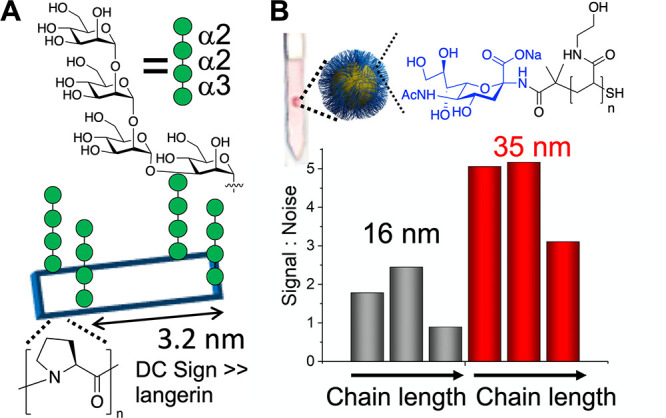
Glycan presentation affects overall binding. (A) Cyclic proline scaffolds bearing Man4, with selective DC-SIGN binding, over Langerin, even though both bind the glycan individually. (B) Flow-through detection of SARS-CoV-2 spike protein using polymer-tethered glyconanoparticles, with the signal controlled by diameter and chain length, with the same glycan. Image adapted from ref (49).
Figure 6
Figure 6
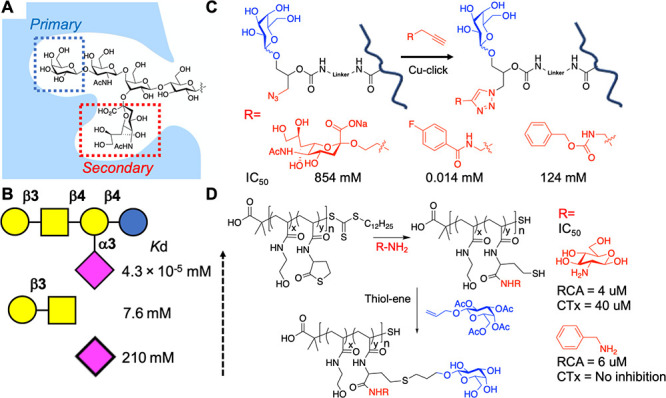
Targeting secondary binding sites in CTx. (A) Schematic of the GM1 glycan in the CTx binding site. (B) Affinity of glycans toward CTx from ITC. (C) Secondary binding site targeting via a click reaction proximal to the primary galactose unit and CTx inhibition. (D) Thiolactone ring opening to install secondary binding units and CTx/RCA120 inhibition.
Figure 7
Figure 7
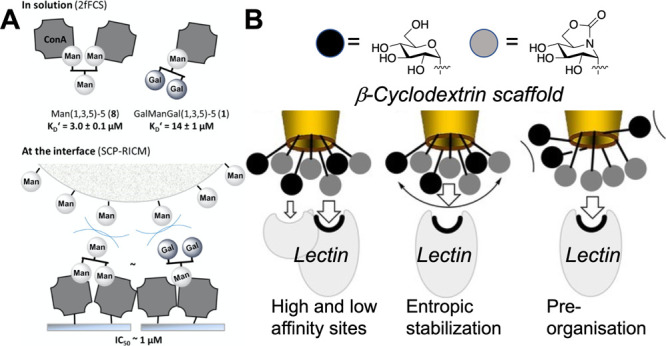
Heterogeneous presentation of high- and low-affinity glycans can enhance binding. (A) Sequence-defined polymers binding Con A in solution and at the interface (competition experiment). Reprinted with permission from ref (90). Copyright 2014 American Chemical Society. (B) Proposed modes of affinity enhancement for heterogeneous glycoclusters based on cyclodextrin scaffolds. Reprinted with permission from ref (91). Copyright 2017 John Wiley and Sons.
Figure 8
Figure 8
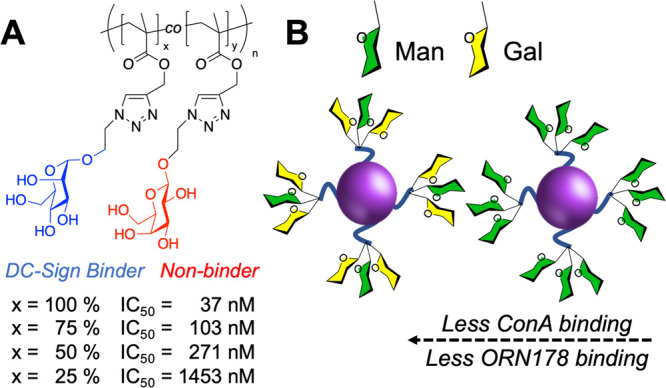
Glycan heterogeneity can reduce affinity. (A) Mannosylated glycopolymers show reduced inhibitory activity vs DC-SIGN on dilution with galactose. (B) Mannosylated glycoparticles with reduced affinity toward Con A and ORN178 (E. coli) as galactose is introduced.
Figure 9
Figure 9
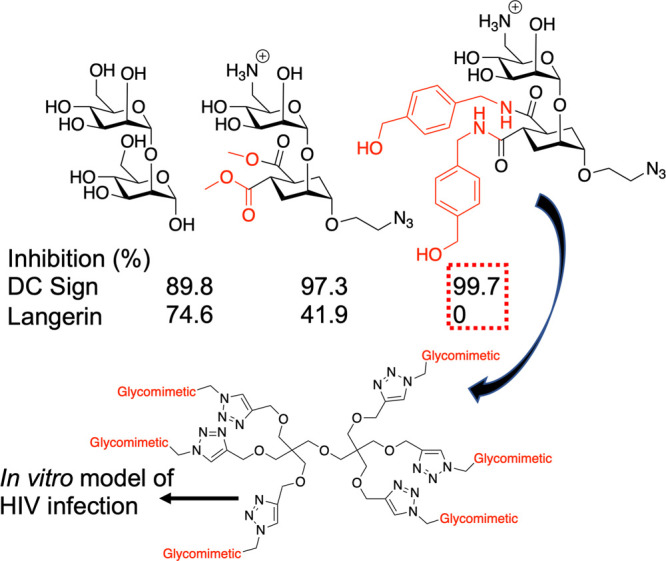
Glycomimetic strategy to identify selective DC-SIGN binders, with no inhibition of Langerin, and subsequent multivalent display.,
Figure 10
Figure 10
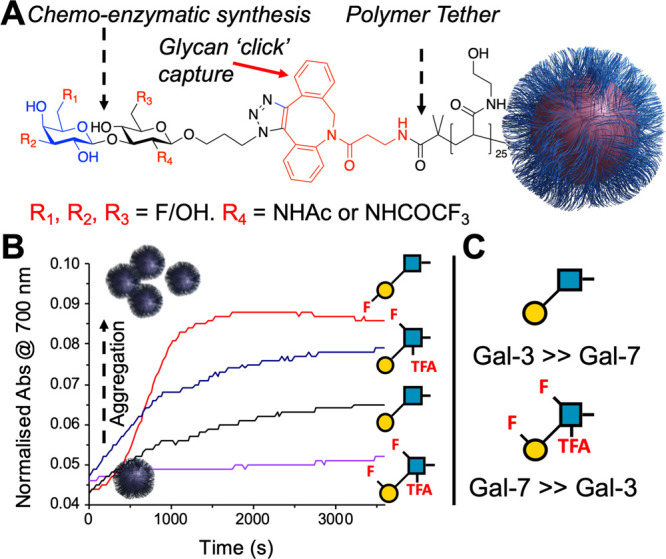
Fluorinated Lacto-N-biose-functional gold nanoparticles to bind galectins. (A) Schematic of glyconanoparticle structure (B) Aggregation kinetics of selected glyconanoparticles with Galectin-3. (C) Glycans identified (in multivalent format only) with switched affinity. Reproduced from ref (108) with permission from the Royal Society of Chemistry.
Figure 11
Figure 11
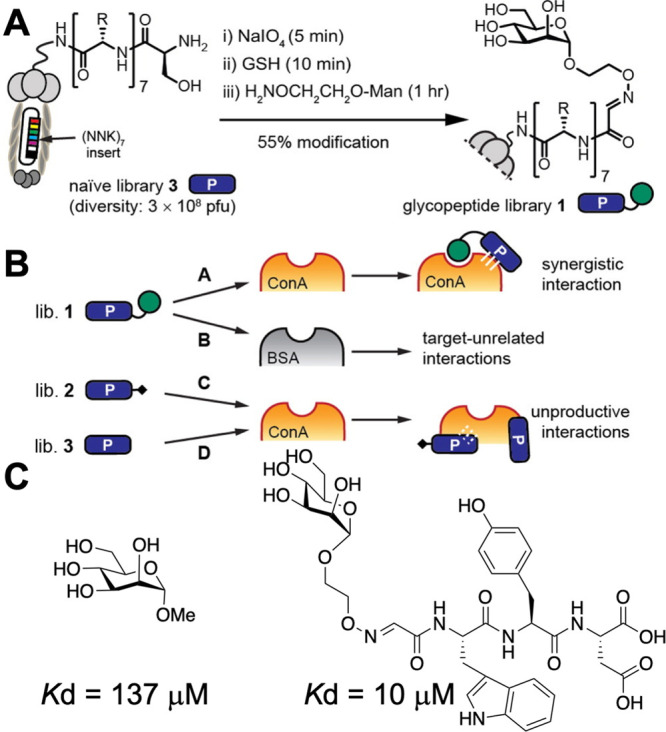
Phage-based screening for glycosylated peptides to enhance mannose binding to Con A. (A) Schematic of glycosylation at the serine N-terminus of peptides on phage. (B) Selection and enrichment processes. (C) Example of a discovered peptide sequence with enhanced Con A affinity in comparison to methyl-mannoside. Reprinted (adapted) with permission from ref (118). Copyright 2015 American Chemical Society.

References

    1. Flynn R. A.; Pedram K.; Malaker S. A.; Batista P. J.; Smith B. A. H.; Johnson A. G.; George B. M.; Majzoub K.; Villalta P. W.; Carette J. E.; Bertozzi C. R. Small RNAs Are Modified with N-Glycans and Displayed on the Surface of Living Cells. Cell 2021, 184 (12), 3109–3124. 10.1016/j.cell.2021.04.023. - DOI - PMC - PubMed
    1. Pilobello K. T.; Mahal L. K. Deciphering the Glycocode: The Complexity and Analytical Challenge of Glycomics. Curr. Opin. Chem. Biol. 2007, 11 (3), 300–305. 10.1016/j.cbpa.2007.05.002. - DOI - PubMed
    1. Bertozzi C. R.; Kiessling L. L. Chemical Glycobiology. Science 2001, 291 (5512), 2357–2364. 10.1126/science.1059820. - DOI - PubMed
    1. Adibekian A.; Stallforth P.; Hecht M.-L.; Werz D. B.; Gagneux P.; Seeberger P. H. Comparative Bioinformatics Analysis of the Mammalian and Bacterial Glycomes. Chem. Sci. 2011, 2 (2), 337–344. 10.1039/C0SC00322K. - DOI
    1. Dedola S.; Rugen M. D.; Young R. J.; Field R. A. Revisiting the Language of Glycoscience: Readers, Writers and Erasers in Carbohydrate Biochemistry. ChemBioChem 2020, 21 (3), 423–427. 10.1002/cbic.201900377. - DOI - PMC - PubMed