Machine learning classifiers do not improve prediction of hospitalization > 2 days after fast-track hip and knee arthroplasty compared with a classical statistical risk model
- PMID: 34984485
- PMCID: PMC8815306
- DOI: 10.2340/17453674.2021.843
Machine learning classifiers do not improve prediction of hospitalization > 2 days after fast-track hip and knee arthroplasty compared with a classical statistical risk model
Abstract
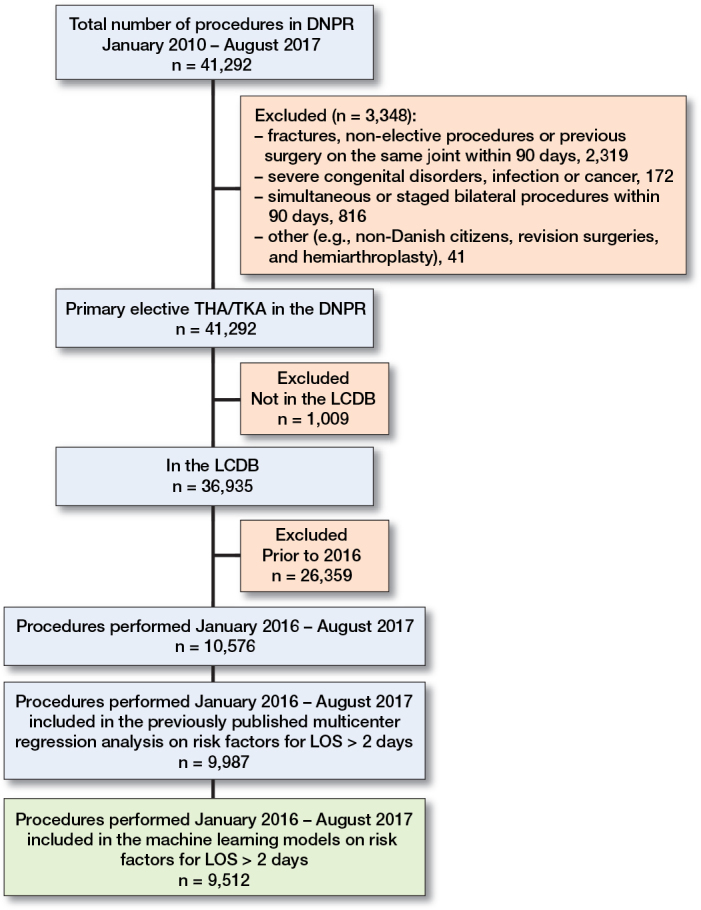
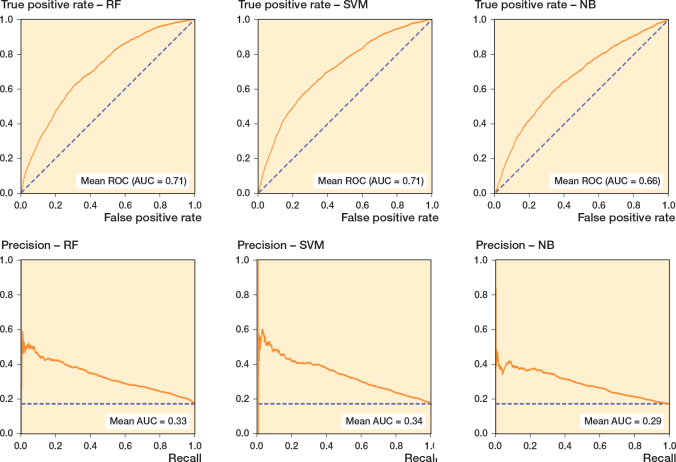
Background and purpose: Prediction of postoperative outcomes and length of hospital stay (LOS) of patients is vital for allocation of healthcare resources. We investigated the performance of prediction models based on machinelearning algorithms compared with a previous risk stratification model using traditional multiple logistic regression, for predicting the risk of a LOS of > 2 days after fast-track total hip and knee replacement. Patients and methods: 3 different machine learning classifiers were trained on data from the Lundbeck Centre for Fast-track Hip and Knee Replacement Database (LCDB) collected from 9,512 patients between 2016 and 2017. The chosen classifiers were a random forest classifier (RF), a support vector machine classifier with a polynomial kernel (SVM), and a multinomial Naïve-Bayes classifier (NB). Results: Comparing performance measures of the classifiers with the traditional model revealed that all the models had a similar performance in terms of F1 score, accuracy, sensitivity, specificity, area under the receiver operating curve (AUC), and area under the precision-recall curve (AUPRC). A feature importance analysis of the RF classifier found hospital, age, use of walking aid, living alone, and joint operated on to be the most relevant input features. None of the classifiers reached a clinically relevant performance with the input data from the LCDB. Interpretation: Despite the promising prospects of machine-learning practices for disease and risk prediction, none of the machine learning models tested outperformed the traditional multiple regression model in predicting which patients in this cohort had a LOS > 2 days.
Figures
References
-
- Jørgensen C C, Gromov K, B, Petersen P B, Kehlet H. ; Lundbeck Foundation Centre for Fast-track Hip and Knee Replacement Collaborative Group.. Influence of day of surgery and prediction of LOS > 2 days after fast-track hip and knee replacement. Acta Orthop 2021; 92(2): 170-5. doi: 10.1080/17453674.2020.1844946. - DOI - PMC - PubMed
MeSH terms
LinkOut - more resources
Full Text Sources
Medical