


Parkinson Disease and Subthalamic Nucleus Deep Brain Stimulation: Cognitive Effects in GBA Mutation Carriers
- PMID: 34984729
- PMCID: PMC8857042
- DOI: 10.1002/ana.26302
Parkinson Disease and Subthalamic Nucleus Deep Brain Stimulation: Cognitive Effects in GBA Mutation Carriers
Abstract
Objective: This study was undertaken to compare the rate of change in cognition between glucocerebrosidase (GBA) mutation carriers and noncarriers with and without subthalamic nucleus deep brain stimulation (STN-DBS) in Parkinson disease.
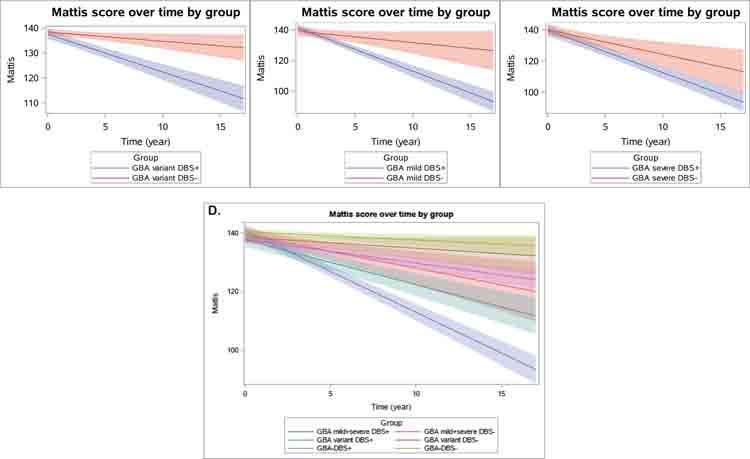
Methods: Clinical and genetic data from 12 datasets were examined. Global cognition was assessed using the Mattis Dementia Rating Scale (MDRS). Subjects were examined for mutations in GBA and categorized as GBA carriers with or without DBS (GBA+DBS+, GBA+DBS-), and noncarriers with or without DBS (GBA-DBS+, GBA-DBS-). GBA mutation carriers were subcategorized according to mutation severity (risk variant, mild, severe). Linear mixed modeling was used to compare rate of change in MDRS scores over time among the groups according to GBA and DBS status and then according to GBA severity and DBS status.
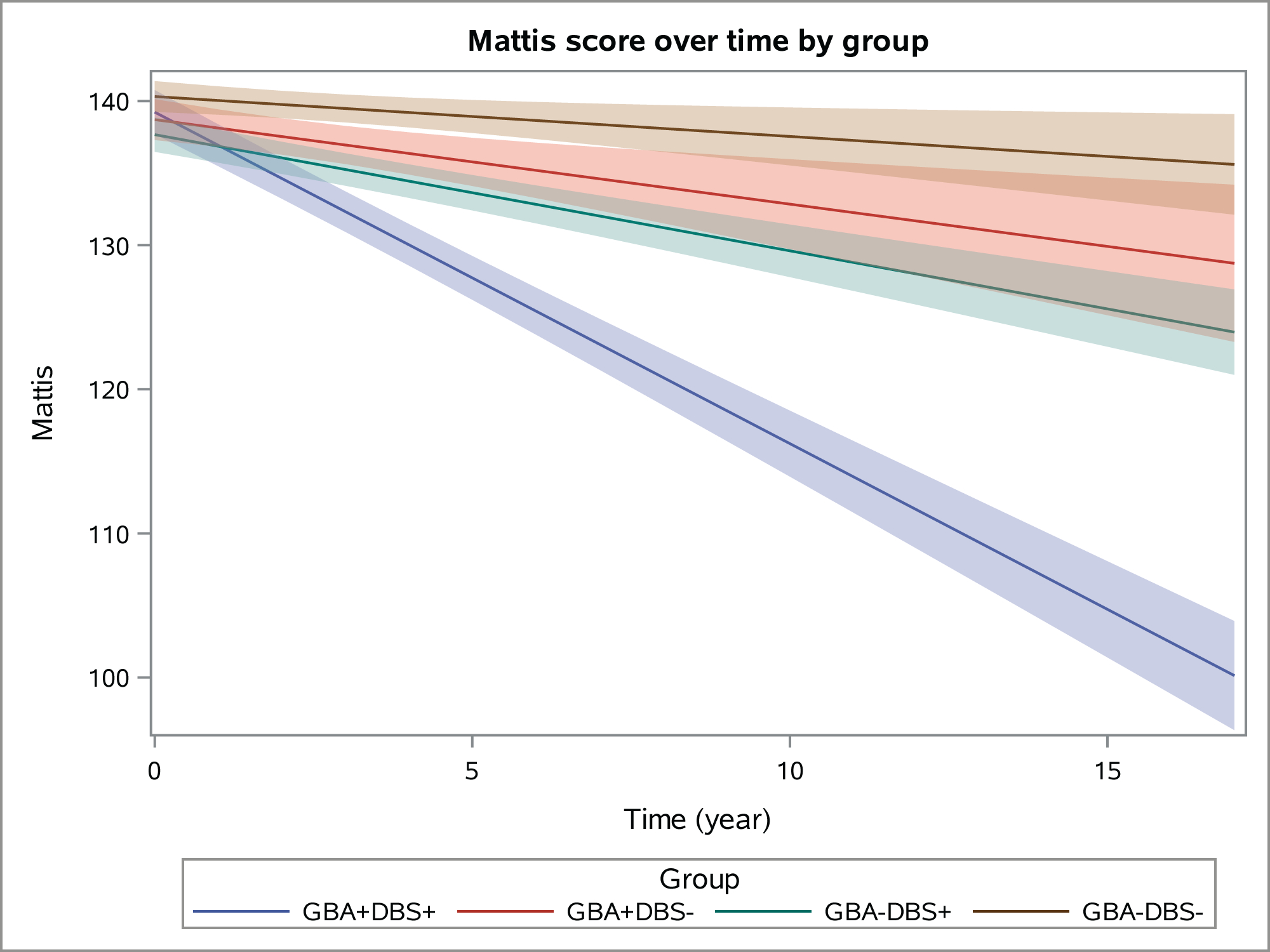
Results: Data were available for 366 subjects (58 GBA+DBS+, 82 GBA+DBS-, 98 GBA-DBS+, and 128 GBA-DBS- subjects), who were longitudinally followed (range = 36-60 months after surgery). Using the MDRS, GBA+DBS+ subjects declined on average 2.02 points/yr more than GBA-DBS- subjects (95% confidence interval [CI] = -2.35 to -1.69), 1.71 points/yr more than GBA+DBS- subjects (95% CI = -2.14 to -1.28), and 1.49 points/yr more than GBA-DBS+ subjects (95% CI = -1.80 to -1.18).
Interpretation: Although not randomized, this composite analysis suggests that the combined effects of GBA mutations and STN-DBS negatively impact cognition. We advise that DBS candidates be screened for GBA mutations as part of the presurgical decision-making process. We advise that GBA mutation carriers be counseled regarding potential risks associated with STN-DBS so that alternative options may be considered. ANN NEUROL 2022;91:424-435.
© 2022 American Neurological Association.
Conflict of interest statement
Figures
Comment in
-
Cognitive Effects of Deep Brain Stimulation in GBA-Related Parkinson Disease.Ann Neurol. 2022 Aug;92(2):344-345. doi: 10.1002/ana.26432. Epub 2022 Jul 1. Ann Neurol. 2022. PMID: 35686430 No abstract available.
-
Reply to: Cognitive Effects of Deep Brain Stimulation in GBA-Related Parkinson's Disease.Ann Neurol. 2022 Aug;92(2):345-346. doi: 10.1002/ana.26433. Epub 2022 Jun 30. Ann Neurol. 2022. PMID: 35687082 Free PMC article. No abstract available.
-
Precision Vs. Personalized DBS for GBA-Related Parkinson Disease.Ann Neurol. 2022 Nov;92(5):906-908. doi: 10.1002/ana.26499. Epub 2022 Sep 14. Ann Neurol. 2022. PMID: 36052602 No abstract available.
-
The Dawn of Precision Medicine for Deep Brain Stimulation in Parkinson's Disease?Mov Disord. 2022 Nov;37(11):2191. doi: 10.1002/mds.29224. Epub 2022 Sep 14. Mov Disord. 2022. PMID: 36103399 No abstract available.
References
-
- de Lau LM, Breteler MM. Epidemiology of Parkinson’s disease. Lancet Neurol. 2006. Jun;5(6):525–35. - PubMed
-
- Ponce FA, Lozano AM. Deep brain stimulation state of the art and novel stimulation targets. Prog Brain Res. 2010;184:311–24. - PubMed
-
- Mangone G, Bekadar S, Cormier-Dequaire F, et al. Early cognitive decline after bilateral subthalamic deep brain stimulation in Parkinson’s disease patients with GBA mutations. Parkinsonism Relat Disord. 2020. Jul;76:56–62. - PubMed
Publication types
MeSH terms
Substances
Grants and funding
LinkOut - more resources
Full Text Sources
Medical
