. 2022 Jan 4;135(13):1578-1587.
doi: 10.1097/CM9.0000000000001822. Online ahead of print.

Circular BANP knockdown inhibits the malignant progression of residual hepatocellular carcinoma after insufficient radiofrequency ablation

Affiliations

Circular BANP knockdown inhibits the malignant progression of residual hepatocellular carcinoma after insufficient radiofrequency ablation

Guoming Li et al. Chin Med J (Engl). .

Abstract

Background: Circular RNAs (circRNAs) are endogenous non-coding RNAs, some of which have pathological roles. The current study aimed to explore the role of circRNA BTG3-associated nuclear protein (circ-BANP) binding with let-7f-5p and its regulation of the toll-like receptor 4 (TLR4)/signal transducer and activator of transcription 3 (STAT3) signaling pathway in residual hepatocellular carcinoma (HCC) after insufficient radiofrequency ablation (RFA).

Methods: Circ-BANP, let-7f-5p, and TLR4 expressions in HCC samples were assessed using reverse transcription-quantitative polymerase chain reaction (RT-qPCR) and Western blotting. Bioinformatics prediction, RNA pull-down assay, and dual luciferase reporter gene assay were used to analyze the relationships among circ-BANP, let-7f-5p, and TLR4. Huh7 cells were used to generate an in vitro model of residual HCC, defined as Huh7-H cells, which were transfected with either a plasmid or the sequence of circ-BANP, let-7f-5p, or TLR4. Expression of circ-BANP, let-7f-5p, and TLR4 mRNA was determined by RT-qPCR. TLR4, STAT3, p-STAT3, vascular endothelial growth factor A, vascular endothelial growth factor receptor-2, and epithelial-mesenchymal transformation (EMT)-related factors proteins were determined by Western blotting. Cell proliferation was determined by cell counting kit-8 and 5-Ethynyl-2'-deoxyuridine (EdU) assay and cell migration and invasion by Transwell assay. Animal studies were performed by inducing xenograft tumors in nude mice.

Results: Circ-BANP and TLR4 mRNAs were upregulated in HCC tissues (the fold change for circ-BANP was 1.958 and that for TLR4 was 1.736 relative to para-tumors) and expression further increased following insufficient RFA (fold change for circ-BANP was 2.407 and that of TLR4 was 2.224 relative to para-tumors). Expression of let-7f-5p showed an opposite tendency (fold change for let-7f-5p in HCC tissues was 0.491 and that in tumors after insufficient RFA was 0.300 relative to para-tumors). Competitive binding of circ-BANP to let-7f-5p was demonstrated and TLR4 was identified as a target of let-7f-5p (P < 0.01). Knockdown of circ-BANP or elevation of let-7f-5p expression inhibited the TLR4/STAT3 signaling pathway, proliferation, invasion, migration, angiogenesis, and EMT in Huh7 and Huh7-H cells (P < 0.01). The effects induced by circ-BANP knockdown were reversed by let-7f-5p inhibition. Overexpression of TLR4 reversed the impact of let-7f-5p upregulation on the cells (P < 0.01). Silencing of circ-BANP inhibited the in vivo growth of residual HCC cells after insufficient RFA (P < 0.01).

Conclusions: Knockdown of circ-BANP upregulated let-7f-5p to inhibit proliferation, migration, and EMT formation in residual HCC remaining after insufficient RFA. Effects occur via regulation of the TLR4/STAT3 signaling pathway.


Conflict of interest statement

None.

Figures

Figure 1
Figure 1
Let-7f-5p is downregulated while circ-BANPand TLR4 are upregulated in HCC, especially in tumors after insufficient RFA. (A–C) circ-BANP, let-7f-5p andTLR4 mRNA expression in HCC and adjacent normal tissues detected using RT-qPCR; (D) protein expression of TLR4 in HCC and adjacent normal tissues detected using Western blotting analysis; (E) circ-BANP, let-7f-5p and TLR4 mRNA expression in Huh7 and Huh7-H cells assessed by RT-qPCR; (F) protein expression of TLR4 in Huh7 and Huh7-H assessed by Western blotting analysis; P < 0.01; para-tumor: n = 83, tumor without RFA: n = 44; residual tumor after RFA: n = 39; repetition = 3; the measurement data conforming to the normal distribution were expressed as mean ± standard deviation, unpaired t test was performed for comparisons between two groups, one-way ANOVA was used for comparisons among multiple groups and Tukey's multiple comparisons test was used for pairwise comparisons after one-way ANOVA. ANOVA: Analysis of variance; circ-BANP: Circular RNABTG3-associated nuclear protein; GAPDH: Glyceraldehyde-3-phosphate dehydrogenase; HCC: Hepatocellular carcinoma; RFA: Radiofrequency ablation; RT-qPCR: Reverse transcriptase-quantitative polymerase chain reaction; TLR4: Toll-like receptor 4.
Figure 2
Figure 2
Circ-BANP binds to let-7f-5p and let-7f-5p targets TLR4. (A) Binding sites between circ-BANP and let-7f-5p predicted at starbase; (B) the binding relationship between circ-BANP and let-7f-5p confirmed using dual luciferase reporter gene assay; (C) the binding relationship between circ-BANP and let-7f-5p detected by RNA pull-down assay; (D) binding sites between let-7f-5p and TLR4 predicted at starbase; (E) targeting relationship between let-7f-5p and TLR4 confirmed using dual luciferase reporter gene assay; P < 0.01; repetition = 3; the measurement data conforming to the normal distribution were expressed as mean ± standard deviation, one-way ANOVA was used for comparisons among multiple groups and Tukey's multiple comparisons test was used for pairwise comparisons after one-way ANOVA. ANOVA: Analysis of variance; circ-BANP: Circular RNA BTG3-associated nuclear protein; MUT: Mutant type; TLR4: Toll-like receptor 4; WT: Wild type.
Figure 3
Figure 3
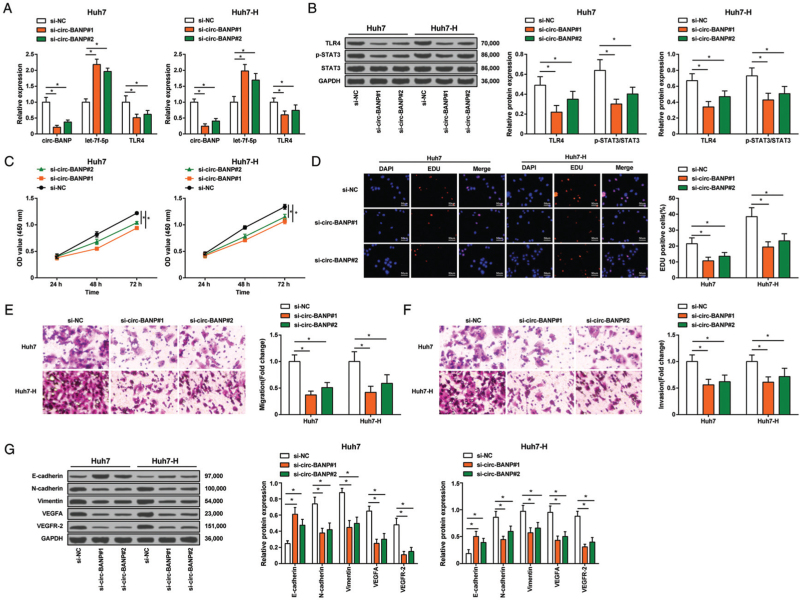
Circ-BANP inhibition represses proliferation, migration, and EMT formation of residual HCC cells after insufficient RFA. (A) circ-BANP, let-7f-5p and TLR4 mRNA expression in cells after transfection assessed by RT-qPCR; (B) protein expression of TLR4, STAT3, and p-STAT3 in cells after transfection assessed by Western blotting analysis; (C) CCK-8 assay was used to evaluate cell proliferation after transfection; (D) EdU incorporation assay was employed to measure the proliferation rate of cells after transfection; (E) cell migration assessed by Transwell assay; (F) cell invasion assessed by Transwell assay; (G) protein expression of E-cadherin, N-cadherin, Vimentin, VEGFA, and VEGFR-2 in cells after transfection was determined using Western blotting analysis; P < 0.05, repetition = 3; the measurement data conforming to the normal distribution were expressed as mean ± standard deviation, one-way ANOVA was used for comparisons among multiple groups and Tukey's multiple comparisons test was used for pairwise comparisons after one-way ANOVA. ANOVA: Analysis of variance; CCK-8: Cell counting kit-8; circ-BANP: Circular RNA BTG3-associated nuclear protein; EMT: Epithelial-mesenchymal transformation; GAPDH: Glyceraldehyde-3-phosphate dehydrogenase; HCC: Hepatocellular carcinoma; RFA: Radiofrequency ablation; STAT3: Signal transducer and activator of transcription 3; TLR4: Toll-like receptor 4.
Figure 4
Figure 4
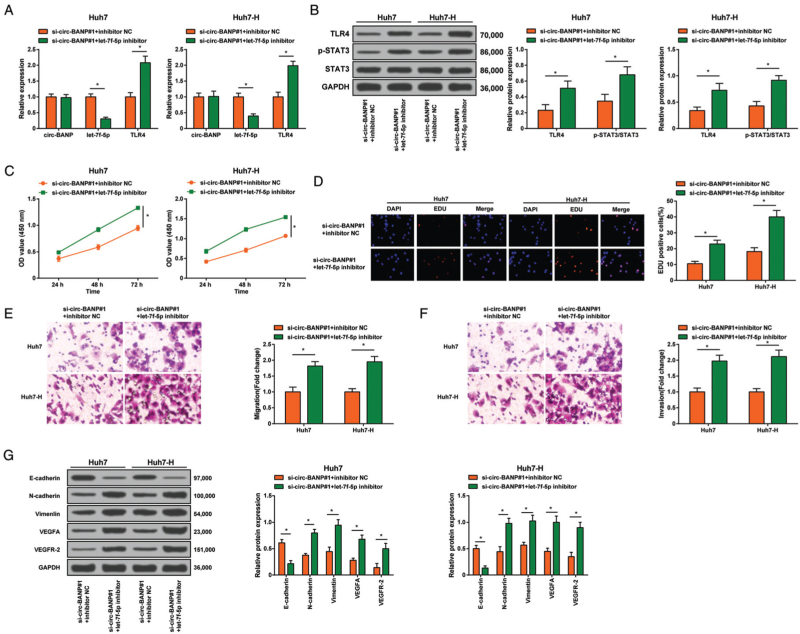
Circ-BANP knockdown inhibits proliferation, migration, and EMT formation of residual HCC cells after insufficient RFA via mediating let-7f-5p. (A) circ-BANP, let-7f-5p and TLR4 mRNA expression in cells after transfection assessed by RT-qPCR; (B) protein expression of TLR4, STAT3, and p-STAT3 in cells after transfection assessed by Western blotting analysis; (C) CCK-8 assay was used to evaluate cell proliferation after transfection; (D) EdU incorporation assay was employed to measure the proliferation rate of cells after transfection; (E) cell migration assessed by Transwell assay; (F) cell invasion assessed by Transwell assay; (G) protein expression of E-cadherin, N-cadherin, Vimentin, VEGFA, and VEGFR-2 in cells after transfection was determined using Western blotting analysis; P < 0.05, repetition = 3; the measurement data conforming to the normal distribution were expressed as mean ± standard deviation, one-way ANOVA was used for comparisons among multiple groups and Tukey's multiple comparisons test was used for pairwise comparisons after one-way ANOVA. ANOVA: Analysis of variance; CCK-8: Cell counting kit-8; circ-BANP: Circular RNA BTG3-associated nuclear protein; EMT: Epithelial-mesenchymal transformation; DAPI: 4’,6-diamidino-2-phenylindole; EDU: 5-ethynyl- 2’-deoxyuridine; HCC: Hepatocellular carcinoma; RFA: Radiofrequency ablation; RT-qPCR: Reverse transcriptase-quantitative polymerase chain reaction; STAT3: Signal transducer and activator of transcription 3; TLR4: Toll-like receptor 4; VEGFA: Vascular endothelial growth factor A; VEGFR-2: Vascular endothelial growth factor receptor 2.
Figure 5
Figure 5
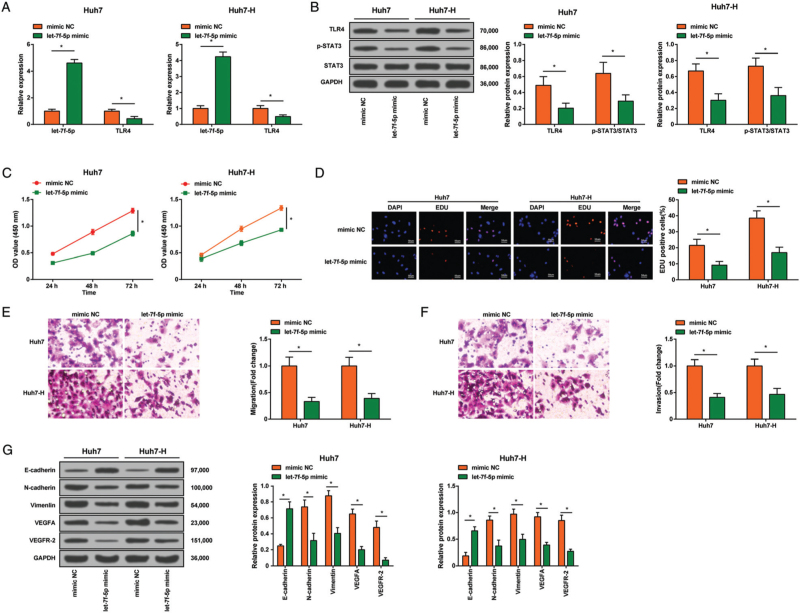
Elevated let-7f-5p reduces proliferation, migration, and EMT formation of residual HCC cells after insufficient RFA. (A) circ-BANP, let-7f-5p and TLR4 mRNA expression in cells after transfection assessed by RT-qPCR; (B) protein expression of TLR4, STAT3, and p-STAT3 in cells after transfection assessed by Western blotting analysis; (C) CCK-8 assay was used to evaluate cell proliferation after transfection; (D) EdU incorporation assay was employed to measure the proliferation rate of cells after transfection; (E) cell migration assessed by Transwell assay; (F) cell invasion assessed by Transwell assay; (G) protein expression of E-cadherin, N-cadherin, Vimentin, VEGFA, and VEGFR-2 in cells after transfection was determined using Western blotting analysis; P < 0.01; repetition = 3; the measurement data conforming to the normal distribution were expressed as mean ± standard deviation, one-way ANOVA was used for comparisons among multiple groups and Tukey's multiple comparisons test was used for pairwise comparisons after one-way ANOVA. ANOVA: Analysis of variance; CCK-8: Cell counting kit-8; circ-BANP: Circular RNA BTG3-associated nuclear protein; EMT: Epithelial-mesenchymal transformation; HCC: Hepatocellular carcinoma; RFA: Radiofrequency ablation; RT-qPCR: Reverse transcriptase-quantitative polymerase chain reaction; STAT3: Signal transducer and activator of transcription 3; TLR4: Toll-like receptor 4.
Figure 6
Figure 6
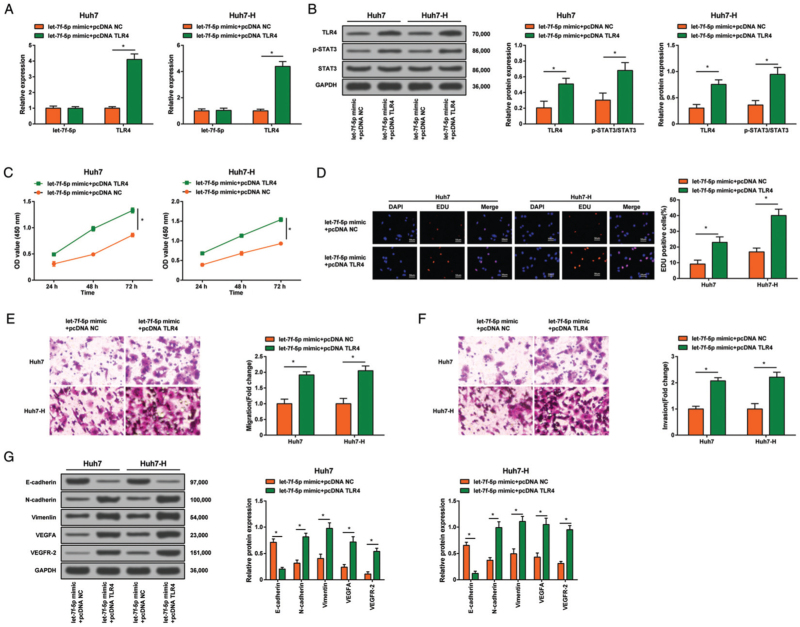
Let-7f-5p elevation targets TLR4 to restrain proliferation, migration, and EMT formation of residual HCC cells after insufficient RFA. (A) circ-BANP, let-7f-5p and TLR4 mRNA expression in cells after transfection assessed by RT-qPCR; (B) protein expression of TLR4, STAT3, and p-STAT3 in cells after transfection assessed by Western blotting analysis; (C) CCK-8 assay was used to evaluate cell proliferation after transfection; (D) EdU incorporation assay was employed to measure the proliferation rate of cells after transfection; (E) cell migration assessed by Transwell assay; (F) cell invasion assessed by Transwell assay; (G) protein expression of E-cadherin, N-cadherin, Vimentin, VEGFA, and VEGFR-2 in cells after transfection was determined using Western blotting analysis; P < 0.01; repetition = 3; the measurement data conforming to the normal distribution were expressed as mean ± standard deviation, unpaired t test was performed for comparisons between two groups, one-way ANOVA was used for comparisons among multiple groups and Tukey's multiple comparisons test was used for pairwise comparisons after one-way ANOVA. ANOVA: Analysis of variance; CCK-8: Cell counting kit-8; circ-BANP: Circular RNA BTG3-associated nuclear protein; EMT: Epithelial-mesenchymal transformation; HCC: Hepatocellular carcinoma; RFA: Radiofrequency ablation; RT-qPCR: Reverse transcriptase-quantitative polymerase chain reaction; STAT3: Signal transducer and activator of transcription 3; STAT3: Signal transducer and activator of transcription 3; TLR4: Toll-like receptor 4.
Figure 7
Figure 7
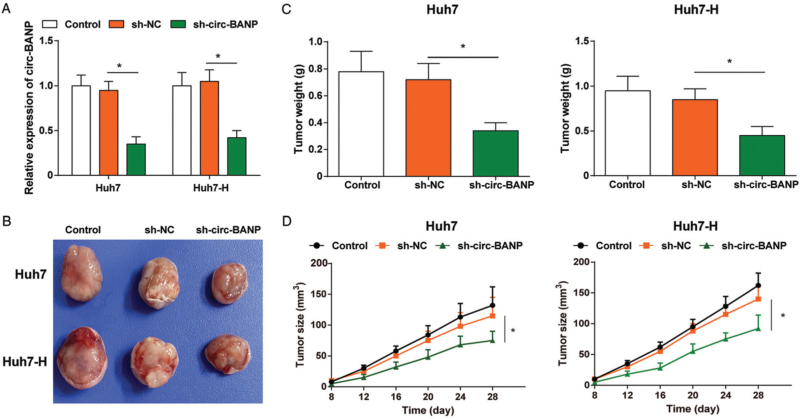
Silencing circ-BANP inhibits in vivo growth of residual HCC cells after insufficient RFA. (A) circ-BANP expression in Huh7 and Huh7-H cells after transfection of sh-circ-BANP or shNC was determined using RT-qPCR; (B) Huh7 and Huh7-H cells that had been transfected with sh-circ-BANP or sh-NC were subcutaneously injected into nude mice and 4 weeks later, the mice were euthanized. Images of tumor volume were exhibited; (C, D) tumor size was measured with a caliper rule every 4 days and tumor weight was measured at the end of the experiment; P < 0.01; n = 5; the measurement data conforming to the normal distribution were expressed as mean ± standard deviation, one-way ANOVA was used for comparisons among multiple groups and Tukey's multiple comparisons test was used for pairwise comparisons after one-way ANOVA. ANOVA: Analysis of variance; circ-BANP: Circular RNA BTG3- associated nuclear protein; HCC: Hepatocellular carcinoma; RFA: Radiofrequency ablation; RT-qPCR: Reverse transcriptase-quantitative polymerase chain reaction.

References

    1. Cao W, Chen HD, Yu YW, Li N, Chen WQ. Changing profiles of cancer burden worldwide and in China: a secondary analysis of the global cancer statistics 2020. Chin Med J 2021; 134:783–791. doi: 10.1097/CM9.0000000000001474. - PMC - PubMed
    1. Chen S, Cao Q, Wen W, Wang H. Targeted therapy for hepatocellular carcinoma: challenges and opportunities. Cancer Lett 2019; 460:1–9. doi: 10.1016/j.canlet.2019.114428. - PubMed
    1. Hwang JW, Kim H, Lee DJ. The 100 most influential manuscripts on hepatocellular carcinoma: a bibliometric analysis. J Int Med Res 2019; 47:1467–1482. doi: 10.1177/0300060519835974. - PMC - PubMed
    1. Niu ZS, Niu XJ, Wang WH. Rle of the receptor tyrosine kinase Axl in hepatocellular carcinoma and its clinical relevance. Future Oncol 2019; 15:653–662. doi: 10.2217/fon-2018-0528. - PubMed
    1. Jiang QL, Feng SJ, Yang ZY, Xu Q, Wang SZ. CircHECTD1 up- regulates mucin 1 expression to accelerate hepatocellular carcinoma development by targeting microRNA-485-5p via a competing endogenous RNA mechanism. Chin Med J 2020; 133:1774–1785. doi: 10.1097/CM9.0000000000000917. - PMC - PubMed