


Single-Cell Multiomics Integration by SCOT
- PMID: 34985990
- PMCID: PMC8812490
- DOI: 10.1089/cmb.2021.0477
Single-Cell Multiomics Integration by SCOT
Abstract
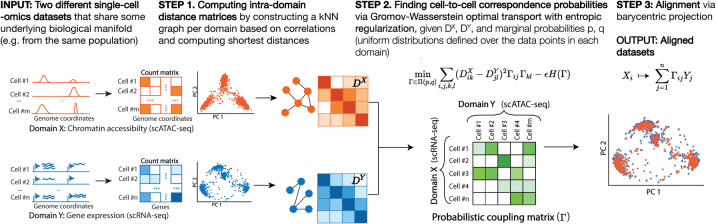
Although the availability of various sequencing technologies allows us to capture different genome properties at single-cell resolution, with the exception of a few co-assaying technologies, applying different sequencing assays on the same single cell is impossible. Single-cell alignment using optimal transport (SCOT) is an unsupervised algorithm that addresses this limitation by using optimal transport to align single-cell multiomics data. First, it preserves the local geometry by constructing a k-nearest neighbor (k-NN) graph for each data set (or domain) to capture the intra-domain distances. SCOT then finds a probabilistic coupling matrix that minimizes the discrepancy between the intra-domain distance matrices. Finally, it uses the coupling matrix to project one single-cell data set onto another through barycentric projection, thus aligning them. SCOT requires tuning only two hyperparameters and is robust to the choice of one. Furthermore, the Gromov-Wasserstein distance in the algorithm can guide SCOT's hyperparameter tuning in a fully unsupervised setting when no orthogonal alignment information is available. Thus, SCOT is a fast and accurate alignment method that provides a heuristic for hyperparameter selection in a real-world unsupervised single-cell data alignment scenario. We provide a tutorial for SCOT and make its source code publicly available on GitHub.
Keywords: data integration; manifold alignment; multiomics; optimal transport; single-cell genomics.
Conflict of interest statement
The authors declare they have competing financial interests.
Figures
References
-
- Amodio, M., and Krishnaswamy, S.. 2018. MAGAN: Aligning biological manifolds. In International Conference on Machine Learning (ICML). Proceedings of Machine Learning Research (PMLR) 80, 215–223. Stockholm, Sweden.
-
- Flamary, R., and Courty, N.. 2021. POT: Python optimal transport. Journal of Machine Learning Research (JMLR) 22, 1–8.
Publication types
MeSH terms
Grants and funding
LinkOut - more resources
Full Text Sources
