Observational Study
. 2022 Feb 24;386(8):744-756.
doi: 10.1056/NEJMoa2116597. Epub 2022 Jan 5.

Effect of Covid-19 Vaccination on Transmission of Alpha and Delta Variants

Affiliations
Observational Study

Effect of Covid-19 Vaccination on Transmission of Alpha and Delta Variants

David W Eyre et al. N Engl J Med. .

Abstract

Background: Before the emergence of the B.1.617.2 (delta) variant of severe acute respiratory syndrome coronavirus 2 (SARS-CoV-2), vaccination reduced transmission of SARS-CoV-2 from vaccinated persons who became infected, potentially by reducing viral loads. Although vaccination still lowers the risk of infection, similar viral loads in vaccinated and unvaccinated persons who are infected with the delta variant call into question the degree to which vaccination prevents transmission.

Methods: We used contact-testing data from England to perform a retrospective observational cohort study involving adult contacts of SARS-CoV-2-infected adult index patients. We used multivariable Poisson regression to investigate associations between transmission and the vaccination status of index patients and contacts and to determine how these associations varied with the B.1.1.7 (alpha) and delta variants and time since the second vaccination.

Results: Among 146,243 tested contacts of 108,498 index patients, 54,667 (37%) had positive SARS-CoV-2 polymerase-chain-reaction (PCR) tests. In index patients who became infected with the alpha variant, two vaccinations with either BNT162b2 or ChAdOx1 nCoV-19 (also known as AZD1222), as compared with no vaccination, were independently associated with reduced PCR positivity in contacts (adjusted rate ratio with BNT162b2, 0.32; 95% confidence interval [CI], 0.21 to 0.48; and with ChAdOx1 nCoV-19, 0.48; 95% CI, 0.30 to 0.78). Vaccine-associated reductions in transmission of the delta variant were smaller than those with the alpha variant, and reductions in transmission of the delta variant after two BNT162b2 vaccinations were greater (adjusted rate ratio for the comparison with no vaccination, 0.50; 95% CI, 0.39 to 0.65) than after two ChAdOx1 nCoV-19 vaccinations (adjusted rate ratio, 0.76; 95% CI, 0.70 to 0.82). Variation in cycle-threshold (Ct) values (indicative of viral load) in index patients explained 7 to 23% of vaccine-associated reductions in transmission of the two variants. The reductions in transmission of the delta variant declined over time after the second vaccination, reaching levels that were similar to those in unvaccinated persons by 12 weeks in index patients who had received ChAdOx1 nCoV-19 and attenuating substantially in those who had received BNT162b2. Protection in contacts also declined in the 3-month period after the second vaccination.

Conclusions: Vaccination was associated with a smaller reduction in transmission of the delta variant than of the alpha variant, and the effects of vaccination decreased over time. PCR Ct values at diagnosis of the index patient only partially explained decreased transmission. (Funded by the U.K. Government Department of Health and Social Care and others.).


Figures

Figure 1
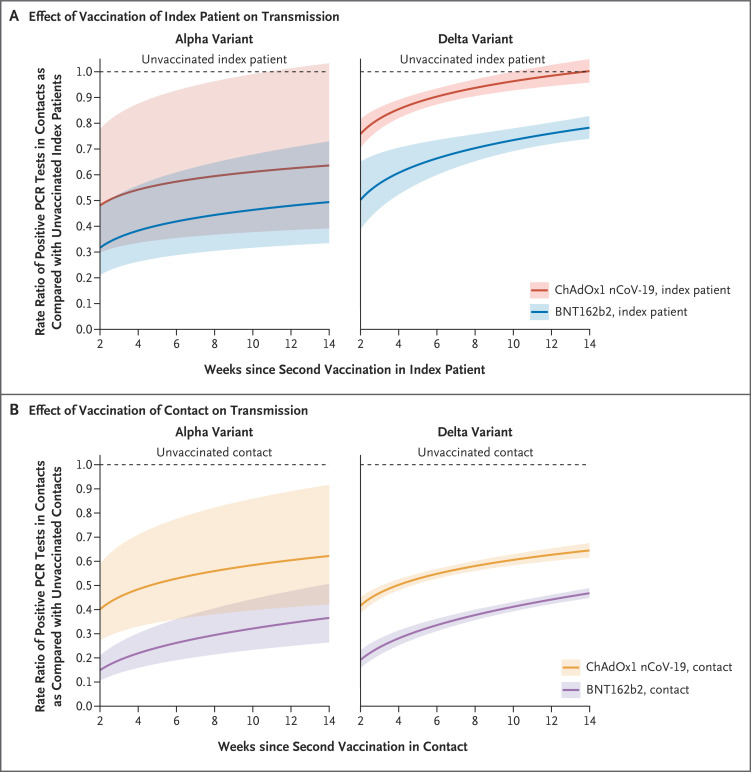
Figure 1. Rate Ratios of Positive PCR Tests in Contacts, According to Time since the Second Vaccination in Index Patients and Contacts, SARS-CoV-2 Variant, and Vaccine Type.
The rate ratios of positive polymerase-chain-reaction (PCR) tests in contacts according to index-patient vaccination status (Panel A) and contact vaccination status (Panel B) are shown. The shaded areas indicate 95% confidence intervals. There was no evidence that fitting different rates according to severe acute respiratory syndrome coronavirus 2 (SARS-CoV-2) variant for the change in protection over weeks since the second vaccination improved the model fit. The broad confidence intervals for the alpha variant show that relatively few persons who were vaccinated twice were infected before the delta variant became the dominant lineage.
Figure 2
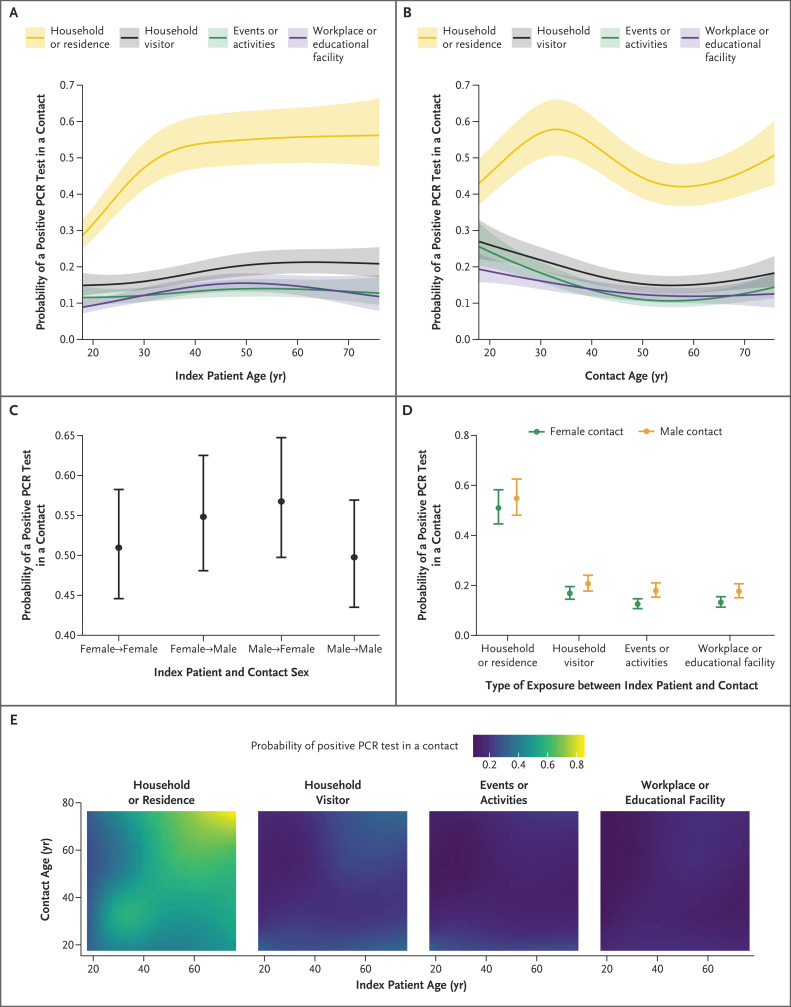
Figure 2. Estimated Probabilities of a Positive PCR Test among Contacts.
Shown are the estimated probabilities of a positive PCR test among contacts, according to the type of exposure between the index patient and contact and the age of the index patient (Panel A), the type of exposure and the age of the contact (Panel B), the sex of the index patient and contact (Panel C), the sex of the contact and the type of exposure (Panel D), and the type of exposure and age of the index patient and contact (Panel E). For each panel, all the other covariates are set to reference values for categorical values and to median values for continuous variables (i.e., the type of exposure is set to household or residence; for index-patient characteristics, age is set to the median, sex to female, vaccination status to unvaccinated, and symptom status to symptomatic; for contact characteristics, age is set to the median, sex to female, and vaccination status to unvaccinated). Local deprivation rank (socioeconomic disadvantage according to geographic area of residence) is adjusted for in the model along with the other covariates listed; local deprivation rank and the local incidence of SARS-CoV-2 infection and calendar time are set to the median. Shaded areas in Panels A and B and 𝙸 bars in Panels C and D indicate 95% confidence intervals.
Figure 3
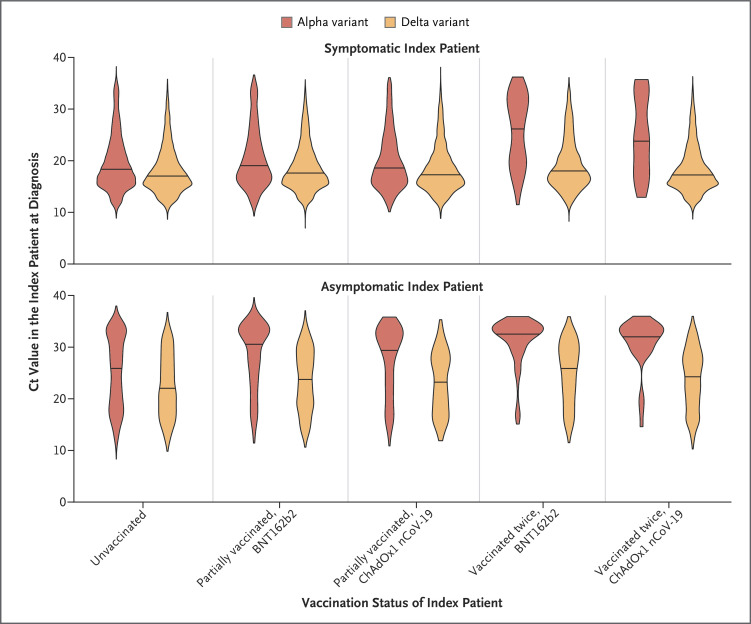
Figure 3. Distribution of Ct Values, According to Vaccination Status of the Index Patient, SARS-CoV-2 Variant, and Symptoms.
The violin plots show the observed frequency density of patients with a given result, and the solid line in each plot indicates the median. Cycle-threshold (Ct) values are indicative of viral load. Lee et al. describe details of equivalent viral loads in copies per milliliter (log10 viral load=12.0−0.328×Ct).
Figure 4
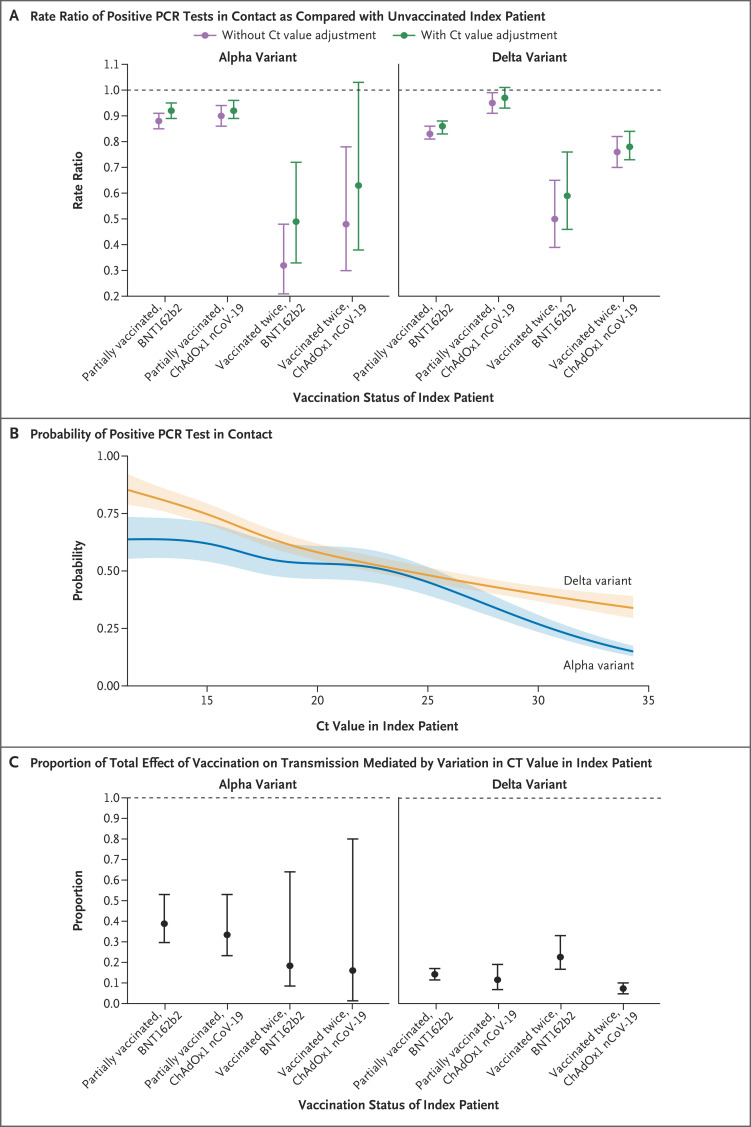
Figure 4. Extent of Vaccine-Associated Reductions in Transmission That Were Explained by Variation in Ct Values at Diagnosis in the Index Patient.
Panel A shows the effect of vaccination of the index patient on onward transmission in models with and without adjustment for the Ct value in the index patient. Panel B shows the relationship between the Ct value in the index patient and onward transmission in a model with adjustment for the Ct value in the index patient at the time of diagnosis. Panel C shows the proportion of the total effect of vaccination of the index patient mediated by variations in the Ct value. 𝙸 bars in Panels A and C and shaded areas in Panel B indicate 95% confidence intervals. Apart from the SARS-CoV-2 variant, there was no evidence that interactions between the Ct value and any other main effect of the model improved the model fit.

References

    1. Polack FP, Thomas SJ, Kitchin N, et al. Safety and efficacy of the BNT162b2 mRNA Covid-19 vaccine. N Engl J Med 2020;383:2603-2615. - PMC - PubMed
    1. Voysey M, Clemens SAC, Madhi SA, et al. Safety and efficacy of the ChAdOx1 nCoV-19 vaccine (AZD1222) against SARS-CoV-2: an interim analysis of four randomised controlled trials in Brazil, South Africa, and the UK. Lancet 2021;397:99-111. - PMC - PubMed
    1. Baden LR, El Sahly HM, Essink B, et al. Efficacy and safety of the mRNA-1273 SARS-CoV-2 vaccine. N Engl J Med 2021;384:403-416. - PMC - PubMed
    1. Lopez Bernal J, Andrews N, Gower C, et al. Effectiveness of the Pfizer-BioNTech and Oxford-AstraZeneca vaccines on covid-19 related symptoms, hospital admissions, and mortality in older adults in England: test negative case-control study. BMJ 2021;373:n1088-n1088. - PMC - PubMed
    1. Dagan N, Barda N, Kepten E, et al. BNT162b2 mRNA Covid-19 vaccine in a nationwide mass vaccination setting. N Engl J Med 2021;384:1412-1423. - PMC - PubMed

Publication types

Supplementary concepts