


Health data collection methods and procedures across EU member states: findings from the InfAct Joint Action on health information
- PMID: 34986889
- PMCID: PMC8728985
- DOI: 10.1186/s13690-021-00780-4
Health data collection methods and procedures across EU member states: findings from the InfAct Joint Action on health information
Erratum in
-
Correction to: Health data collection methods and procedures across EU member states: findings from the InfAct Joint Action on health information.Arch Public Health. 2022 Feb 14;80(1):51. doi: 10.1186/s13690-022-00806-5. Arch Public Health. 2022. PMID: 35164869 Free PMC article. No abstract available.
Abstract
Background: Health-related data are collected from a variety of sources for different purposes, including secondary use for population health monitoring (HM) and health system performance assessment (HSPA). Most of these data sources are not included in databases of international organizations (e.g., WHO, OECD, Eurostat), limiting their use for research activities and policy making. This study aims at identifying and describing collection methods, quality assessment procedures, availability and accessibility of health data across EU Member States (MS) for HM and HSPA.
Methods: A structured questionnaire was developed and administered through an online platform to partners of the InfAct consortium form EU MS to investigate data collections applied in HM and HSPA projects, as well as their methods and procedures. A descriptive analysis of the questionnaire results was performed.
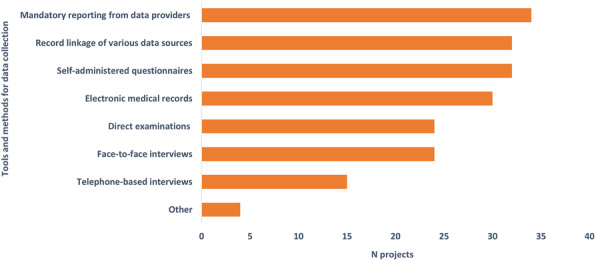
Results: Information on 91 projects from 18 EU MS was collected. In these projects, data were mainly collected through administrative sources, population health interview or health examination surveys and from electronic medical records. Tools and methods used for data collection were mostly mandatory reports, self-administered questionnaires, or record linkage of various data sources. One-third of the projects shared data with EU research networks and less than one-third performed quality assessment of their data collection procedures using international standardized criteria. Macrodata were accessible via open access and reusable in 22 projects. Microdata were accessible upon specific request and reusable in 15 projects based on data usage licenses. Metadata was available for the majority of the projects, but followed reporting standards only in 29 projects. Overall, compliance to FAIR Data principles (Findable, Accessible, Interoperable, and Reusable) was not optimal across the EU projects.
Conclusions: Data collection and exchange procedures differ across EU MS and research data are not always available, accessible, comparable or reusable for further research and evidence-based policy making. There is a need for an EU-level health information infrastructure and governance to promote and facilitate sharing and dissemination of standardized and comparable health data, following FAIR Data principles, across the EU.
Keywords: Data accessibility; Data availability; Data collection methods; FAIR principles; Health data; Health information; Quality assessment.
© 2021. The Author(s).
Conflict of interest statement
H. Van Oyen is one of the co-authors of this paper and the editor of
Figures


References
-
- Teutsch SM, Thacker SB. Planning a public health surveillance system. Epidemiol Bull. 1995;16(1):1–6. - PubMed
-
- Hurtado MP, Swift EK, Corrigan JM. Envisioning the National Health Care Quality report. Washington: National Academies Press (US). 2001. - PubMed
-
- Kelley E, Hurst J, Health care quality indicators project conceptual framework paper . Paris: Organisation for Economic Co-operation and Development (Health Working Papers no. 23) 2006.
Grants and funding
LinkOut - more resources
Full Text Sources
