


Causality Evaluation of Drug-Induced Liver Injury in Newborns and Children in the Intensive Care Unit Using the Updated Roussel Uclaf Causality Assessment Method
- PMID: 34987403
- PMCID: PMC8721278
- DOI: 10.3389/fphar.2021.790108
Causality Evaluation of Drug-Induced Liver Injury in Newborns and Children in the Intensive Care Unit Using the Updated Roussel Uclaf Causality Assessment Method
Abstract
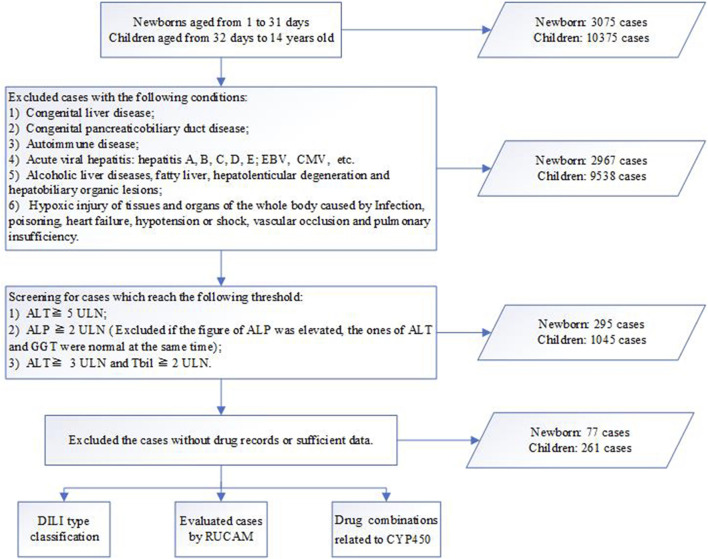
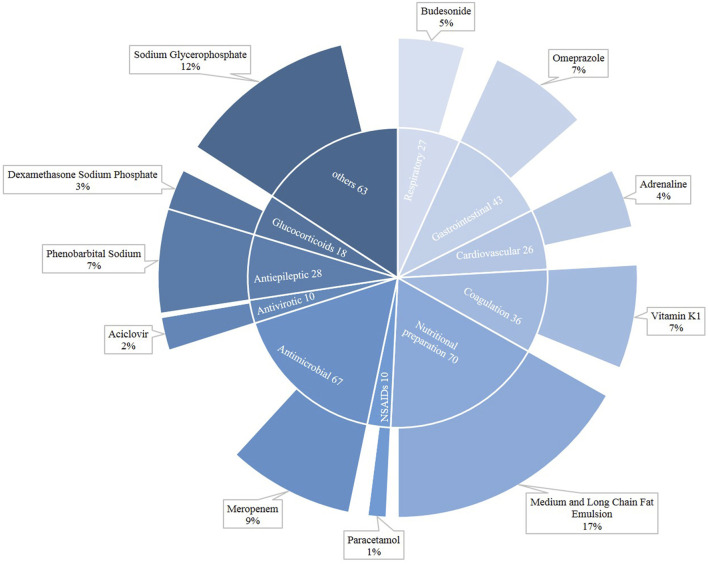
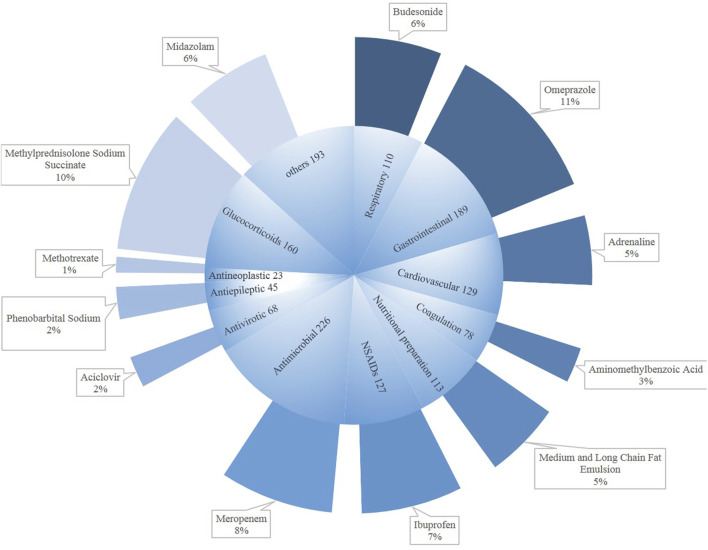
Purpose: Drug-induced liver injury (DILI) is a common adverse reaction in the clinic; however, there are relatively few reports of DILI in critically ill newborns and children. Making use of the Pediatric Intensive Care database (PIC), this study identifies which drugs are related to DILI in neonates and children in China. Methods: Using the PIC, we screened for patients whose liver was suspected of being injured by drugs during hospitalization. The medicine they used was then assessed by the Roussel Uclaf Causality Assessment Method (RUCAM). At the same time, we also collated drug combinations that may affect CYP (Cytochrome P) enzyme metabolism, which may cause DILI. Results: A total of 13,449 patients were assessed, of whom 77 newborns and 261 children were finally included. The main type of liver injury in neonates was mixed (83.1%), while the hepatic injury types of children were mostly distributed between hepatocellular (59.4%) and cholestatic (28.4%). In terms of the RUCAM assessment, the drugs that were most considered to cause or be associated with hepatic injury in newborns were medium and long chain fat emulsions (17%), sodium glycerophosphate (12%), and meropenem (9%); while omeprazole (11%), methylprednisolone sodium succinate (10%), and meropenem (8%) were the primary culprits of DILI in children. Drug combinations frequently seen in neonates that may affect CYP enzyme metabolism are omeprazole + budesonide (16.9%), dexamethasone + midazolam (10.4%), and midazolam + sildenafil (10.4%). In children, the commonly used drug combinations are fentanyl + midazolam (20.7%), ibuprofen + furosemide (18.4%), and diazepam + omeprazole (15.3%). Conclusions: In this study, medium and long chain fat emulsions and sodium glycerophosphate have been strongly associated with DILI in newborns, while omeprazole and methylprednisolone sodium succinate play an important role in the DILI of children. Also, attention should be paid to the effect on CYP enzymes when using multiple drugs at the same time. In future DILI cases, it is advisable to use the latest RUCAM for prospective study design so that complete case data and high RUCAM scores can be collected.
Keywords: China; Roussel Uclaf causality assessment method; children; critically ill; drug-induced liver injury; newborns; updated RUCAM.
Copyright © 2021 Ye, Feng, Huang, Guo, Wu, He, Tan, Wang, Wu, Hu, Li, Yang, Chengxian and He.
Conflict of interest statement
Authors XIW and YW, were employed by the company Easier Data Technologies Co., Ltd. Author XUW was employed by the company Hunan Creator Information Technology Co., Ltd. The remaining authors declare that the research was conducted in the absence of any commercial or financial relationships that could be construed as a potential conflict of interest.
Figures
References
LinkOut - more resources
Full Text Sources
