


Alternating high-intensity interval training and continuous training is efficacious in improving cardiometabolic health in obese middle-aged men
- PMID: 34987589
- PMCID: PMC8689221
- DOI: 10.1016/j.jesf.2021.11.003
Alternating high-intensity interval training and continuous training is efficacious in improving cardiometabolic health in obese middle-aged men
Abstract
Background: High-intensity interval training (HIIT) or moderate-intensity continuous training (MICT) alone has been shown to improve metabolic health, but the effects of alternating the two training approaches as often practiced in real life remained unclear.
Purpose: To examine the effects of HIIT or MICT alone or alternating HIIT-MICT on cardiometabolic responses in inactive obese middle-aged men.
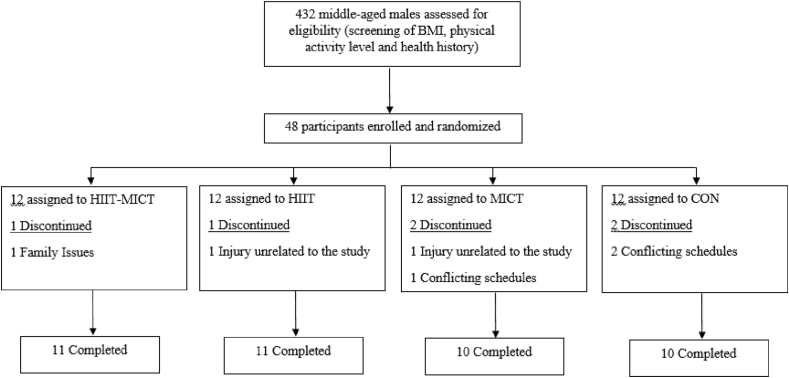
Methods: Forty-two participants (age: 42 ± 5 y; BMI: 26.3 ± 2.1 kg m-2) were randomly assigned to four groups: HIIT (12 x 1-min running bouts at 80-90% HRmax interspersed with 1-min active recovery at 50% HRmax), MICT (40-min brisk walk at 65-70% HRmax), alternating HIIT-MICT or a non-exercise control group (CON). Exercise sessions were conducted three times per week for 16 weeks. Maximal oxygen uptake (VO2max), body composition (by bioelectrical impedance analysis), blood pressure, fasting blood glucose, insulin resistance (HOMA-IR) and lipid profile were assessed at baseline and after the 16-week intervention. Enjoyment and self-efficacy were also assessed at the end of intervention.
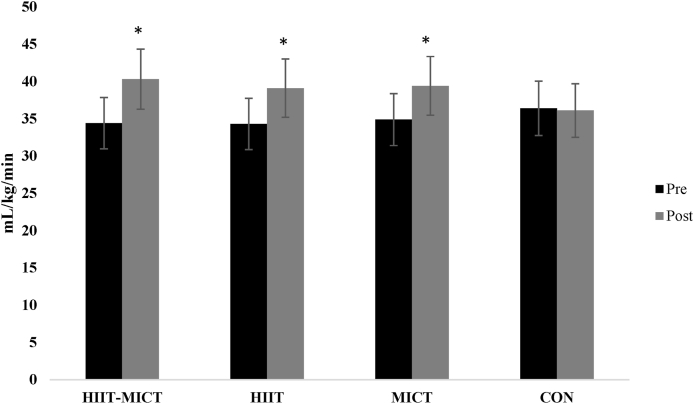
Results: All exercise groups showed a similar VO2max increase of ∼15% (HIIT: 34.3 ± 4.4 vs 39.1 ± 5.4; MICT: 34.9 ± 5.0 vs 39.4 ± 7.2; and alternating HIIT-MICT: 34.4 ± 5.0 vs 40.3 ± 4.6 mL kg-1min-1) compared to baseline and CON (all p < 0.05). Weight, BMI, % fat and waist circumference also showed similar reductions in all exercise groups compared to baseline and CON (all p < 0.05). No significant group difference was observed for all blood markers. Compared to baseline, total cholesterol decreased after HIIT-MICT, while HIIT significantly decreased fasting insulin level and improved insulin resistance (p < 0.05). Enjoyment, self-efficacy and adherence were similar among all exercise groups.
Conclusion: HIIT or MICT alone or alternating HIIT-MICT similarly improve cardiovascular fitness and body composition in obese middle-aged men despite differences in total training volume and time commitment.
Keywords: Continuous training; HIIT; Interval exercise; Public health; Weight management.
© 2021 The Society of Chinese Scholars on Exercise Physiology and Fitness. Published by Elsevier (Singapore) Pte Ltd.
Figures
References
-
- WHO. World Health Organization Physical Activity Fact Sheet2016.
-
- ACSM . tenth ed. Wolters Kluwer; Philadelphia, PA: 2017. ACSM's Guidelines for Exercise Testing and Prescription.
-
- WHO . World Health Organization; Geneva: 2010. Global Recommendations on Physical Activity for Health. - PubMed
-
- Stutts W.C. Physical activity determinants in adults. Perceived benefits, barriers, and self efficacy. AAOHN J. 2002;50:499–507. - PubMed
-
- Kilpatrick M.W., Jung M.E., Little J.P. HIGH-INTENSITY interval training A review of physiological and psychological responses. ACSM's Health & Fit J. 2014;18:11–16.
LinkOut - more resources
Full Text Sources
