


Risk for Myocardial Infarction Following 5-Fluorouracil Treatment in Patients With Gastrointestinal Cancer: A Nationwide Registry-Based Study
- PMID: 34988482
- PMCID: PMC8702810
- DOI: 10.1016/j.jaccao.2021.11.001
Risk for Myocardial Infarction Following 5-Fluorouracil Treatment in Patients With Gastrointestinal Cancer: A Nationwide Registry-Based Study
Abstract
Background: Myocardial infarction is a cardiac adverse event associated with 5-fluorouracil (5-FU). There are limited data on the incidence, risk, and prognosis of 5-FU-associated myocardial infarction.
Objectives: The aim of this study was to examine the risk for myocardial infarction in patients with gastrointestinal (GI) cancer treated with 5-FU compared with age- and sex-matched population control subjects without cancer (1:2 ratio).
Methods: Patients with GI cancer treated with 5-FU between 2004 and 2016 were identified within the Danish National Patient Registry. Prevalent ischemic heart disease in both groups was excluded. Cumulative incidences were calculated, and multivariable regression and competing risk analyses were performed.
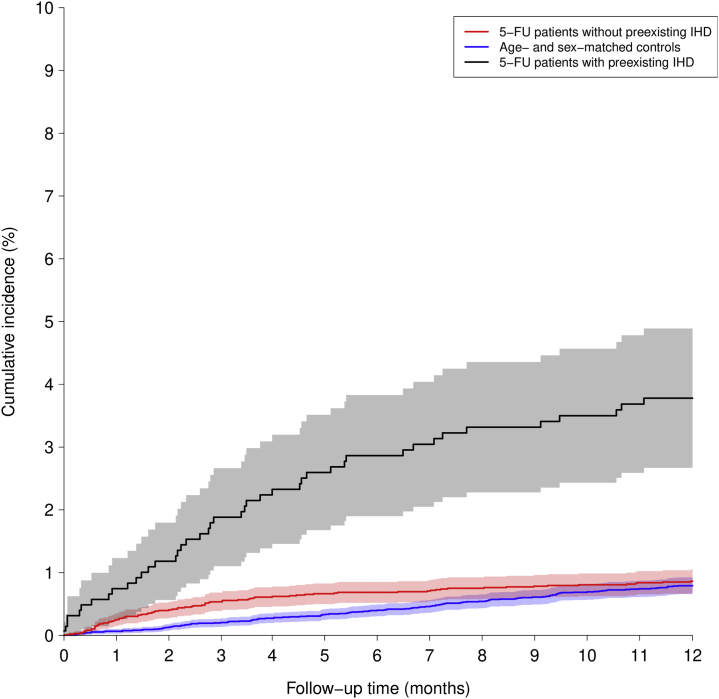
Results: A total of 30,870 patients were included in the final analysis, of whom 10,290 had GI cancer and were treated with 5-FU and 20,580 were population control subjects without cancer. Differences in comorbid conditions and select antianginal medications were nonsignificant (P > 0.05 for all). The 6-month cumulative incidence of myocardial infarction was significantly higher for 5-FU patients at 0.7% (95% CI: 0.5%-0.9%) versus 0.3% (95% CI: 0.3%-0.4%) in population control subjects, with a competing risk for death of 12.1% versus 0.6%. The 1-year cumulative incidence of myocardial infarction for 5-FU patients was 0.9% (95% CI: 0.7%-1.0%) versus 0.6% (95% CI: 0.5%-0.7%) among population control subjects, with a competing risk for death of 26.5% versus 1.4%. When accounting for competing risks, the corresponding subdistribution hazard ratios suggested an increased risk for myocardial infarction in 5-FU patients, compared with control subjects, at both 6 months (hazard ratio: 2.10; 95% CI: 1.50-2.95; P < 0.001) and 12 months (hazard ratio: 1.39; 95% CI: 1.05-1.84; P = 0.022).
Conclusions: Despite a statistically significantly higher 6- and 12-month risk for myocardial infarction among 5-FU patients compared with population control subjects, the absolute risk for myocardial infarction was low, and the clinical significance of these differences appears to be limited in the context of the significant competing risk for death in this population.
Keywords: 5-FU, 5-fluorouracil; 5-fluorouracil; GI, gastrointestinal; IQR, Interquartile range; MI, myocardial infarction; cardiotoxicity; gastrointestinal cancer; myocardial infarction.
© 2021 The Authors.
Conflict of interest statement
Dr El-Galaly was previously employed at Roche; and has received speaker fees from Abbvie. All other authors have reported that they have no relationships relevant to the contents of this paper to disclose.
Figures


References
-
- Grem J.L. 5-Fluorouracil: forty-plus and still ticking. A review of its preclinical and clinical development. Invest New Drugs. 2000;18(4):299–313. - PubMed
-
- Myers C.E. The pharmacology of the fluoropyrimidines. Pharmacol Rev. 1981;33(1):1–15. - PubMed
-
- de Forni M., Malet-Martiono M.C., Jaillais J., et al. Cardiotoxicity of high-dose continuous infusion fluorouracil: a prospective clinical study. J Clin Oncol. 1992;10(11):1795–1801. - PubMed
-
- Lestuzzi C., Vaccher E., Talamini R., et al. Effort myocardial ischemia during chemotherapy with 5-fluorouracil: an underestimated risk. Ann Oncol. 2014;25(5):1059–1064. - PubMed
-
- Stewart T., Pavlakis N., Ward M. Cardiotoxicity with 5-fluorouracil and capecitabine: more than just vasospastic angina. Intern Med J. 2010;40(4):303–307. - PubMed
LinkOut - more resources
Full Text Sources
