


What Laboratory Tests and Physiologic Triggers Should Guide the Decision to Administer a Platelet or Plasma Transfusion in Critically Ill Children and What Product Attributes Are Optimal to Guide Specific Product Selection? From the Transfusion and Anemia EXpertise Initiative-Control/Avoidance of Bleeding
- PMID: 34989701
- PMCID: PMC8769352
- DOI: 10.1097/PCC.0000000000002854
What Laboratory Tests and Physiologic Triggers Should Guide the Decision to Administer a Platelet or Plasma Transfusion in Critically Ill Children and What Product Attributes Are Optimal to Guide Specific Product Selection? From the Transfusion and Anemia EXpertise Initiative-Control/Avoidance of Bleeding
Abstract
Objectives: To present consensus statements and supporting literature for plasma and platelet product variables and related laboratory testing for transfusions in general critically ill children from the Transfusion and Anemia EXpertise Initiative-Control/Avoidance of Bleeding.
Design: Systematic review and consensus conference of international, multidisciplinary experts in platelet and plasma transfusion management of critically ill children.
Setting: Not applicable.
Patients: Critically ill pediatric patients at risk of bleeding and receiving plasma and/or platelet transfusions.
Interventions: None.
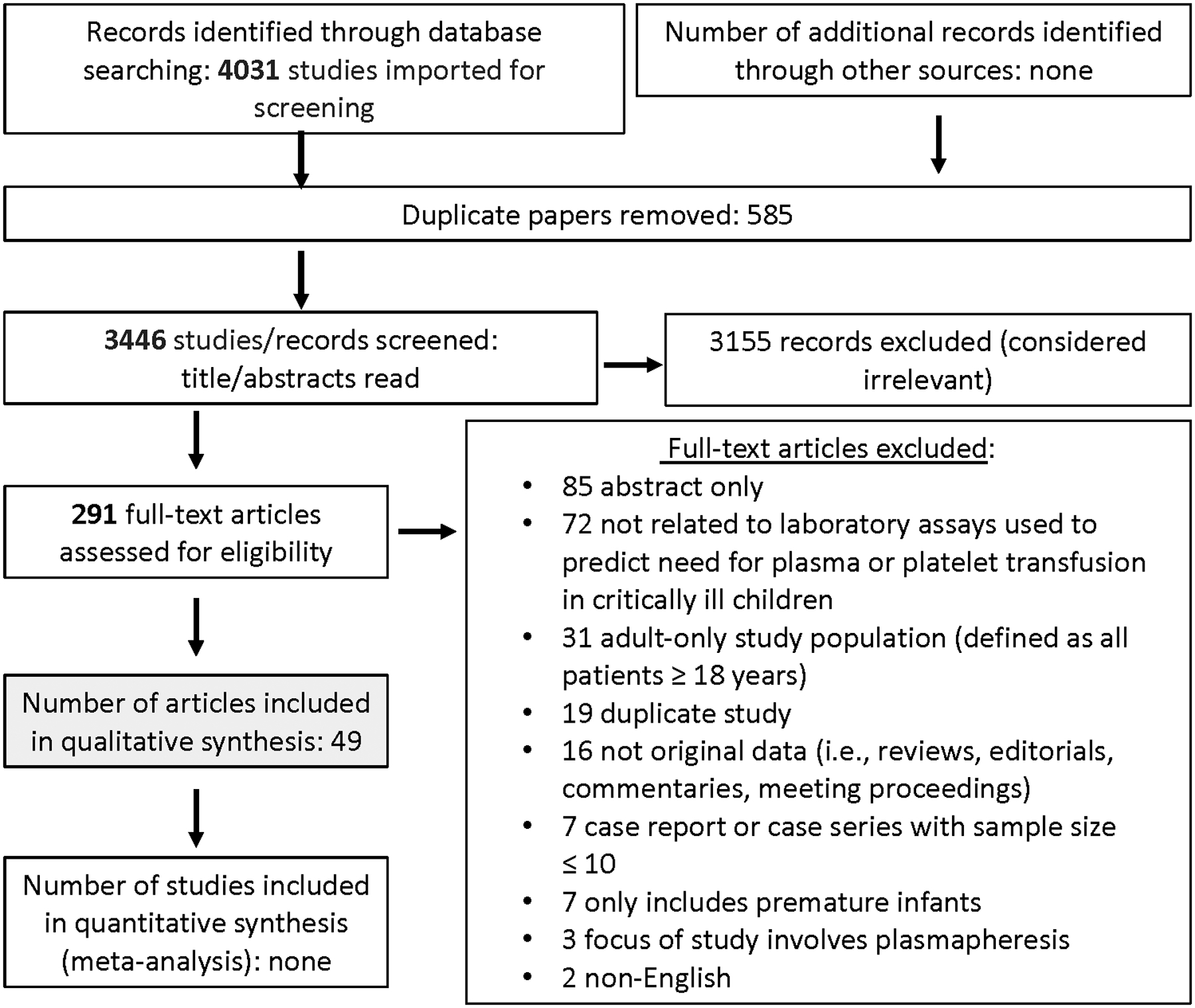
Measurements and main results: A panel of 10 experts developed evidence-based and, when evidence was insufficient, expert-based statements for laboratory testing and blood product attributes for platelet and plasma transfusions. These statements were reviewed and ratified by the 29 Transfusion and Anemia EXpertise Initiative - Control/Avoidance of Bleeding experts. A systematic review was conducted using MEDLINE, EMBASE, and Cochrane Library databases, from inception to December 2020. Consensus was obtained using the Research and Development/University of California, Los Angeles Appropriateness Method. Results were summarized using the Grading of Recommendations Assessment, Development, and Evaluation method. We developed five expert consensus statements and two recommendations in answer to two questions: what laboratory tests and physiologic triggers should guide the decision to administer a platelet or plasma transfusion in critically ill children; and what product attributes are optimal to guide specific product selection?
Conclusions: The Transfusion and Anemia EXpertise Initiative-Control/Avoidance of Bleeding program provides some guidance and expert consensus for the laboratory and blood product attributes used for decision-making for plasma and platelet transfusions in critically ill pediatric patients.
Trial registration: ClinicalTrials.gov NCT02549222.
Copyright © 2022 by the Society of Critical Care Medicine and the World Federation of Pediatric Intensive and Critical Care Societies.
Conflict of interest statement
Dr. Goel received funding from the National Heart, Lung, and Blood Institute and Rigel Pharmaceuticals. Dr. Nellis received support for article research from the National Institutes of Health. The remaining authors have disclosed that they do not have any potential conflicts of interest.
Figures

References
-
- Organization tJCoAoHC: Available at: https://www.jointcommissionjournal.com/article/S1553-7250(17)30198-8/ful.... Accessed June 1, 2021.
-
- Slonim AD, Joseph JG, Turenne WM, et al. Blood transfusions in children: a multi-institutional analysis of practices and complications. Transfusion 2008; 48:73–80. - PubMed
-
- Bolton-Maggs PH. Bullet points from SHOT: key messages and recommendations from the Annual SHOT Report 2013. Transfus Med 2014; 24:197–203. - PubMed
-
- Oakley FD, Woods M, Arnold S, Young PP. Transfusion reactions in pediatric compared with adult patients: a look at rate, reaction type, and associated products. Transfusion 2015; 55:563–570. - PubMed
Publication types
MeSH terms
Associated data
Grants and funding
LinkOut - more resources
Full Text Sources
Medical
