


Cerebral venous congestion exacerbates cerebral microhemorrhages in mice
- PMID: 34989944
- PMCID: PMC9135950
- DOI: 10.1007/s11357-021-00504-0
Cerebral venous congestion exacerbates cerebral microhemorrhages in mice
Abstract
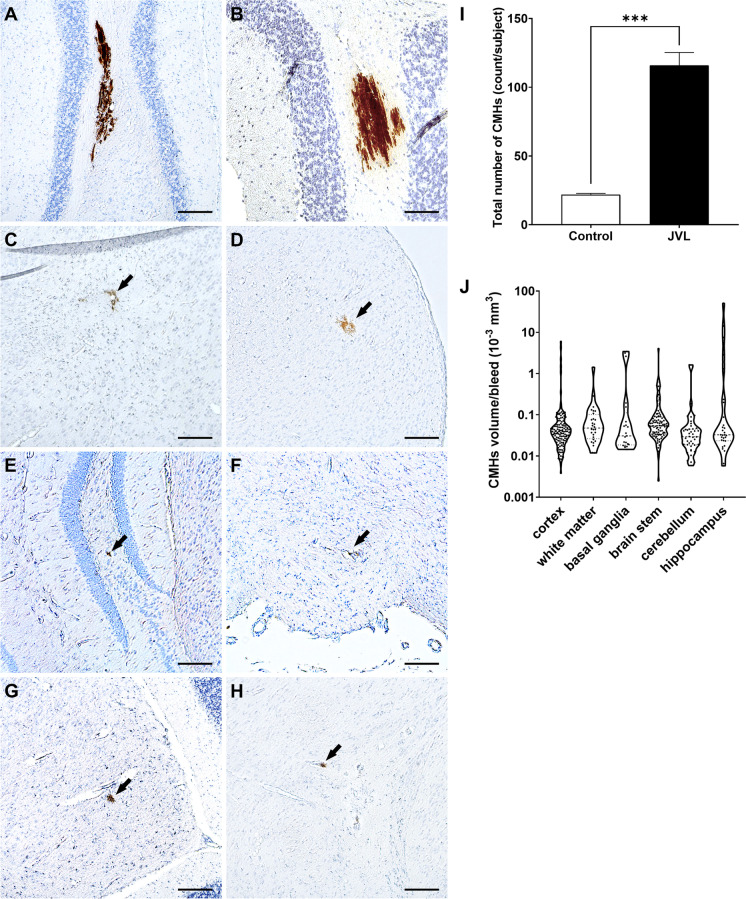
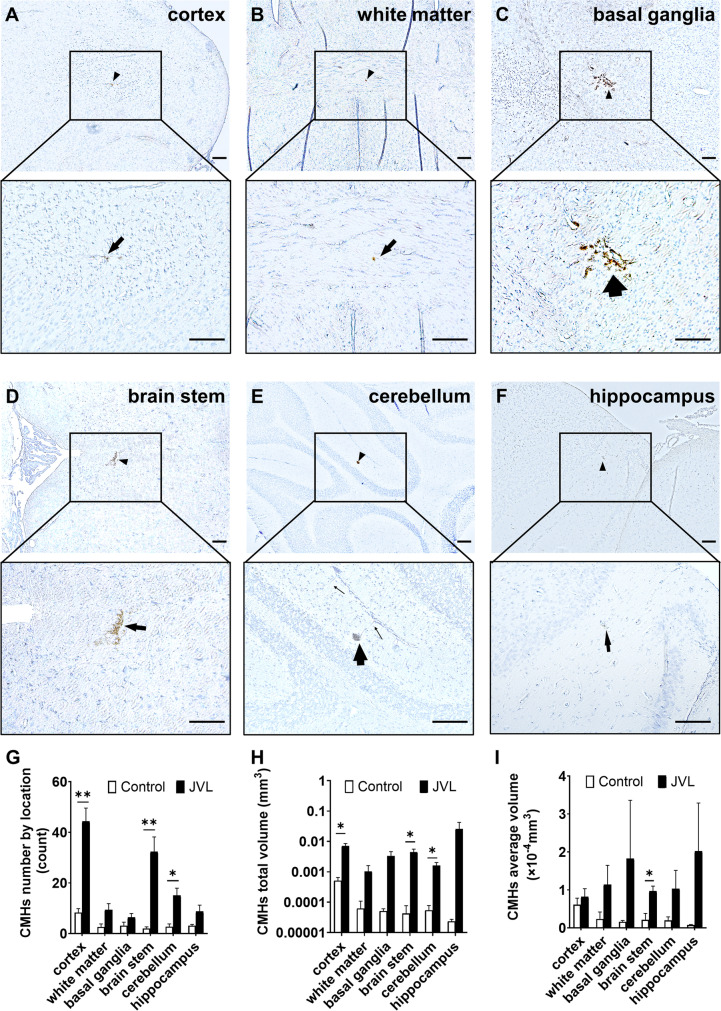
Cerebral microhemorrhages (CMHs; microbleeds), which are small focal intracerebral hemorrhages, importantly contribute to the pathogenesis of cognitive decline and dementia in older adults. Although recently it has been increasingly recognized that the venous side of the cerebral circulation likely plays a fundamental role in the pathogenesis of a wide spectrum of cerebrovascular and brain disorders, its role in the pathogenesis of CMHs has never been studied. The present study was designed to experimentally test the hypothesis that venous congestion can exacerbate the genesis of CMHs. Increased cerebral venous pressure was induced by internal and external jugular vein ligation (JVL) in C57BL/6 mice in which systemic hypertension was induced by treatment with angiotensin II plus L-NAME. Histological analysis (diaminobenzidine staining) showed that mice with JVL developed multiple CMHs. CMHs in mice with JVL were often localized adjacent to veins and venules and their morphology was consistent with venous origin of the bleeds. In brains of mice with JVL, a higher total count of CMHs was observed compared to control mice. CMHs were distributed widely in the brain of mice with JVL, including the cortical gray matter, brain stem, the basal ganglia, subcortical white matter, cerebellum, and the hippocampi. In mice with JVL, there were more CMHs predominantly in cerebral cortex, brain stem, and cerebellum than in control mice. CMH burden, defined as total CMH volume, also significantly increased in mice with JVL. Thus, cerebral venous congestion can exacerbate CMHs. These observations have relevance to the pathogenesis of cognitive impairment associated with right heart failure as well as elevated cerebral venous pressure due to jugular venous reflux in older adults.
Keywords: Cerebral circulation; Heart failure; ICH; Intracerebral hemorrhage; Microbleed; VCI; Vascular cognitive impairment; Vascular contributions to cognitive impairment and dementia (VCID); Vein; Venous congestion.
© 2022. The Author(s), under exclusive licence to American Aging Association.
Conflict of interest statement
Dr. Anna Csiszar serves as Associate Editor for The Journal of Gerontology, Series A: Biological Sciences and Medical Sciences and GeroScience. Dr. Stefano Tarantini serves as Guest Editor for Frontiers in Aging Neuroscience. Dr. Zoltan Ungvari serves as Editor-in-Chief for GeroScience and as Consulting Editor for The American Journal of Physiology-Heart and Circulatory Physiology.
Figures
References
-
- Fulop GA, Tarantini S, Yabluchanskiy A, Molnar A, Prodan CI, Kiss T, Csipo T, Lipecz A, Balasubramanian P, Farkas E, Toth P, Sorond F, Csiszar A, Ungvari Z. Role of age-related alterations of the cerebral venous circulation in the pathogenesis of vascular cognitive impairment. Am J Physiol Heart Circ Physiol. 2019;316:H1124–H1140. doi: 10.1152/ajpheart.00776.2018. - DOI - PMC - PubMed
Publication types
MeSH terms
Grants and funding
- U54 GM104938/GM/NIGMS NIH HHS/United States
- R01-AG038747/NH/NIH HHS/United States
- R01-AG047879/NH/NIH HHS/United States
- K01-AG073614/NH/NIH HHS/United States
- T32 AG052363/AG/NIA NIH HHS/United States
- R01 AG068295/AG/NIA NIH HHS/United States
- R01-NS056218/NS/NINDS NIH HHS/United States
- K01 AG073614/AG/NIA NIH HHS/United States
- R01 NS056218/NS/NINDS NIH HHS/United States
- R01-NS100782/NS/NINDS NIH HHS/United States
- T32AG052363/AG/NIA NIH HHS/United States
- U54GM104938/GM/NIGMS NIH HHS/United States
- P30 CA225520/CA/NCI NIH HHS/United States
- R01-AG055395/NH/NIH HHS/United States
- P30CA225520/CA/NCI NIH HHS/United States
LinkOut - more resources
Full Text Sources
