


Development and validation of the new HER2DX assay for predicting pathological response and survival outcome in early-stage HER2-positive breast cancer
- PMID: 34990895
- PMCID: PMC8741424
- DOI: 10.1016/j.ebiom.2021.103801
Development and validation of the new HER2DX assay for predicting pathological response and survival outcome in early-stage HER2-positive breast cancer
Abstract
Background: Both clinical and genomic data independently predict survival and treatment response in early-stage HER2-positive breast cancer. Here we present the development and validation of a new HER2DX risk score, and a new HER2DX pathological complete response (pCR) score, both based on a 27-gene expression plus clinical feature-based classifier.
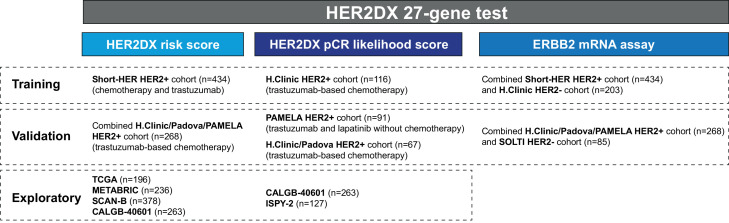
Methods: HER2DX is a supervised learning algorithm incorporating tumour size, nodal staging, and 4 gene expression signatures tracking immune infiltration, tumour cell proliferation, luminal differentiation, and the expression of the HER2 amplicon, into a single score. 434 HER2-positive tumours from the Short-HER trial were used to train a prognostic risk model; 268 cases from an independent cohort were used to verify the accuracy of the HER2DX risk score. In addition, 116 cases treated with neoadjuvant anti-HER2-based chemotherapy were used to train a predictive model of pathological complete response (pCR); two independent cohorts of 91 and 67 cases were used to verify the accuracy of the HER2DX pCR likelihood score. Five publicly available independent datasets with >1,000 patients with early-stage HER2-positive disease were also analysed.
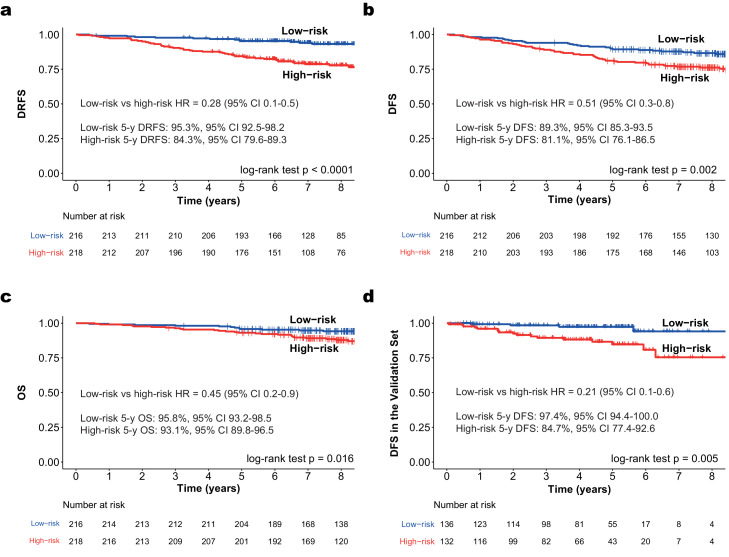
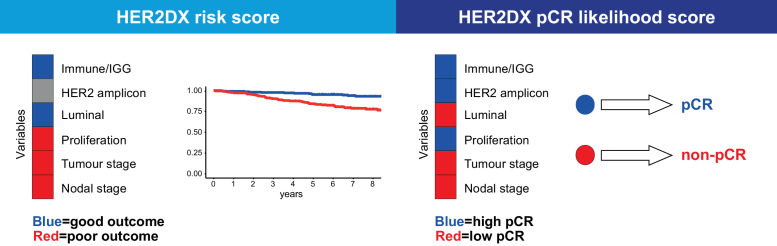
Findings: In Short-HER, HER2DX variables were associated with good risk outcomes (i.e., immune, and luminal) and poor risk outcomes (i.e., proliferation, and tumour and nodal staging). In an independent cohort, continuous HER2DX risk score was significantly associated with disease-free survival (DFS) (p=0·002); the 5-year DFS in the low-risk group was 97·4% (94·4-100·0%). For the neoadjuvant pCR predictor training cohort, HER2DX variables were associated with pCR (i.e., immune, proliferation and HER2 amplicon) and non-pCR (i.e., luminal, and tumour and nodal staging). In both independent test set cohorts, continuous HER2DX pCR likelihood score was significantly associated with pCR (p<0·0001). A weak negative correlation was found between the HER2DX risk score versus the pCR score (correlation coefficient -0·19).
Interpretation: The two HER2DX tests provide accurate estimates of the risk of recurrence, and the likelihood to achieve a pCR, in early-stage HER2-positive breast cancer.
Funding: This study received funding from Reveal Genomics, IDIBAPS and the University of Padova.
Keywords: De-escalation; Gene expression; HER2-positive breast cancer; HER2DX; Immune; Neoadjuvant; Pathological complete response; Prognosis; Risk of relapse.
Copyright © 2021 The Author(s). Published by Elsevier B.V. All rights reserved.
Conflict of interest statement
Declaration of Competing Interest Dr. Perou, Dr. Prat, Dr. Vivancos, Dr. Villagrasa, and Dr. Parker are equity stockholders of Reveal Genomics; Dr. Perou, Dr. Prat, Dr. Vivancos, and Dr. Parker are also consultants of Reveal Genomics. Dr. Prat reports grants from Reveal Genomics, during the conduct of the study; other from Reveal Genomics, personal fees from Roche, grants and personal fees from AstraZeneca, grants and personal fees from Daiichi-Sankyo, grants and personal fees from Novartis, personal fees from Foundation Medicine, personal fees from Oncolytics Biotech, outside the submitted work; In addition, Dr. Prat has a patent HER2DX licensed to Reveal Genomics, and a patent WO 2018/103834 licensed to Reveal Genomics. Dr. Paré has a patent HER2DX licensed to Reveal Genomics. Dr. Cortés reports grants and personal fees from Roche, personal fees from Celgene, personal fees from Cellestia, grants and personal fees from AstraZeneca, personal fees from Seattle Genetics, personal fees from Daiichi Sankyo, personal fees from Erytech, personal fees from Athenex, personal fees from Polyphor, personal fees from Lilly, personal fees from Merck Sharp&Dohme, personal fees from GSK, personal fees from Leuko, personal fees from Bioasis, personal fees from Clovis Oncology, personal fees from Boehringer Ingelheim, personal fees from Ellipses, personal fees from Hibercell, personal fees from BioInvent, personal fees from Gemoab, personal fees from Gilead, personal fees from Menarini, personal fees from Zymeworks, grants from Guardant health, grants from Pfizer, grants from Puma, non-financial support from Medsir, outside the submitted work; In addition, Dr. Cortés has a patent WO 2018/103834 licensed to Reveal Genomics. Dr. Dieci reports personal fees from Eli Lilly, MSD, Exact Sciences, Novartis, Pfizer, Seagen, outside the submitted work; In addition, Dr. Dieci has a patent HER2DX licensed to Reveal Genomics. Dr. Griguolo reports personal fees from Eli Lilly, Amgen, Novartis, Pfizer, Daiichi Sankyo, outside the submitted work; Dr. Guarneri reports personal fees from Eli Lilly, Roche, Novartis, MSD, GSK, Gilead, outside the submitted work; In addition, Dr. Guarneri has a patent HER2DX licensed to Reveal Genomics. Dr. Llombart-Cussac reports grants and personal fees from Roche, grants and personal fees from Daiichi Sankyo, personal fees from Pfizer, personal fees from Novartis, personal fees from Lilly, personal fees from MSD, personal fees from Agendia, from Exact Sciences, non-financial support from AstraZeneca, personal fees from Gilead, other from MedSir, outside the submitted work; In addition, Dr. Llombart-Cussac has a patent WO 2018/103834 licensed to Reveal Genomics. Dr. Villagrasa reports other from Reveal Genomics, personal fees from Nanostring, outside the submitted work; In addition, Dr. Villagrasa has a patent HER2DX pending. Dr. Conte reports personal fees from Roche, personal fees from Novartis, personal fees from Daiichi Sankyo, personal fees from Astrazeneca, personal fees from Elililly, outside the submitted work; In addition, Dr. Conte has a patent HER2DX pending. Dr. Brasó-Maristany has a patent New HER2DX assay licensed to Reveal Genomics. Dr. Vivancos reports personal fees from Bayer, personal fees from Bristol Meyers Squibb, personal fees from Guardant Health, personal fees from Merck, personal fees from Novartis, personal fees from Roche, personal fees from Incyte, outside the submitted work; In addition, Dr. Vivancos has a patent WO2015145388A3 licensed. Dr. Perou reports grants from Reveal Genomics, during the conduct of the study; other from Reveal Genomics, outside the submitted work. No authors have been paid to write this article.
Figures
References
-
- GLOBOCAN 2020 Breast Cancer Fact Sheet. World Health Organization. Accessed January 2021.
-
- Martínez-Sáez O, Prat A. Current and future management of HER2-positive metastatic breast cancer. JCO Oncol Pract; 0(0): OP.21.00172. - PubMed
MeSH terms
Substances
LinkOut - more resources
Full Text Sources
Other Literature Sources
Medical
Research Materials
Miscellaneous
