


The representation of Indigenous peoples in chronic disease clinical trials in Australia, Canada, New Zealand, and the United States
- PMID: 34991361
- PMCID: PMC8847750
- DOI: 10.1177/17407745211069153
The representation of Indigenous peoples in chronic disease clinical trials in Australia, Canada, New Zealand, and the United States
Abstract
Background: Indigenous peoples are overrepresented with chronic health conditions and experience suboptimal outcomes compared with non-Indigenous peoples. Genetic variations influence therapeutic responses, thus there are potential risks and harm when extrapolating evidence from the general population to Indigenous peoples. Indigenous population-specific clinical studies, and inclusion of Indigenous peoples in general population clinical trials, are perceived to be rare. Our study (1) identified and characterized Indigenous population-specific chronic disease trials and (2) identified the representation of Indigenous peoples in general population chronic disease trials conducted in Australia, Canada, New Zealand, and the United States.
Methods: For Objective 1, publicly available clinical trial registries were searched from May 2010 to May 2020 using Indigenous population-specific terms and included for data extraction if in pre-specified chronic disease. For identified trials, we extracted Indigenous population group identity and characteristics, type of intervention, and funding type. For Objective 2, a random selection of 10% of registered clinical trials was performed and the proportion of Indigenous population participants enrolled extracted.
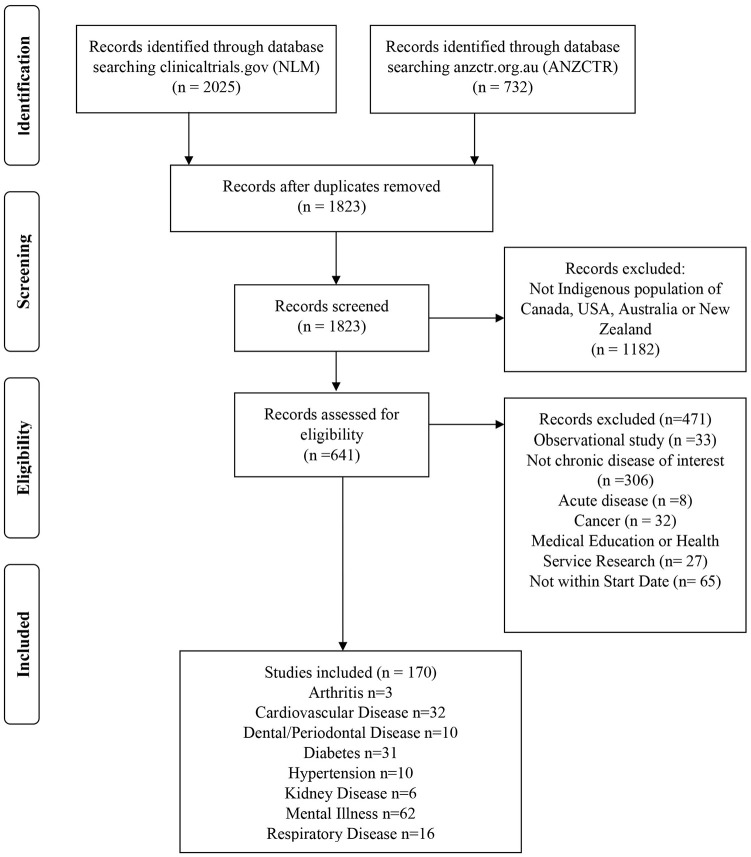
Results: In total, 170 Indigenous population-specific chronic disease trials were identified. The clinical trials were predominantly behavioral interventions (n = 95). Among general population studies, 830 studies were randomly selected. When race was reported in studies (n = 526), Indigenous individuals were enrolled in 172 studies and constituted 5.6% of the total population enrolled in those studies.
Conclusion: Clinical trials addressing chronic disease conditions in Indigenous populations are limited. It is crucial to ensure adequate representation of Indigenous peoples in clinical trials to ensure trial data are applicable to their clinical care.
Keywords: Clinical trials; Indigenous health; Indigenous people; chronic disease; health disparities.
Conflict of interest statement
Figures
References
-
- Glover M, Kira A, Johnston V. et al. A systematic review of barriers and facilitators to participation in randomized controlled trials by Indigenous people from New Zealand, Australia, Canada and the United States. Glob Health Promot 2015; 22(1): 21–31. - PubMed
-
- Nazha B, Mishra M, Pentz R. et al. Enrollment of racial minorities in clinical trials: old problem assumes new urgency in the age of immunotherapy. Am Soc Clin Oncol Educ Book 2019; 39: 3–10. - PubMed
-
- Hurd K, Barnabe C. Mortality causes and outcomes in Indigenous populations of Canada, the United States, and Australia with rheumatic disease: a systematic review. Semin Arthritis Rheum 2018; 47(4): 586–592. - PubMed
-
- Hernandez LM, Blazer DG. Genes, behavior, and the social environment: moving beyond the nature/nurture debate. Washington, DC: National Academies Press, 2006, https://www.ncbi.nlm.nih.gov/books/NBK19932/ - PubMed
Publication types
MeSH terms
Grants and funding
LinkOut - more resources
Full Text Sources
