


A collaborative approach to adopting/adapting guidelines. The Australian 24-hour movement guidelines for children (5-12 years) and young people (13-17 years): An integration of physical activity, sedentary behaviour, and sleep
- PMID: 34991606
- PMCID: PMC8734238
- DOI: 10.1186/s12966-021-01236-2
A collaborative approach to adopting/adapting guidelines. The Australian 24-hour movement guidelines for children (5-12 years) and young people (13-17 years): An integration of physical activity, sedentary behaviour, and sleep
Abstract
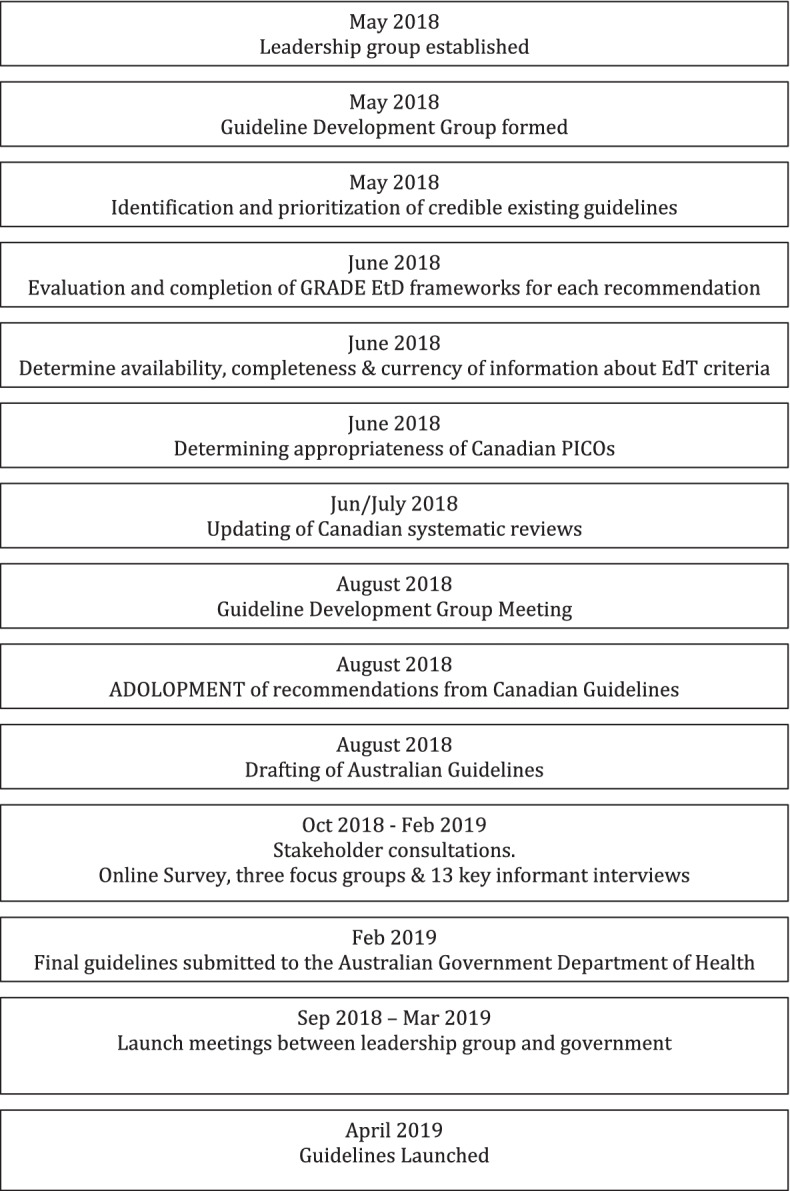
Background: In 2018, the Australian Government updated the Australian Physical Activity and Sedentary Behaviour Guidelines for Children and Young People. A requirement of this update was the incorporation of a 24-hour approach to movement, recognising the importance of adequate sleep. The purpose of this paper was to describe how the updated Australian 24-Hour Movement Guidelines for Children and Young People (5 to 17 years): an integration of physical activity, sedentary behaviour and sleep were developed and the outcomes from this process.
Methods: The GRADE-ADOLOPMENT approach was used to develop the guidelines. A Leadership Group was formed, who identified existing credible guidelines. The Canadian 24-Hour Movement Guidelines for Children and Youth best met the criteria established by the Leadership Group. These guidelines were evaluated based on the evidence in the GRADE tables, summaries of findings tables and recommendations from the Canadian Guidelines. We conducted updates to each of the Canadian systematic reviews. A Guideline Development Group reviewed, separately and in combination, the evidence for each behaviour. A choice was then made to adopt or adapt the Canadian recommendations for each behaviour or create de novo recommendations. We then conducted an online survey (n=237) along with three focus groups (n=11 in total) and 13 key informant interviews. Stakeholders used these to provide feedback on the draft guidelines.
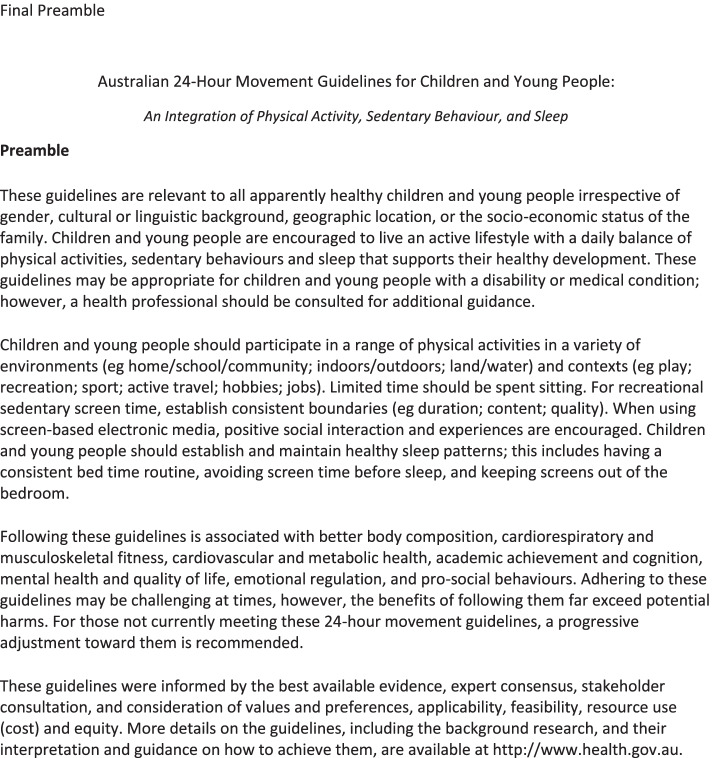
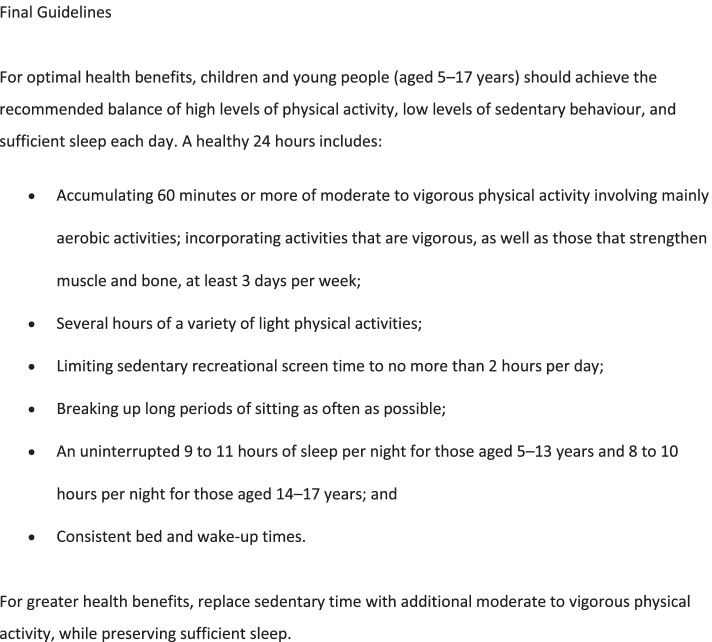
Results: Based on the evidence from the Canadian systematic reviews and the updated systematic reviews in Australia, the Guideline Development Group agreed to adopt the Canadian recommendations and, apart from some minor changes to the wording of good practice statements, maintain the wording of the guidelines, preamble, and title of the Canadian Guidelines. The Australian Guidelines provide evidence-informed recommendations for a healthy day (24-hours), integrating physical activity, sedentary behaviour (including limits to screen time), and sleep for children (5-12 years) and young people (13-17 years).
Conclusions: To our knowledge, this is only the second time the GRADE-ADOLOPMENT approach has been used to develop movement behaviour guidelines. The judgments of the Australian Guideline Development Group did not differ sufficiently to change the directions and strength of the recommendations and as such, the Canadian Guidelines were adopted with only very minor alterations. This allowed the Australian Guidelines to be developed in a shorter time frame and at a lower cost. We recommend the GRADE-ADOLOPMENT approach, especially if a credible set of guidelines that was developed using the GRADE approach is available with all supporting materials. Other countries may consider this approach when developing and/or revising national movement guidelines.
Keywords: GRADE-ADOLOPMENT; Guideline development; Methodology; Public health recommendations.
© 2022. The Author(s).
Conflict of interest statement
The authors declare that they have no competing interests.
Figures
References
-
- Trost S: Discussion paper for the development of recommendations for children's and youth's participation in health promoting physical activity. In. Canberra: Department of Health and Ageing; 2003.
-
- Okely A, Salmon J, Vella SA, Cliff D, Timperio A, Tremblay M, Trost SG, Shilton T, Hinkley T, Ridgers N et al: A Systematic Review to inform the Australian Sedentary Behaviour Guidelines for Children and Young People. Report prepared for the Australian Government Department of Health. In. (Print ISBN: 978-1-74186-067-2; Online ISBN: 978-1-74186-068-9); 2012.
-
- Okely A, Salmon J, Vella SA, Cliff D, Timperio A, Tremblay M, Trost SG, Shilton T, Hinkley T, Ridgers N et al: A Systematic Review to update the Australian Physical Activity Guidelines for Children and Young People. Report prepared for the Australian Government Department of Health. In. (Print ISBN: 978-1-74186-067-2; Online ISBN: 978-1-74186-068-9); 2012.
-
- Tremblay MS, Carson V, Chaput J-P, Connor Gorber S, Dinh T, Duggan M, Faulkner G, Gray CE, Gruber R, Janson K, et al. Canadian 24-hour movement guidelines for children and youth: an integration of physical activity, sedentary behaviour, and sleep. Applied Physiology, Nutrition, and Metabolism. 2016;41(6):S311–S327. - PubMed
Publication types
MeSH terms
LinkOut - more resources
Full Text Sources
Medical
Miscellaneous
